You are delayed by multitasking
In modern business, it is customary to rely on multitasking, and employee assessment as a specialist depends on his ability to perform several tasks at the same time. IT specialists are constantly working in several projects at once. Has it always been like this? Is multitasking really necessary? What real benefits does it bring? And is there any alternative to it?
Single - tasking is a retronym, invented to determine how software was developed earlier, before multitasking. Multi-tasking here refers to the simultaneous work of a specialist on several projects. This term in this sense began to be used in the modern business environment, where this approach is considered the most effective and one that will allow you to get the most benefit from the employee’s work. It can be said that multitasking, albeit on a smaller scale, is completely inherent in our life, at work or outside it. There is much in common between these scales of multitasking in terms of how we organize it and how it affects us.
Other point of view
')
When we talk about the experience gained while working within the framework of Agile or Scrum, the idea that a team works much better and more efficiently if it has a permanent composition and its members are not engaged in other teams is always a stumbling block. This is nothing new. We have many years of experience in creating teams of specialists to solve especially difficult problems, especially in times of crisis. And at the same time, our organizations came to a model where multispecialists are engaged simultaneously in a multitude of projects. In fact, this is the only solution to cope with many things at once. It is believed that this is the most effective way to use "limited resources", that is, when you have few specialists, but they are all of a broad profile.
Changes are hard. In order to change the process, you need a clear reason, a vision of possible benefits and determination. Resistance to change is quite natural, because people feel insecure when something changes in their environment. If we can move on to Lean thinking, we can use the key ideas of “respecting people” and “constantly improving the system” in order to determine the goal, calculate the benefits and take the first steps towards improvement. Hearing the word "thrifty", many people begin to think about how to do better, what we do well. "Thrift" also means that you can get rid of a large number of unnecessary costs, at once ceasing unprofitable, and therefore unnecessary, activity.
Multitasking Costs
When a person switches from one project to another, it leads to costs every time. First, a change of context takes time. We all know that simple malfunctions due to phone calls require from 15 minutes in order to re-concentrate [1] . The more complex the task, the more time it takes to switch [2] .
If you are working on more than two projects, the costs can be even higher. If you have not returned to one of the projects for a long time, then you may need a lot of time to remember where you left off. Accordingly, if you switch constantly, a significant part of your working time will be the time spent switching from one context to another.
Some studies show that people can rather successfully switch between two contexts to perform simple tasks [3] . If we are talking about short-term switching, then their success is associated with the activity of the hemispheres of the brain. The fact is that the human brain, with a certain efficiency, can cope with two different tasks simultaneously, but only for a short period of time. To switch to more serious tasks will take time. Jerry Weinberg [4] cited a schedule for increasing the time spent on switching with an increase in the number of projects. In the calculations it was assumed that each switch takes about 10% of the time. But in reality, this figure can be much more.
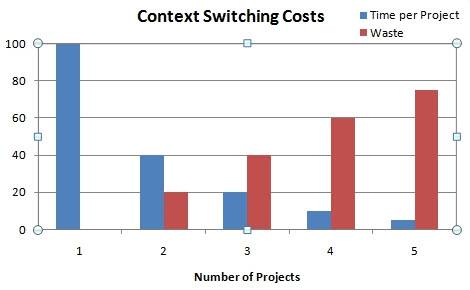
X: the number of projects.
Y: percentage of time.
When a person works in a team — loosely attached to a project or to an Agile sample team — switching costs overlap: if a team member leaves to perform some other task, the team loses its efficiency, and when the absent person returns, the team spends time to bring him up to date.
Agile and multitasking
Wait, you say. Agile teams are multifunctional, they do a variety of things every day. These are requirements development, analysis, design, testing, and programming. Isn't that multitasking? It's all about the breadth of context. Sharp transitions between distant technologies or topics take more time. The brain normally copes with switching between similar tasks. In the case of a team focused on a narrow task, all tasks are performed within a narrow set of technologies and functions. Simultaneous attention is given to only a few aspects. The context is narrow, even if the tasks within it are diverse. In addition, Agile includes a set of methods that help not to lose focus - collaboration, task board, automated testing, retrospection. Jumping from one context to another - other projects, other employees, other participants in the process - this is what causes inconvenience.
Neurobiology Multitasking
The human brain shows itself well with internal multitasking. He does it all the time. Many parts of the brain work in conjunction or independently of each other every minute. Be all different - our livelihood was impossible in a complex and changeable environment. Most of the tasks the brain performs unconsciously - it filters information transmitted by the senses, integrates such information, moves data from short-term memory to long-term memory, stimulates the heart and lungs.
At the same time, we need to perform many external tasks –– drive the car, simultaneously look at the map and listen to the radio about the situation on the road, talk on the phone and cook dinner, plan a vacation and work in the garden. Some tasks, such as folding clothes or walking, are done mechanically and do not require switching costs. Others, such as viewing a document or renaming a method, can be brought to automatism with time. But software development is much more complicated. In most cases, automatic switching from task to task succeeds without loss, but everything has a limit [5] .
Because of the switch between projects when performing a wide range of tasks, it may be necessary to redo it a second time. The human brain has two types of memory - long-term and short-term. There are mechanisms for moving data between them. There is no guarantee that everything will be moved properly and that the output will be the same as the input. New information should be stored in the short-term memory for a certain time with that. To get into the long term. For example, cramming before an exam will help you get a good grade, but after a couple of weeks you’ll remember a little about what you jagged. That is why it can be difficult, what you ended up with in one of the projects, if you haven’t returned to it for a long time, and with high probability it will be the information that will be necessary in order to continue working.
The study mentions a list of aspects in which multitasking can be harmful. In particular:
Single task in the work of Agile teams
Some modern technological techniques can improve concentration. For example:
Single-tasking in companies
Arguments against multitasking have been known for a long time, and at the same time, in modern corporate culture, this form of “load sharing” has taken root in order to maximize the efficient use of human resources. We freely group teams of people. Possessing the necessary skills that are partly employed in several projects at once. Can we expect good performance from the party timers team? Or are we just accustomed to consider it more important that everyone always looks extremely busy?
The most difficult thing in learning new things is to abandon the old, usual ways. This is as true in the case of organizations as it is with people - it is difficult to make a mental leap from what is already known to what may work better. Here is a simple visual argument that will help not only easier to lead people through change, but also bring material gain.
The simple scenario shown in Figure 2 illustrates the work of 4 people on 3 projects. The dynamics are the same as for larger projects with a large number of busy professionals. In the first scenario, people are busy simultaneously in 3 projects.
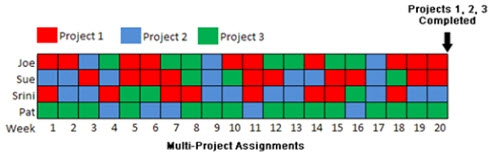
Vertically - employees, horizontally - weeks (20).
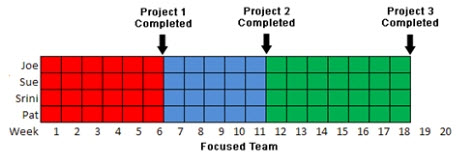
Figure 3 illustrates the second scenario, where the same people from the same team complete the projects sequentially. This scenario may cause a conservative assumption that there is no benefit from teamwork and a reduction in the number of necessary switchings from project to project. Please note that all projects are completed by the same date in both scenarios, but projects 2 and 3 are completed faster in the second case. Imagine how you can benefit from this.

If there was no need to switch and an estimated 10% increase in labor productivity, thanks to simultaneous and focused teamwork, one would expect that all three projects would be completed even faster, as shown in Figure 4.
Variety Sweetens Life
Well, multitasking is obviously harmful, and we should never use it, right? Then how is this compatible with the idea that diversity is what makes life more interesting? Studies of the human brain have shown that everything new attracts - it stimulates the release of dopamine, a neurotransmitter that makes us want more [11] . The answer to this question is reasonable focus and scope. If the context change is too harsh, multitasking has a bad effect on employees and their teammates. If this change involves switching between similar contexts, it fits into the scope of thinking and brings a good result. When working in the Agile-team, we gain a good new experience by learning from each other and stimulating the release of neurotransmitters responsible for a sense of success and a well-done business.
findings
Switching between different types of activities within several projects takes time and requires organization costs. The more people involved in projects, and the more complex they are, the higher the costs will be. By focusing on one aspect of working for a longer period of time, a person can work much more efficiently. By gathering teams, given that the projects will be implemented alternately, you can reduce the cost of changing the context and get more benefits from the cohesive work of the team.
Links
[1] Slow Down, Brave Multitasker, and
[2] Multitasking Can Make You Lose ... Um ... Focus
[3] Motivated Multitasking: American Science.
[4] Weinberg, GM Quality Software Management: Vol. 1 System Thinking. New York. Dorset House, 1992.
[5] See "Hanging up and Drive" at the time.
[6] The Neuroscience of Leadership
[7] Studies show multitasking makes you stupid
[8] The Madness of Multitasking (Psychology Today)
[9] Slow Down, Brave Multitasker, and
[10] "Your Brain At Work", David Rock
[11] Multitasking: The Brain Seeks Novelty
Single - tasking is a retronym, invented to determine how software was developed earlier, before multitasking. Multi-tasking here refers to the simultaneous work of a specialist on several projects. This term in this sense began to be used in the modern business environment, where this approach is considered the most effective and one that will allow you to get the most benefit from the employee’s work. It can be said that multitasking, albeit on a smaller scale, is completely inherent in our life, at work or outside it. There is much in common between these scales of multitasking in terms of how we organize it and how it affects us.
Other point of view
')
When we talk about the experience gained while working within the framework of Agile or Scrum, the idea that a team works much better and more efficiently if it has a permanent composition and its members are not engaged in other teams is always a stumbling block. This is nothing new. We have many years of experience in creating teams of specialists to solve especially difficult problems, especially in times of crisis. And at the same time, our organizations came to a model where multispecialists are engaged simultaneously in a multitude of projects. In fact, this is the only solution to cope with many things at once. It is believed that this is the most effective way to use "limited resources", that is, when you have few specialists, but they are all of a broad profile.
The Agile methodology puts everything upside down. We form teams of employees focused on a small set of simultaneous tasks. Instead of setting tasks and chasing people around them, we form a team and drive the flow of tasks through it. We pull, not push.
Changes are hard. In order to change the process, you need a clear reason, a vision of possible benefits and determination. Resistance to change is quite natural, because people feel insecure when something changes in their environment. If we can move on to Lean thinking, we can use the key ideas of “respecting people” and “constantly improving the system” in order to determine the goal, calculate the benefits and take the first steps towards improvement. Hearing the word "thrifty", many people begin to think about how to do better, what we do well. "Thrift" also means that you can get rid of a large number of unnecessary costs, at once ceasing unprofitable, and therefore unnecessary, activity.
Multitasking Costs
When a person switches from one project to another, it leads to costs every time. First, a change of context takes time. We all know that simple malfunctions due to phone calls require from 15 minutes in order to re-concentrate [1] . The more complex the task, the more time it takes to switch [2] .
If you are working on more than two projects, the costs can be even higher. If you have not returned to one of the projects for a long time, then you may need a lot of time to remember where you left off. Accordingly, if you switch constantly, a significant part of your working time will be the time spent switching from one context to another.
Some studies show that people can rather successfully switch between two contexts to perform simple tasks [3] . If we are talking about short-term switching, then their success is associated with the activity of the hemispheres of the brain. The fact is that the human brain, with a certain efficiency, can cope with two different tasks simultaneously, but only for a short period of time. To switch to more serious tasks will take time. Jerry Weinberg [4] cited a schedule for increasing the time spent on switching with an increase in the number of projects. In the calculations it was assumed that each switch takes about 10% of the time. But in reality, this figure can be much more.
1.X: the number of projects.
Y: percentage of time.
When a person works in a team — loosely attached to a project or to an Agile sample team — switching costs overlap: if a team member leaves to perform some other task, the team loses its efficiency, and when the absent person returns, the team spends time to bring him up to date.
Agile and multitasking
Wait, you say. Agile teams are multifunctional, they do a variety of things every day. These are requirements development, analysis, design, testing, and programming. Isn't that multitasking? It's all about the breadth of context. Sharp transitions between distant technologies or topics take more time. The brain normally copes with switching between similar tasks. In the case of a team focused on a narrow task, all tasks are performed within a narrow set of technologies and functions. Simultaneous attention is given to only a few aspects. The context is narrow, even if the tasks within it are diverse. In addition, Agile includes a set of methods that help not to lose focus - collaboration, task board, automated testing, retrospection. Jumping from one context to another - other projects, other employees, other participants in the process - this is what causes inconvenience.
Neurobiology Multitasking
The human brain shows itself well with internal multitasking. He does it all the time. Many parts of the brain work in conjunction or independently of each other every minute. Be all different - our livelihood was impossible in a complex and changeable environment. Most of the tasks the brain performs unconsciously - it filters information transmitted by the senses, integrates such information, moves data from short-term memory to long-term memory, stimulates the heart and lungs.
At the same time, we need to perform many external tasks –– drive the car, simultaneously look at the map and listen to the radio about the situation on the road, talk on the phone and cook dinner, plan a vacation and work in the garden. Some tasks, such as folding clothes or walking, are done mechanically and do not require switching costs. Others, such as viewing a document or renaming a method, can be brought to automatism with time. But software development is much more complicated. In most cases, automatic switching from task to task succeeds without loss, but everything has a limit [5] .
Because of the switch between projects when performing a wide range of tasks, it may be necessary to redo it a second time. The human brain has two types of memory - long-term and short-term. There are mechanisms for moving data between them. There is no guarantee that everything will be moved properly and that the output will be the same as the input. New information should be stored in the short-term memory for a certain time with that. To get into the long term. For example, cramming before an exam will help you get a good grade, but after a couple of weeks you’ll remember a little about what you jagged. That is why it can be difficult, what you ended up with in one of the projects, if you haven’t returned to it for a long time, and with high probability it will be the information that will be necessary in order to continue working.
The study mentions a list of aspects in which multitasking can be harmful. In particular:
- There is evidence that multitasking actually harms short-term memory, and not only in the case of the topics it deals with, but on the whole to the areas of the cortex responsible for this type of memory. Multitasking causes stress, which, in turn, activates the parts of the brain responsible for the sense of personal safety, drawing resources to them that are necessary for higher level nervous activity [6] . Stress can also harm the nerve cells responsible for remembering new information. [7]
- We are more prone to mistakes when we switch from task to task, which means that the quality of our work decreases [8] . Of course, the cost of the project at the same time increase - errors must be corrected.
- Some parts of the brain work only consistently and are not able to perform tasks in parallel [9] .
- The prefrontal cortex, that is, the brain region responsible for complex cognitive functions and decision making, consumes the most resources [10] . Additional load due to multitasking will lead to rapid depletion and impaired cognitive function, as well as to a greater need for recovery.
Single task in the work of Agile teams
Some modern technological techniques can improve concentration. For example:
- Test Driven Development allows you to focus technical tasks on narrow issues that require little time.
- Continuous integration helps you immediately focus on a broken assembly or site that fails the test.
- Pair programming helps two people focus on a short section of code.
Single-tasking in companies
Arguments against multitasking have been known for a long time, and at the same time, in modern corporate culture, this form of “load sharing” has taken root in order to maximize the efficient use of human resources. We freely group teams of people. Possessing the necessary skills that are partly employed in several projects at once. Can we expect good performance from the party timers team? Or are we just accustomed to consider it more important that everyone always looks extremely busy?
The most difficult thing in learning new things is to abandon the old, usual ways. This is as true in the case of organizations as it is with people - it is difficult to make a mental leap from what is already known to what may work better. Here is a simple visual argument that will help not only easier to lead people through change, but also bring material gain.
The simple scenario shown in Figure 2 illustrates the work of 4 people on 3 projects. The dynamics are the same as for larger projects with a large number of busy professionals. In the first scenario, people are busy simultaneously in 3 projects.
2. ,Vertically - employees, horizontally - weeks (20).
Figure 3 illustrates the second scenario, where the same people from the same team complete the projects sequentially. This scenario may cause a conservative assumption that there is no benefit from teamwork and a reduction in the number of necessary switchings from project to project. Please note that all projects are completed by the same date in both scenarios, but projects 2 and 3 are completed faster in the second case. Imagine how you can benefit from this.
3. .If there was no need to switch and an estimated 10% increase in labor productivity, thanks to simultaneous and focused teamwork, one would expect that all three projects would be completed even faster, as shown in Figure 4.
4. .In more detail this topic is covered in the work of Joanna Rothman "Manage Your Project Portfolio" .
Variety Sweetens Life
Well, multitasking is obviously harmful, and we should never use it, right? Then how is this compatible with the idea that diversity is what makes life more interesting? Studies of the human brain have shown that everything new attracts - it stimulates the release of dopamine, a neurotransmitter that makes us want more [11] . The answer to this question is reasonable focus and scope. If the context change is too harsh, multitasking has a bad effect on employees and their teammates. If this change involves switching between similar contexts, it fits into the scope of thinking and brings a good result. When working in the Agile-team, we gain a good new experience by learning from each other and stimulating the release of neurotransmitters responsible for a sense of success and a well-done business.
findings
Switching between different types of activities within several projects takes time and requires organization costs. The more people involved in projects, and the more complex they are, the higher the costs will be. By focusing on one aspect of working for a longer period of time, a person can work much more efficiently. By gathering teams, given that the projects will be implemented alternately, you can reduce the cost of changing the context and get more benefits from the cohesive work of the team.
Links
[1] Slow Down, Brave Multitasker, and
[2] Multitasking Can Make You Lose ... Um ... Focus
[3] Motivated Multitasking: American Science.
[4] Weinberg, GM Quality Software Management: Vol. 1 System Thinking. New York. Dorset House, 1992.
[5] See "Hanging up and Drive" at the time.
[6] The Neuroscience of Leadership
[7] Studies show multitasking makes you stupid
[8] The Madness of Multitasking (Psychology Today)
[9] Slow Down, Brave Multitasker, and
[10] "Your Brain At Work", David Rock
[11] Multitasking: The Brain Seeks Novelty
Source: https://habr.com/ru/post/99675/
All Articles