Evidence of death
Increasingly, social network users receive messages and notifications from dead people. Someone is scared, someone is upset because of the flood of memories of a man who has left, but no one remains indifferent.
Facebook's largest social network and many others are built in such a way that users receive automatic notifications, for example, about birthdays of friends, significant events, etc. And network owners are faced with the problem of automating to find out that a particular user has died.
Facebook is trying to deal with the "ghosts" in its network, but recognize that they have not found the optimal solution to this problem. “This is a very delicate subject,” said company spokeswoman Meredith Chin, “Of course, getting pop-up messages from dead friends can be painful. And given the size of the site and the fact that people die every day, we most likely will never be perfect in this direction, ”she added.
James Katz, professor of communications at Rutgers University, said that the company is going through a stage of age formation, since at the very beginning of the existence of networks, users were mostly young and deaths were rare and often tragic.
')
Now, people over 65 years of age are registered on Facebook much more often than people from any other age group. And given that the death rate in this age group is one of the highest in the world, the problem is only getting worse.
Some people are not against reminders about "departed" friends and relatives, and it is often a reason to remember once more about the dead, to look at his photo, but sometimes, especially when someone has recently died, his friends have a rather difficult time. Nevertheless, many people consider receiving messages from dead people to be a bit creepy.
Facebook's approach to the death of its users evolves over time. Previously, they immediately deleted the profile, having received confirmation of the death of its owner. Now, the company recognizes the importance of finding the right way to keep these pages, as places where people can grieve about the deceased. By popular demand, the company provided the ability to convert user profiles into virtual memorials. On such pages, some personal information is deleted, and this profile will not appear in the search results. At the same time, grieving friends will still be able to post messages on these pages.
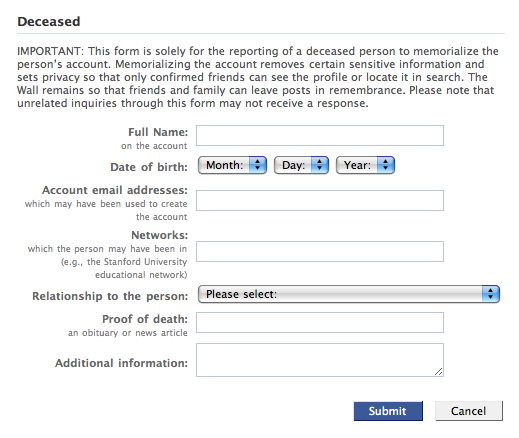
Of course, companies still need to determine if the user is actually dead. And the company is looking for ways to involve users or their computers in this process to help in this work. The system may not always make the right decision about the death of the user automatically. One solution seems to be the organization of a place where users could report the demise of a loved one, which Facebook does. To perpetuate the profile memory, a family member or friend must fill out a form on the site and provide proof of death, such as a link to an obituary or news, where Facebook employees could read about the tragic event.
But not many people know about this feature, and therefore many pages are not converted into memorials and messages from dead users continue to run across friends. And now the question is being considered of introducing software that will scan messages from friends, and when messages appear that may indicate the death of a person, for example, “rest in peace”, “we miss you”, etc., send someone then from the staff to confirm the fact of death.
Of course, this approach leaves moves to manipulate death status, and there have already been cases where users were banned from users about their accounts, and then they had to prove for a long time that everything was fine with them and return everything as it was.
Facebook thinks about this and other problems and tries to make them so that they can be avoided completely. But death, unfortunately, is inevitable, and social networks should find a way to integrate this aspect into the functional most painlessly. Social networks should not be carriers of bad news, but nevertheless are obliged to take care of those who live memories.
A source
Source: https://habr.com/ru/post/99605/
All Articles