Announcement of books 7'2010
Russian and foreign publishing houses are working for the benefit of simple developers and produce dozens of books per month from various fields of computer science. At the same time, as in many other areas, the percentage of quality goods remains at a certain (not too high) level. Before you go to the store and buy a book (yes, I’m old-fashioned in this matter and don’t understand how to read a good technical book in electronic form) you have to spend considerable time studying whether it is worth the money and effort spent.
Before choosing a book, I also try to find out the answer to this question with the help of some criteria, which are the “cross-references” of authoritative authors to each other, the name of the author himself (few doubt the next book of Jeffrey Richter, his books can be taken almost without hesitation), as well as reviews, preferably, as well-known people.
Recently, a sufficient number of interesting books have been published (or is about to be released), both in Russian and in English, so I decided to make a selection of books that I either recently purchased or would have done with pleasure as soon as possible. With some of the books below, I am more or less familiar personally and my opinion is more reasonable, in some other cases I rely on the above criteria, so my opinion may well not be very accurate (although my opinion may not match with yours). The list below is such a wish list of new computer literature, which can be a starting point for other specialists choosing a book.
')
( Original : Robert C. Martin, Clean Code: A Handbook of Agile Software Craftsmanship, Prentice Hall, 2008)
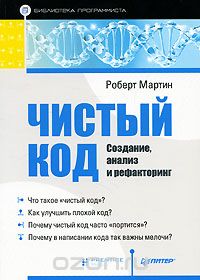
Even bad code can work. However, if the code is not “clean”, it will always interfere with the development of the project and the company-developer, taking away significant resources for its support and “taming”.
This book is about good programming. It is full of real code examples. We will consider the code from different directions: from top to bottom, from bottom to top, and even from the inside. After reading the book, you will learn a lot about the code. Moreover, you will learn to distinguish good code from bad. You will learn how to write good code and how to convert bad code to good.
The book consists of three parts. The first part outlines the principles, patterns, and techniques for writing clean code; given a large amount of code examples. The second part consists of practical scenarios of increasing complexity. Each scenario is an exercise in cleaning the code or converting the problem code into code with fewer problems. The third part of the book is a concentrated expression of its essence. It consists of one chapter with a list of heuristic rules and “code smells” collected during the analysis. This part is a knowledge base that describes our way of thinking in the process of reading, writing and cleaning code.
There are several arguments that speak in favor of this book, and although each one may not look too convincing, if you put them all together, you can conclude that the book is at least worthy of close attention on your part.
First, “Uncle” Bob Martin is a very famous person, the author of many well-known and popular books and articles, in particular, it is he who is the author of such a concept as the design principles of SOLID. Secondly, this book is very, very well received by the readership: rating 4.5 on amazon.com (with 67 reviews), a huge amount of positive reviews on stackoverflow (look for it ), and it’s easy to find reviews on this book in Google (look for it ). Thirdly, it is a high quality book and an unforgettable author's style of presentation. The topic of clean code is not new in computer literature, quite a lot has been said about this, but “Uncle” Bob does it great: the book covers a large number of code examples; The style of presentation is clear and simple, and with the sense of humor the authors are fine.
When I just started reading this book, the very first drawing made it clear that this would be a very interesting exercise:
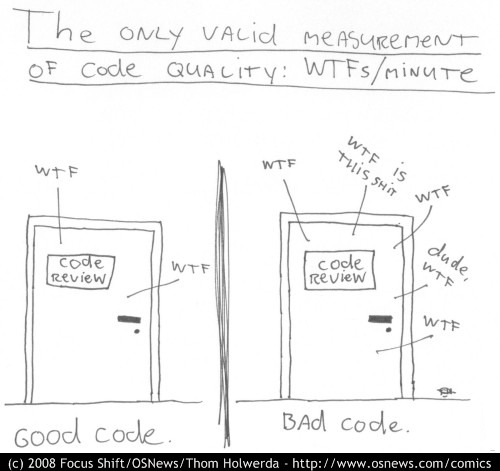
And I am not disappointed in it yet.
PS The book has quite a good Russian translation. There are terms that I don’t agree with the translation, but overall, the Russian edition made a very good impression on me (except for the translation of the second title of the book, which originally sounds like “A Handbook of Agile Software Craftsmanship”, and in the Russian version it turned out “ Creation, analysis and refactoring ").
Buy : books.ru , ozon.ru , amazon.com
Reviews : google , stackoverflow
Quotes : quote pad
( Original : CJ Date, SQL and Relational Theory, O'Reilly Media, 2009)
The SQL language is common everywhere. But working with it is not easy: it is complicated, confused, it is easy to make a mistake when writing SQL commands. Understanding the theory behind SQL is the best way to ensure that your code is written correctly and the database itself is reliable and maintainable.
In the proposed book, K.J.Date — a recognized expert who started working on these issues as early as 1970 — demonstrates how to apply relational theory to the daily practice of working with SQL. The author explains in detail the various aspects of this model, argues and proves, gives numerous examples of the use of this language in accordance with relational theory.
Without being tied to any particular product, the publication draws on many years of research experience and represents the most current presentation of the material. Anyone who has at least some experience in using SQL, from modest to very extensive, will gain considerable benefit and pleasure from reading this book.
Chris Date is one of the most authoritative people in the field of relational databases, he has more than ten books (including “Introduction to Database Systems”), as well as more than a hundred scientific papers (many of which are available in Russian on citforum.ru ). This is the latest book by Chris Data, which has now been released and is a logical continuation of one of his previous books “Database in Depth: Relational Theory for Practioners”. All the books of Data cannot be called simple, they are hard enough to read; they deeply examine the theoretical aspects of the relational model; they are often criticized by modern SQL-based DBMS implementations, and many examples are given in Tutorial D. If you do not need the SQL language reference book and you are not ready to devote enough time to this book to study this book, then most likely the book will suit you. If you need a SQL reference book or an introductory course on this topic, it’s best to turn your attention to other sources. But if you are willing to spend enough time studying more fundamental things, then this book may be useful to you.
Buy : books.ru ; ozon.ru ; amazon.com
Reviews : Review by xaprb
(Original: 97 Things Every Software Architect, O'Reilly Media, 2009)

A successful career as a software architect requires a good knowledge of both technological and business aspects of architecture design issues. In this unusual book, leading software architects from around the world discuss important design principles that go far beyond purely technological issues.
The software architect plays the role of an intermediary between the development team and the company's business management; therefore, in order to succeed in this profession, it is necessary not only to master various technologies, but also to ensure that the project is working in accordance with business goals. In the book, more than 50 architects talk about what they consider the most important in their work, give advice on how to organize communication with other project participants, how to reduce the complexity of architecture, and how to provide support to developers. They generously share a variety of useful ideas and techniques that they learned from their many years of experience. The authors hope that the book will become a source of inspiration and a guide to action for many professional programmers.
I am familiar with this book closer than with other books presented in this review, since I worked on it as a scientific editor for a Russian-language publication, but I do not think that this will impose any restrictions on the objectivity of my judgments.
I cannot apply such epithets to this book as “magnificent”, “unforgettable”, “delightful” and something in the same, since frankly speaking, this is not true. This book can not be put next to the books of Fowler, Meyer, Butch or Beck, rather it’s just a “good”, “high-quality” and “interesting” book that will be useful to most professional developers. It does not reveal the sacred knowledge of the secret society of architects, after reading which you will be able to open the doors to your leader with your feet. But at the same time, the book raises interesting topics, ranging from simple technical advice, such as the benefits of continuous integration, to more philosophical questions, such as, advice not to be too clever or recommendations on how to combat the inherent (essential) complexity.
Books with a similar presentation format have been popular for several decades (remember that Brooks’s famous Mythical Man Month is also a collection of essays), but unlike many other publications, this book of sketches turned out to be too short (97 sketches of 255 pages ). As a result, the authors simply do not have the opportunity to uncover the topic; they can only state some facts that the reader may or may not believe. Many of these facts will be useful even if the reader has never heard of them, but many of them due to their small volume can simply slip past the reader's mind and not get stuck in their heads. In addition, most of these studies are familiar to almost every professional developer, but due to its diversity, almost every professional will find something interesting for himself.
Buy : books.ru ; ozon.ru ; amazon.com
Reviews : 1 , 2 , 3
Electronic version: the book is available as original, unedited contributions for the book on a separate wiki-page of the OReilly publishing house at 97things.oreilly.com/wiki/index.php/97_Things_Every_Software_Architect_Should_Know_-_The_Book
C # has changed significantly since it was first introduced. With the many upgraded features, C # is more expressive than ever. However, it’s understanding that it’s necessary to get the most out of the language.
C # in Depth, Second Edition, this makes it a powerful and flexible development tool. Rather than re-hashing it out, since it’s been a re-hashing of the C # of the c #
This is a completely revamped version of the C # 4 as well as Code Contracts. The trickier bits will be the best. Insider tips teach readers how to avoid hidden pitfalls. This book is designed for readers who have learned the basics of C #.
This year, literally in a month (August 28, 2010), the continuation of the remarkable book by John Skit (C # In Depth) should be released. If we talk about the previous edition, then we can definitely say that this is one of the most powerful books about the C # language that has ever been published (yes, and do not confuse with Richter books; Richter still writes about the .net platform, and Skit - about the C # language. The book really answers its name; The topics are discussed very deeply, but in spite of this the style of presentation is simple and clear, with many good illustrative examples.
In addition, even if you are not interested in computer literature, you could meet the name of John Skete before. He is the author of a very popular blog and # 1 on stackoverflow, so it’s quite possible that when you were looking for an answer to some question related to the C # language or the .net platform, you would come across answers or articles from this person.
So I don’t know about you, but I’m waiting for the release of this book.
Buy : amazon.com
Reviews of the previous edition : a huge amount of reviews of this book, it doesn’t make any sense to bring them all, but it’s still worth highlighting the review of Eric Lippert .

“Based on my own experience, I’m a developer who wants to get it.”
–From the Foreword by Don Box
The C # C language. The C # Programming Language, the Fourth Edition, is the authoritative and technical technical reference for C # 4.0.
Written by Anders Hejlsberg, Scott Wiltamuth, and his colleagues, Mike Torgersen, this language has been completely updated and reorganized for C # 4.0. This book provides a prominent C # gurus along with descriptions, reference materials, code samples, and nine annotations from nine prominent C # gurus.
Understanding rarely found in any programming book. It is a cogent language of the C #, and it is a cogent annotations.
This is a definitive reference for any developer who wants to understand C #.
This is another book that will be published only in a few months, but which I would very much like to mention now.
One might think (yes, I myself thought so for a long time) that reading the specification is not a very sensible occupation, which is not capable of bringing tangible benefits to a mere mortal, but this is not so. Although the specification is written in a dry language, it contains a wealth of useful information that can easily replace both MSDN and other authors' books with you. Such a book is impossible (although rather difficult) to read from cover to cover; but it is quite possible to come back to it again and again when some kind of controversy arises or you need to find out what behavior should be in a particular case. In addition, annotations written by recognized experts in their field complement this formal presentation and make reading this book a more enjoyable experience.
Buy: amazon.com
Reviews of the previous edition: 1 , 2

From the technology expert, awarding it to the ACM Software Award, a revolutionary textbook that makes it a funeral reward. It is a very interesting way to learn how to learn new programming techniques.
It was a combination of a practical, hands-on approach to learn how to build a high quality software. The use of full color brings exciting programming concepts to life.
It has been shown that it is important to use it.
A professional course of study, professional relaxed and humorous way.
This book today is very hard to call a novelty, because almost a year has passed since its release, but I would still, like to focus on it, because it has received unfairly little attention from the computer community. This is a textbook written by one of the most serious scientists in the field of object-oriented programming, Bertrand Meyer, which is based on the Computer Science course at the University of Zurich. I am very sorry that none of the Russian publishing houses took up this book, since it would be an excellent textbook for students and many other professionals who want to replenish their knowledge in various fields of computer science. This book covers a wide range of topics, ranging from the notion of variables, basic data structures and algorithms, to lambda computing, object-oriented programming, and contractual design. So I really hope that our publishers will change their minds and still pay attention to another book by Professor Meyer.
Buy: amazon.com
Additional links: official website of the book ; Bertrand Meyer on the release of a new book
Before choosing a book, I also try to find out the answer to this question with the help of some criteria, which are the “cross-references” of authoritative authors to each other, the name of the author himself (few doubt the next book of Jeffrey Richter, his books can be taken almost without hesitation), as well as reviews, preferably, as well-known people.
Recently, a sufficient number of interesting books have been published (or is about to be released), both in Russian and in English, so I decided to make a selection of books that I either recently purchased or would have done with pleasure as soon as possible. With some of the books below, I am more or less familiar personally and my opinion is more reasonable, in some other cases I rely on the above criteria, so my opinion may well not be very accurate (although my opinion may not match with yours). The list below is such a wish list of new computer literature, which can be a starting point for other specialists choosing a book.
')
R. Martin. Clean code: creation, analysis and refactoring. Peter. 2010
( Original : Robert C. Martin, Clean Code: A Handbook of Agile Software Craftsmanship, Prentice Hall, 2008)
annotation
Even bad code can work. However, if the code is not “clean”, it will always interfere with the development of the project and the company-developer, taking away significant resources for its support and “taming”.
This book is about good programming. It is full of real code examples. We will consider the code from different directions: from top to bottom, from bottom to top, and even from the inside. After reading the book, you will learn a lot about the code. Moreover, you will learn to distinguish good code from bad. You will learn how to write good code and how to convert bad code to good.
The book consists of three parts. The first part outlines the principles, patterns, and techniques for writing clean code; given a large amount of code examples. The second part consists of practical scenarios of increasing complexity. Each scenario is an exercise in cleaning the code or converting the problem code into code with fewer problems. The third part of the book is a concentrated expression of its essence. It consists of one chapter with a list of heuristic rules and “code smells” collected during the analysis. This part is a knowledge base that describes our way of thinking in the process of reading, writing and cleaning code.
Opinion
There are several arguments that speak in favor of this book, and although each one may not look too convincing, if you put them all together, you can conclude that the book is at least worthy of close attention on your part.
First, “Uncle” Bob Martin is a very famous person, the author of many well-known and popular books and articles, in particular, it is he who is the author of such a concept as the design principles of SOLID. Secondly, this book is very, very well received by the readership: rating 4.5 on amazon.com (with 67 reviews), a huge amount of positive reviews on stackoverflow (look for it ), and it’s easy to find reviews on this book in Google (look for it ). Thirdly, it is a high quality book and an unforgettable author's style of presentation. The topic of clean code is not new in computer literature, quite a lot has been said about this, but “Uncle” Bob does it great: the book covers a large number of code examples; The style of presentation is clear and simple, and with the sense of humor the authors are fine.
When I just started reading this book, the very first drawing made it clear that this would be a very interesting exercise:
And I am not disappointed in it yet.
PS The book has quite a good Russian translation. There are terms that I don’t agree with the translation, but overall, the Russian edition made a very good impression on me (except for the translation of the second title of the book, which originally sounds like “A Handbook of Agile Software Craftsmanship”, and in the Russian version it turned out “ Creation, analysis and refactoring ").
Additional links
Buy : books.ru , ozon.ru , amazon.com
Reviews : google , stackoverflow
Quotes : quote pad
K. Dayt. SQL and relational theory. How to correctly write code in SQL. Symbol Plus. 2010
( Original : CJ Date, SQL and Relational Theory, O'Reilly Media, 2009)
annotation
The SQL language is common everywhere. But working with it is not easy: it is complicated, confused, it is easy to make a mistake when writing SQL commands. Understanding the theory behind SQL is the best way to ensure that your code is written correctly and the database itself is reliable and maintainable.
In the proposed book, K.J.Date — a recognized expert who started working on these issues as early as 1970 — demonstrates how to apply relational theory to the daily practice of working with SQL. The author explains in detail the various aspects of this model, argues and proves, gives numerous examples of the use of this language in accordance with relational theory.
Without being tied to any particular product, the publication draws on many years of research experience and represents the most current presentation of the material. Anyone who has at least some experience in using SQL, from modest to very extensive, will gain considerable benefit and pleasure from reading this book.
Opinion
Chris Date is one of the most authoritative people in the field of relational databases, he has more than ten books (including “Introduction to Database Systems”), as well as more than a hundred scientific papers (many of which are available in Russian on citforum.ru ). This is the latest book by Chris Data, which has now been released and is a logical continuation of one of his previous books “Database in Depth: Relational Theory for Practioners”. All the books of Data cannot be called simple, they are hard enough to read; they deeply examine the theoretical aspects of the relational model; they are often criticized by modern SQL-based DBMS implementations, and many examples are given in Tutorial D. If you do not need the SQL language reference book and you are not ready to devote enough time to this book to study this book, then most likely the book will suit you. If you need a SQL reference book or an introductory course on this topic, it’s best to turn your attention to other sources. But if you are willing to spend enough time studying more fundamental things, then this book may be useful to you.
Additional links
Buy : books.ru ; ozon.ru ; amazon.com
Reviews : Review by xaprb
Neil Ford et al. 97 etudes for software architects. Symbol Plus. 2010
(Original: 97 Things Every Software Architect, O'Reilly Media, 2009)
annotation
A successful career as a software architect requires a good knowledge of both technological and business aspects of architecture design issues. In this unusual book, leading software architects from around the world discuss important design principles that go far beyond purely technological issues.
The software architect plays the role of an intermediary between the development team and the company's business management; therefore, in order to succeed in this profession, it is necessary not only to master various technologies, but also to ensure that the project is working in accordance with business goals. In the book, more than 50 architects talk about what they consider the most important in their work, give advice on how to organize communication with other project participants, how to reduce the complexity of architecture, and how to provide support to developers. They generously share a variety of useful ideas and techniques that they learned from their many years of experience. The authors hope that the book will become a source of inspiration and a guide to action for many professional programmers.
Opinion
I am familiar with this book closer than with other books presented in this review, since I worked on it as a scientific editor for a Russian-language publication, but I do not think that this will impose any restrictions on the objectivity of my judgments.
I cannot apply such epithets to this book as “magnificent”, “unforgettable”, “delightful” and something in the same, since frankly speaking, this is not true. This book can not be put next to the books of Fowler, Meyer, Butch or Beck, rather it’s just a “good”, “high-quality” and “interesting” book that will be useful to most professional developers. It does not reveal the sacred knowledge of the secret society of architects, after reading which you will be able to open the doors to your leader with your feet. But at the same time, the book raises interesting topics, ranging from simple technical advice, such as the benefits of continuous integration, to more philosophical questions, such as, advice not to be too clever or recommendations on how to combat the inherent (essential) complexity.
Books with a similar presentation format have been popular for several decades (remember that Brooks’s famous Mythical Man Month is also a collection of essays), but unlike many other publications, this book of sketches turned out to be too short (97 sketches of 255 pages ). As a result, the authors simply do not have the opportunity to uncover the topic; they can only state some facts that the reader may or may not believe. Many of these facts will be useful even if the reader has never heard of them, but many of them due to their small volume can simply slip past the reader's mind and not get stuck in their heads. In addition, most of these studies are familiar to almost every professional developer, but due to its diversity, almost every professional will find something interesting for himself.
Additional links
Buy : books.ru ; ozon.ru ; amazon.com
Reviews : 1 , 2 , 3
Electronic version: the book is available as original, unedited contributions for the book on a separate wiki-page of the OReilly publishing house at 97things.oreilly.com/wiki/index.php/97_Things_Every_Software_Architect_Should_Know_-_The_Book
Jon Skeet. C # in Depth, Second Edition, August 28, 2010
annotation
C # has changed significantly since it was first introduced. With the many upgraded features, C # is more expressive than ever. However, it’s understanding that it’s necessary to get the most out of the language.
C # in Depth, Second Edition, this makes it a powerful and flexible development tool. Rather than re-hashing it out, since it’s been a re-hashing of the C # of the c #
This is a completely revamped version of the C # 4 as well as Code Contracts. The trickier bits will be the best. Insider tips teach readers how to avoid hidden pitfalls. This book is designed for readers who have learned the basics of C #.
Opinion
This year, literally in a month (August 28, 2010), the continuation of the remarkable book by John Skit (C # In Depth) should be released. If we talk about the previous edition, then we can definitely say that this is one of the most powerful books about the C # language that has ever been published (yes, and do not confuse with Richter books; Richter still writes about the .net platform, and Skit - about the C # language. The book really answers its name; The topics are discussed very deeply, but in spite of this the style of presentation is simple and clear, with many good illustrative examples.
In addition, even if you are not interested in computer literature, you could meet the name of John Skete before. He is the author of a very popular blog and # 1 on stackoverflow, so it’s quite possible that when you were looking for an answer to some question related to the C # language or the .net platform, you would come across answers or articles from this person.
So I don’t know about you, but I’m waiting for the release of this book.
Additional links
Buy : amazon.com
Reviews of the previous edition : a huge amount of reviews of this book, it doesn’t make any sense to bring them all, but it’s still worth highlighting the review of Eric Lippert .
Anders Hejlsberg et al. The C # Programming Language. 4th edition. October 18, 2010
annotation
“Based on my own experience, I’m a developer who wants to get it.”
–From the Foreword by Don Box
The C # C language. The C # Programming Language, the Fourth Edition, is the authoritative and technical technical reference for C # 4.0.
Written by Anders Hejlsberg, Scott Wiltamuth, and his colleagues, Mike Torgersen, this language has been completely updated and reorganized for C # 4.0. This book provides a prominent C # gurus along with descriptions, reference materials, code samples, and nine annotations from nine prominent C # gurus.
Understanding rarely found in any programming book. It is a cogent language of the C #, and it is a cogent annotations.
This is a definitive reference for any developer who wants to understand C #.
Opinion
This is another book that will be published only in a few months, but which I would very much like to mention now.
One might think (yes, I myself thought so for a long time) that reading the specification is not a very sensible occupation, which is not capable of bringing tangible benefits to a mere mortal, but this is not so. Although the specification is written in a dry language, it contains a wealth of useful information that can easily replace both MSDN and other authors' books with you. Such a book is impossible (although rather difficult) to read from cover to cover; but it is quite possible to come back to it again and again when some kind of controversy arises or you need to find out what behavior should be in a particular case. In addition, annotations written by recognized experts in their field complement this formal presentation and make reading this book a more enjoyable experience.
Additional links
Buy: amazon.com
Reviews of the previous edition: 1 , 2
B. Meyer. Touch of Class: Learning to Program Well with Objects and Contracts. 2009
annotation
From the technology expert, awarding it to the ACM Software Award, a revolutionary textbook that makes it a funeral reward. It is a very interesting way to learn how to learn new programming techniques.
It was a combination of a practical, hands-on approach to learn how to build a high quality software. The use of full color brings exciting programming concepts to life.
It has been shown that it is important to use it.
A professional course of study, professional relaxed and humorous way.
Opinion
This book today is very hard to call a novelty, because almost a year has passed since its release, but I would still, like to focus on it, because it has received unfairly little attention from the computer community. This is a textbook written by one of the most serious scientists in the field of object-oriented programming, Bertrand Meyer, which is based on the Computer Science course at the University of Zurich. I am very sorry that none of the Russian publishing houses took up this book, since it would be an excellent textbook for students and many other professionals who want to replenish their knowledge in various fields of computer science. This book covers a wide range of topics, ranging from the notion of variables, basic data structures and algorithms, to lambda computing, object-oriented programming, and contractual design. So I really hope that our publishers will change their minds and still pay attention to another book by Professor Meyer.
Additional links
Buy: amazon.com
Additional links: official website of the book ; Bertrand Meyer on the release of a new book
Source: https://habr.com/ru/post/99542/
All Articles