Employee - “slave”, or employee - “partner”?
The article is devoted to the problem of setting clear goals for personnel and tracking their performance. It will be of interest to managers at all levels, especially those whose work is related to project activities (many unique weakly formalized tasks).
As a preamble - in my experience there are many reasons why management is dissatisfied with staff (laziness, low level of training, lack of strategic thinking, disloyalty, etc.). At the same time, 99% of complaints to the management consist only of reproaches in the incorrect formulation of the problem. Of course, often these careless performers justify their own incompetence by “turning the arrows”, but still an interesting fact. Want to improve the staff opinion about you? Learn to set goals clearly.
Goal setting is not a new science. Personally, the concept of SMART comes in handy in my life and is easily remembered and the word is beautiful.
There are a lot of decoding when I even collected a “collection” of them. The easiest of the transcripts -
')
What are these beautiful words?
Specific. Clear statement of the problem, limiting the scope of the project, formulated concisely and at the same time covering all the key points. In fact, this is the name of the task, and "How do you call a yacht - so it will float ..."
Measureable. Criterion for measurability of success. Western business is generally obsessed with numbers and control. “That which you cannot measure, you cannot control, which means you cannot influence it.” A very delicate moment, since not all aspects of a task can be easily measured, and sometimes the measurement process itself becomes expensive and time consuming. But, anyway, there must be some objective tool for assessing the quality of performance.
Aggresive. Or attainable in canonical decoding. The goal must be aggressive (that is, motivating, reaching which you could be proud of, but not fantastically impossible or unreal).
Relevant. The goal should relate to the strategy of the company, project, etc. At the same time, R is also Resource-based, it is important to emphasize what resources an employee has for solving a task (which is inextricably linked with agressive)
Time-bounded There must be a clear completion date.
Sometimes, by the way, they use the concept of SMARTER - adding Evaluate and Rewarded (how, who and when evaluates the execution of the task and what the good / bad will be for the performer).
Jokes are jokes, and I think you are far from always in your practice, you set “smart” goals, although their requirements are logical. Yes, and we ourselves definitely prefer that we ourselves set goals precisely “smart”.
As an example, let’s take a look at a favorite joke at a construction site for beginners - “bring a bucket of nails”. The joke is that when pouring nails from a bag into a bucket, everything seems to be real, but not every super-heavyweight can lift a bucket hammered with nails. So what would a smart target sound like? Like that -
“Bring to this place (Specific) a full (Measureable) bucket of 5-cm (Specific) nails for dinner (Time-bounded). Without using any mechanical means for transfer (Resource-based). Consider that an unprepared person does not lift more than a third of a bucket at a time (Agressive). We need nails for attaching decorative elements to the facade of a building (Relevant). Foreman Ivan Ivanovich will come and check (Evaluate) and if not done - "Untranslatable Folk Folklore" (Rewarded). "
Agree to the goal sounds completely different, and the result will be very different. Although we spent a couple of minutes on thinking about setting a goal and its formulation, it can be saved at least half a day, and the whole construction process will not be delayed, and the newcomer will not fall from the hernia. Investments of 2-3 minutes of time are more than justified.
But micro-management is good, but still “slavery” has been recognized as ineffective in a number of countries and we want to set long-term goals for our employees in order to only occasionally come and get a ready-made result “for free”. Theoretically, this is the job descriptions. But in practice, few have seen them except for the process of employment and what was written there is fundamentally different from what one has to do, and the “smartness” in them is not included in the format itself.
What does a modern job description look like that can serve as a “contract” between you and an employee, ensuring clear and understandable rules of the game?
An example below. Although pedants will surely find something to complain about (and this is where my joy lies in the article), the general idea is certainly understandable.
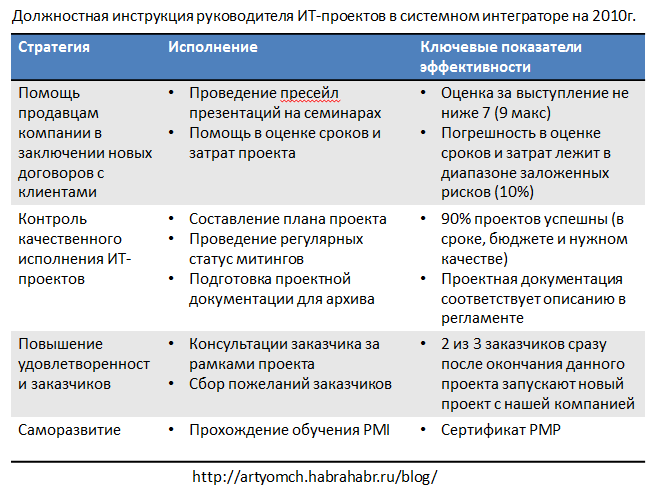
And finally, the "fly in the ointment" - management by objectives - a potent medicine. Able to transform your company. Both for the better and for the worse. It strongly depends on the quality and dose of application. A few tips - firstly, plan enough time to develop the target system (at least 1-2 weeks), secondly, test the system for at least six months (give out bonuses as before, but inform the employee about what would have been in the new system) . Third, set a certain balance between the manager's opinion (30% of the bonus or rating) and indicators (70% of the bonus or rating) - as “insurance” against those people who try to “move science sideways” - to formally perform the indicators, but not do the work using the imperfection of the scorecard.
And success to all of us!
As a preamble - in my experience there are many reasons why management is dissatisfied with staff (laziness, low level of training, lack of strategic thinking, disloyalty, etc.). At the same time, 99% of complaints to the management consist only of reproaches in the incorrect formulation of the problem. Of course, often these careless performers justify their own incompetence by “turning the arrows”, but still an interesting fact. Want to improve the staff opinion about you? Learn to set goals clearly.
Goal setting is not a new science. Personally, the concept of SMART comes in handy in my life and is easily remembered and the word is beautiful.
There are a lot of decoding when I even collected a “collection” of them. The easiest of the transcripts -
')
What are these beautiful words?
Specific. Clear statement of the problem, limiting the scope of the project, formulated concisely and at the same time covering all the key points. In fact, this is the name of the task, and "How do you call a yacht - so it will float ..."
Measureable. Criterion for measurability of success. Western business is generally obsessed with numbers and control. “That which you cannot measure, you cannot control, which means you cannot influence it.” A very delicate moment, since not all aspects of a task can be easily measured, and sometimes the measurement process itself becomes expensive and time consuming. But, anyway, there must be some objective tool for assessing the quality of performance.
Aggresive. Or attainable in canonical decoding. The goal must be aggressive (that is, motivating, reaching which you could be proud of, but not fantastically impossible or unreal).
Relevant. The goal should relate to the strategy of the company, project, etc. At the same time, R is also Resource-based, it is important to emphasize what resources an employee has for solving a task (which is inextricably linked with agressive)
Time-bounded There must be a clear completion date.
Sometimes, by the way, they use the concept of SMARTER - adding Evaluate and Rewarded (how, who and when evaluates the execution of the task and what the good / bad will be for the performer).
Jokes are jokes, and I think you are far from always in your practice, you set “smart” goals, although their requirements are logical. Yes, and we ourselves definitely prefer that we ourselves set goals precisely “smart”.
As an example, let’s take a look at a favorite joke at a construction site for beginners - “bring a bucket of nails”. The joke is that when pouring nails from a bag into a bucket, everything seems to be real, but not every super-heavyweight can lift a bucket hammered with nails. So what would a smart target sound like? Like that -
“Bring to this place (Specific) a full (Measureable) bucket of 5-cm (Specific) nails for dinner (Time-bounded). Without using any mechanical means for transfer (Resource-based). Consider that an unprepared person does not lift more than a third of a bucket at a time (Agressive). We need nails for attaching decorative elements to the facade of a building (Relevant). Foreman Ivan Ivanovich will come and check (Evaluate) and if not done - "Untranslatable Folk Folklore" (Rewarded). "
Agree to the goal sounds completely different, and the result will be very different. Although we spent a couple of minutes on thinking about setting a goal and its formulation, it can be saved at least half a day, and the whole construction process will not be delayed, and the newcomer will not fall from the hernia. Investments of 2-3 minutes of time are more than justified.
But micro-management is good, but still “slavery” has been recognized as ineffective in a number of countries and we want to set long-term goals for our employees in order to only occasionally come and get a ready-made result “for free”. Theoretically, this is the job descriptions. But in practice, few have seen them except for the process of employment and what was written there is fundamentally different from what one has to do, and the “smartness” in them is not included in the format itself.
What does a modern job description look like that can serve as a “contract” between you and an employee, ensuring clear and understandable rules of the game?
An example below. Although pedants will surely find something to complain about (and this is where my joy lies in the article), the general idea is certainly understandable.
And finally, the "fly in the ointment" - management by objectives - a potent medicine. Able to transform your company. Both for the better and for the worse. It strongly depends on the quality and dose of application. A few tips - firstly, plan enough time to develop the target system (at least 1-2 weeks), secondly, test the system for at least six months (give out bonuses as before, but inform the employee about what would have been in the new system) . Third, set a certain balance between the manager's opinion (30% of the bonus or rating) and indicators (70% of the bonus or rating) - as “insurance” against those people who try to “move science sideways” - to formally perform the indicators, but not do the work using the imperfection of the scorecard.
And success to all of us!
Source: https://habr.com/ru/post/99483/
All Articles