Inside Apple's Black Labs
Not surprisingly, after Apple finished a press conference about the problems with the iPhone 4 antenna, the company wanted to go even further and say “yes, we really test these phones to the fullest before releasing them to the public”. Although Steve Jobs in his presentation and spoke about the many different tests of wireless equipment, which are held at Apple headquarters, the guys from Cupertino did not think this was enough. And therefore, it seems to us, we (along with a small group of other journalists) were invited to a small tour of Apple laboratories on the Infinite Loop (the street on which Apple's headquarters is located). Despite the fact that we were not allowed to shoot a video or photo, we can tell you about what we saw and heard behind closed doors.
After Jobs rounded out his almost one-and-a-half-hour presentation, Apple's PR employees pulled us aside and led us through the center of the block on the Infinite Loop - this was a new experience for us, since we had never been deeper than one of the company's presentation theaters before. When everyone got together (there was Jason Snell from Macworld, John Gruber from Daring Fireball, and a handful of mainstream journalists from Wired, USA Today and the New York Times), we were led further through headquarters to a separate building. After a series of double doors and long, nameless halls, we ended up in a large warehouse-like laboratory, stuffed with equipment for tests in the middle of massive tables covered with a mysterious black cloth (we were not allowed to look under the cloth). We were waiting for Phil Schiller, Greg Josviak, Bob Mansfield and engineer Ruben Caballero. The latter became a controversial figure this week, because according to rumors he knew and spoke in advance about the problems of the antenna design (according to an article on Bloomberg, which Jobs called nonsense at yesterday’s press conference). Oh, yes, there were also a number of PR-department employees who made sure that especially zealous journalists did not get out of control.
')

So, our group was in a room of concrete and steel — rather empty and utilitarian, not quite what we expected from Apple — with giant aluminum cubes (several of the company's 17 anechoic chambers) and a small group of Apple representatives. Ruben began by telling us that these labs were once secret, even for Apple employees — something they called black labs. Also, he told us that in these laboratories there are 40 engineers who are experts with doctoral degrees in physics, telemetry and other black magic, allowing the company to develop and test wireless technologies. We were led to one of the stranger chambers, with a box on one side and a tapered part on the other, which gave the whole structure a bird's beak look. Ruben informed us that this particular camera cost about $ 1.2 million dollars. Inside, the room was covered with massive greenish-blue pyramids of sound and radio signal limiting foam, and there was an iPad attached to a rotating mechanism, which, we were told, was used to understand what the wireless signal would be at different angles. It was a passive test, as opposed to active tests with people and real interference (more on that later), and this test was conducted using Macs running ... Windows XP. When we asked why they were still testing the iPad, Bob and Ruben laughed, answering us that they had tested the iPad for years, and then Ruben smiled and explained to us that they continue to test the products even after they were released to the market. OK.
We were shown another room opposite the “beak”, where the iPhone 4 was clamped in a curious kind of styrofoom cube, rotating at regular intervals. The panels in the room also rotated, while the antenna on the leg (transmitting a cellular signal to the device, it was an active test) periodically changed its location. To say that we were not slightly concerned would be a lie - it all seemed like some small mechanisms from the movie “Saw”. According to Phil, the room was “the most advanced radio testing laboratory in the world.”

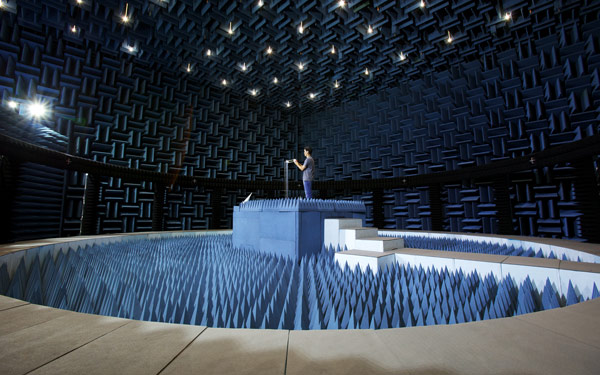
It is worth mentioning the sequence of types of testing that we saw, each of which added slightly more variables and human influence, which, eventually, led us, perhaps, to the most interesting thing we could see: the room from the image above.
The third camera was something like a throne room, or “Stargate,” as, according to Ruben, it is called Apple. And it really looks like something from a science fiction movie. Roughly speaking, this room is used to test a 360-degree radio signal around a subject holding or using a device. The structure surrounding the chair is covered with antennas - these small yellow pluses are the only purpose of which are to tell the tester whether a signal is received or not in a certain position. We cannot exaggerate how isolated these cameras are. Calling them dead rooms would be an understatement. We had been in quite dead rooms before, but these are just coffins of foam. In this room, one person from our group started asking about the amount of time that a standard test takes, but people from Apple didn’t want to answer how much they were testing specific devices. Even when they were asked about the “average time” for a nameless product, there was no answer. The company, however, said that the products go through each experiment for at least 24 hours, but that says nothing about long-term testing.
Ruben and the team took us through another hall to a separate laboratory, where testing focused on interference from “heads” and “hands”. The heads are made of plastic and filled with a liquid mixture that copies the contents of ... hm, the human head. The hands are made of some foam rubber, which, according to Ruben, is not a standard, which means that this is not what state commissions use to test phones. These hands are used to test interference in various positions. In the same room, we were shown a “leg” made for $ 20,000, on which the radiochip was tested in Nike +. Then we were led through the station, where the insides of the iPhone were shown on two large monitors using computed tomography. Ruben explained that when there is a problem in a device, its autopsy will change the conditions of the experiment, so they put the scanner to look inside without opening it.
Finally, we were taken outside, where there was a minibus stuffed with different devices, in which Apple testers are moving. The car contained several stations for “heads” and “hands” that we saw earlier, as well as places for people to take devices to the real world. The purpose of this demonstration, as well as the entire tour, was to show that Apple is taking antenna and wireless communications testing very seriously - if anyone had any doubts about that.
And we understand this - over the past few weeks there have been many people who hinted that Apple simply did not test the phone before launching it on the market. Or Apple was so stupid that they only tested the phones in those camouflage cases to bring the phones to the bars, and so they didn’t notice the problem. However, let's be honest - this is a multi-billion dollar company that has been manufacturing wireless devices for a long time. This is not their first phone, this is already the fourth, and even with previous models there were problems in terms of reception, nothing says that Apple does not make all the necessary efforts to manufacture phones. To be honest, we didn’t need a tour to understand this, but perhaps some doubted that.
Source: https://habr.com/ru/post/99359/
All Articles