"Industrial" chassis for the server in a hurry

When I needed to quickly build another server for my home file storage, I had everything I needed: an Intel motherboard with a sealed Celeron processor and a 512MB memory bar, a couple of hard drives and a power supply. There were also a lot of loops, adapters and other useful things for assembling a computer. There was only the body. Since the server was needed really quickly and I didn’t want to spend time and money on the purchase of the case, I decided to make a case out of scrap materials on my own. Basically, these were materials left over from the ongoing repair of the apartment, so the building, or rather the chassis, turned out to be a very “industrial” type.
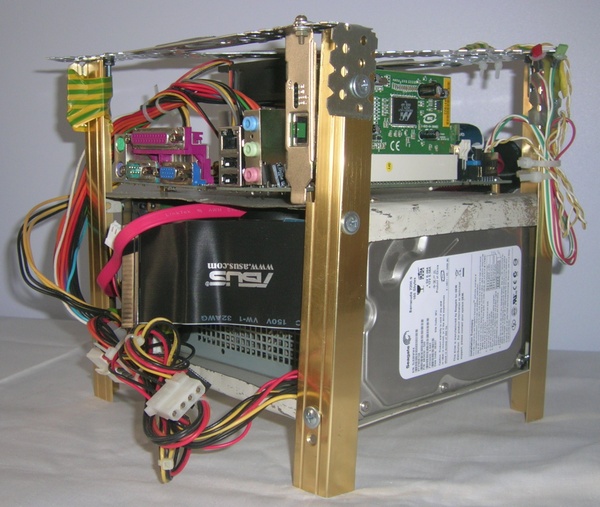
The design feature was the use of hard drives to stiffen (sorry for the pun) the entire chassis. The disks are installed between two metal plates, and the power supply unit is placed between the disks. The plates were cut with an electric jigsaw with a metal file from the lid of the old case (the case itself was not preserved), the edges of the plates were bent about 10 mm (one edge was already bent, I bent the second with pliers and a hammer). Holes were fixed in each plate for mounting the hard drives, besides holes were made in the upper plate for racks for fixing the motherboard.
Racks made of copper and cut them into a steel plate thread failed. Therefore it was necessary to fix the rack with the back side pieces of tin (from the usual cans). I screwed the stand into a hole in a piece of tin, and then soldered them together. It turned out quite firmly.
Then a piece of aluminum powder (corner) was sawn into 4 equal parts and holes for attaching to the plates were drilled in them. The chassis elements are fastened with 3,5 * 16mm self-tapping screws, the main thing was to calculate the location of the hard drives so that the self-tapping screws did not fit into them during assembly.
')
For mounting an additional Gigabit NIC, which occupied the only PCI slot on the motherboard, and also for mounting an 80mm cooling fan, I used profile holders for drywall. They are good because there are a lot of holes in them and they easily bend with relatively high strength (besides, I had them close at hand!) Three profiles fastened with the letter “Z” made it possible to fix the fan over both radiators: the processor and the chipset. The control LEDs and the power button are attached to them with insulating tape.
The result was the most compact and reliable in terms of rigidity fasteners of all server components. His absolutely unaesthetic appearance does not bother me at all, since the server is in a closed cabinet and is not visible to anyone. In the future, I plan to disassemble this server and use its components for other purposes, and as a simple temporary solution, the resulting construction completely suits me.
During operation, problems with overheating (even in the current hot days) and electromagnetic interference were not identified. The noise level in the closed cabinet is negligible even at night.
A couple of pictures: view from the side of the BP cooler ...

... and the view from the side of the motherboard connectors
Source: https://habr.com/ru/post/99304/
All Articles