New Zealanders presented a robotic exoskeleton - a replacement wheelchair
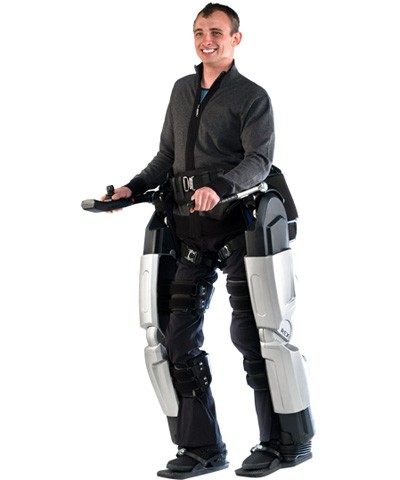
Yes, New Zealand does not appear very often in the reports of technological innovations. But this time it was New Zealand that distinguished itself - the guys from Rex Bionics created a more or less portable exoskeleton for people with impaired motor function of the lower limbs. The authors say that this exoskeleton is a product that has been developed for 7 years, and now, finally, this invention has been brought to its final point.
It is clear that there is no limit to perfection, but the Rex Bionics exoskeleton is now able to withstand the full weight of a person, supporting him and “walking” wherever the owner wants. The exoskeleton does not stand out in size, so it can be used at home, on the street, and at work - the unit is very convenient to use. It is clear that this statement is written from the words of those who tried the exoskeleton in their work.
')
This device is controlled by a manipulator (it looks almost like a game), plus there is an additional control panel. In general, such a device should be easy to manage, and after a small workout, a person who still only moved in a wheelchair can walk.
Interestingly, this is not a piece of development, the authors are going to start production line production, and already in 2011, according to the plan, Rex Bionics will deliver the first exoskeletons to the stores. True, the cost of the device goes off scale - only a millionaire can afford 150 thousand dollars. But we are pleased that such a device exists, and we all know how much the first mobile phones cost, and how much they cost now.
It may well be that in a couple of years the cost of such an exoskeleton will drop to an acceptable value.
First this unit was tested by a person with spinal cord injury - as is well known, such damage leads in its mass to complete paralysis of the lower extremities. The guy's name is Hayden Allen, and it is clear that he looks very happy - not every person with such a violation is lucky to get such a device. Well, one can only hope that in 2-3 years such devices will carry their owners through the streets of cities, and not only in New Zealand.
Interestingly, how much would such a device cost if it was developed and produced in the CIS? Or, for example, if you make its production in China - probably, the cost could be reduced by an order. True, it remains to fear for the quality of the well-known Chinese assembly (although over the past few years, a high-quality Chinese assembly will give odds to the same American).
Here is the source
Source: https://habr.com/ru/post/99205/
All Articles