The creators of SETI @ Home launch a new project
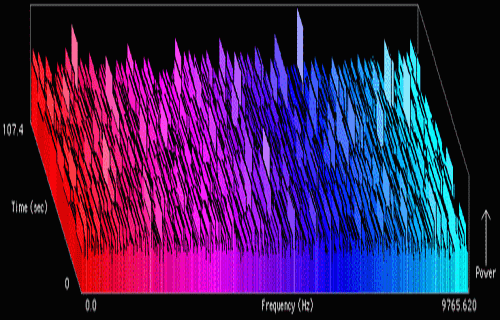
Probably, the overwhelming part of the community has heard about the SETI @ Home project, many have even participated or are participating in this program. Indeed, the “listening” of space has been going on for decades, and over the past few five-year periods more and more Internet users have joined the SETI @ Home distributed computing program. Despite the fact that alien civilizations have not yet been discovered (although some consider the WOW signal to be evidence of the presence of brothers in mind), the project has given a great deal to humanity, including the detection of rare classes of space objects. But here, the creators of SETI @ Home are going to launch a new project.
According to Jill Tarter, head of the SETI Research Center, the new project will be almost as revolutionary as the first. It was SETI @ Home that, in fact, was one of the first global “cloud” projects, and for a long time remained one of the most popular.
')
Now scientists believe that the time has come to open a new page in studies of the radio frequency spectrum of the universe. The fact is that the research literally "drowned" in a huge amount of data that no one has time to process. Previously, the analysis of the radio frequency spectrum of the surrounding Metagalaxy was carried out in a mode that with a stretch can be called a real-time mode.
Now, despite the significant expansion of the computing base as a result of the emergence of more productive computers and an increase in network bandwidth, data continues to accumulate, there are already a lot of them.
Scientists believe that the main problem is that the software created by them is imperfect. Yes, it worked before and it works now, but it is already outdated. The SETI team is going to appeal to anyone who can help create a new, clean and clear, and most importantly - effective code of the new software.
In addition, scientists have developed a new API, which will be presented at OSCON. The API was developed jointly with the Cloudant startup, which is engaged in “cluster” software development. According to the project, each project participant will be able to write their own part of the code, then uploading it to the general “cloud”. By the way, this cloud is based on the facilities of the EC2 service provided by Amazon (recall that EC2 is a new Amazon cloud service that allows you to get the power of a supercomputer even to companies that do not have the money to create their own super).
Those program participants who do not have programming skills will be involved in the analysis of very busy sections of the spectrum, which SETI cannot cope with.
Incidentally, Jill Tarter argues that the notorious Drake equation, which allows you to calculate the number of intelligent races in our galaxy, is reduced with the discovery of new exoplanets.
“I think that in a couple of years we will discover an earth-like planet that will allow us to significantly increase the probability of finding sentient beings,” says Tarter.
In general, the SETI @ Home project really moves to a new level of development, allowing you to use the help of programmers around the world, coupled with the enormous computing power of commercial services.
If anyone is interested, here is an interview with Tarter (English).
Source: https://habr.com/ru/post/99118/
All Articles