Predicting the results of World Cup matches
Recently ended the World Cup, which won the Spanish national team. The most famous "predictor" of the world championship was the octopus Paul, who correctly predicted eight results of football matches in a row (including the outcome of the final).
But, as it turned out, English scientists also decided to keep up with the octopus and developed a model that allowed Spain to predict a victory in the final and explain England’s defeat against Germany.
Mathematicians and football fans at the same time - Dr. Javier López Peña and Dr. Hugo Touchette from the University of London collected information about the passes of all World Cup games and analyzed how they relate to the characteristics of the national styles of the game.
')
Using graph theory, they found problems in the tactics of the game against the German national team and suggested that Holland and Spain would play in the final.
For each team, mathematicians built a network of passes and analyzed how these networks correlate (intersect) with each other. Each player was assigned a rating (centrality), which showed how a particular player is important for the network as a whole. This method can be used to plan a football strategy.
Graph theory is used to analyze various types of networks, most often computer. With its help, situations are simulated for cases if, for example, some parts of the network suddenly disappear. Such studies can help build more robust and resilient networks.
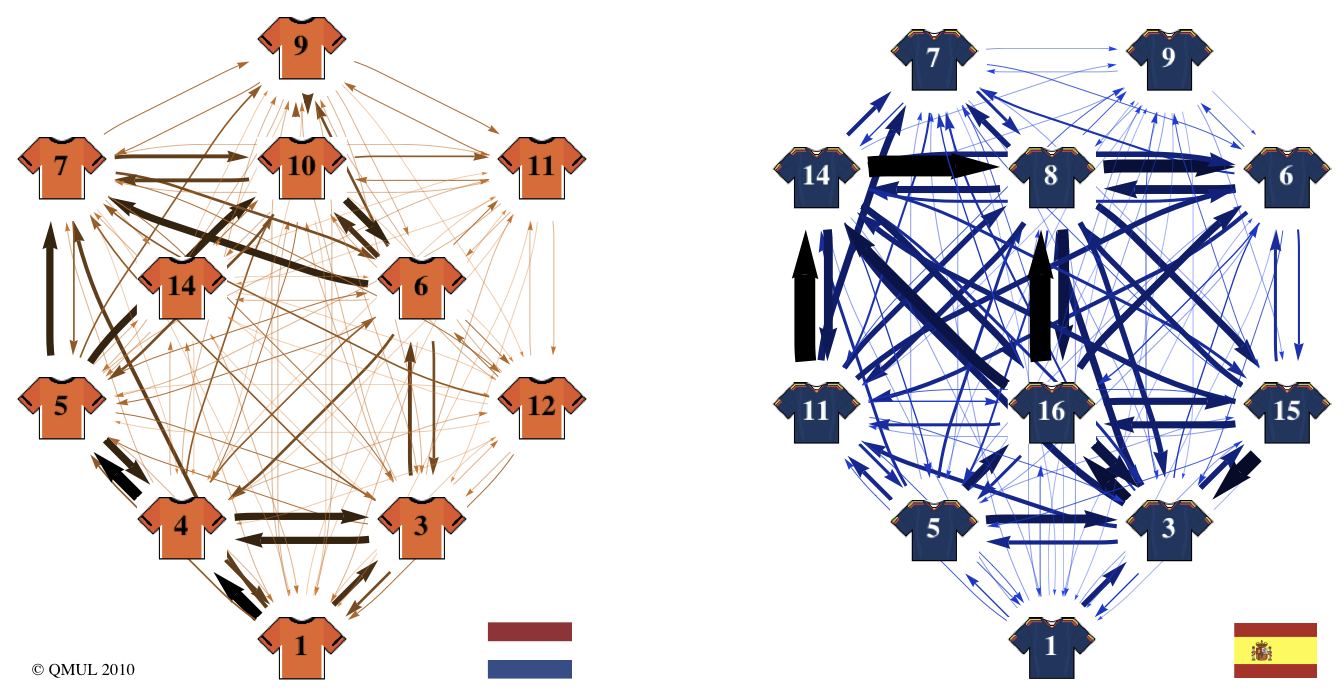
The networks built showed that Spanish players made 40% more passes than Germany and twice as many as Denmark. David Villa received an average of 37% of passes per game - more than anyone in this championship (Torres scored only 13%). (But as we already know, Villa was not very distinguished in the final match and was replaced by Torres.)
Based on these data, a forecast was made that Spain would win (which happened at the end of extra time).
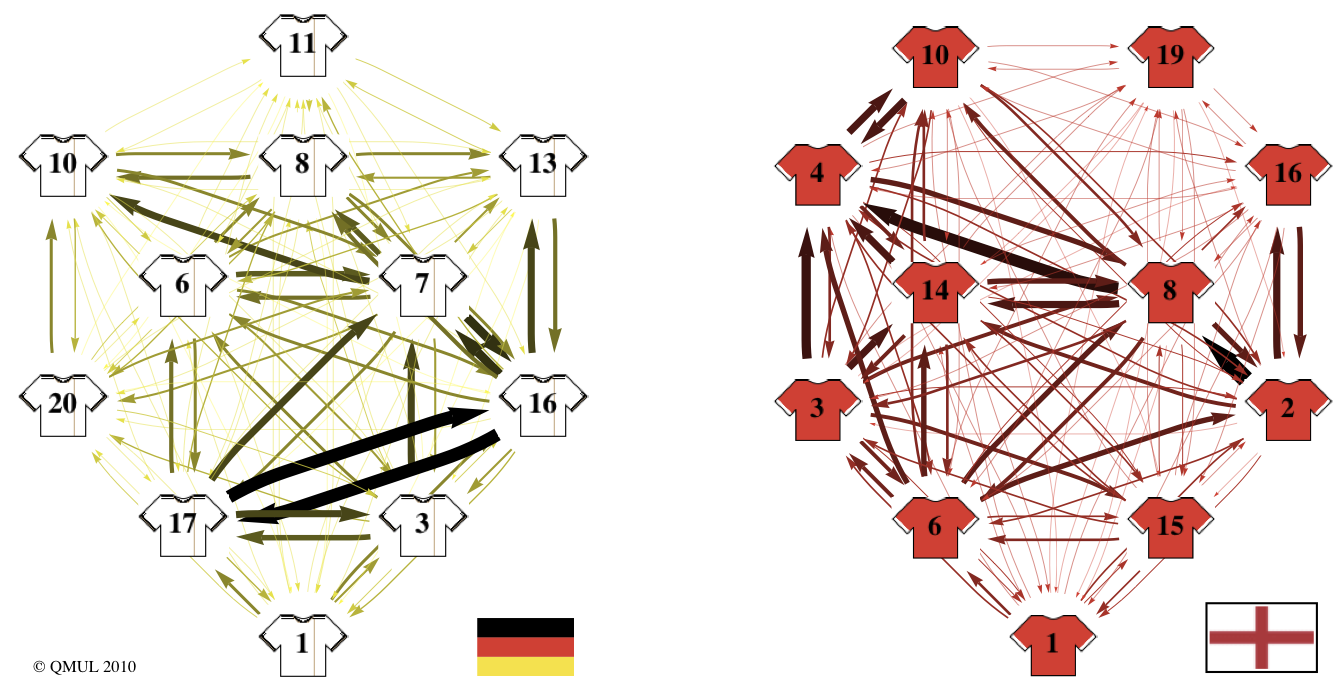
A good game in the midfield of Frank Lampard, Steven Gerard and Gareth Barry (Frank Lampard, Steven Gerrard, Gareth Barry) did not lead to a good game of forwards, when Vane Rooney received three times more passes than Jermain Defoe. This made England’s attacks very predictable and Rooney was easy to stop, as he usually gave a return pass to Gerardoux.
Germany's network turned out to be more balanced in comparison with English, with a large number of passes, which means more movement of the ball across the field. “Important passes were passes between Philip Lam and Bastian Schweinsteiger, and most of the attacks were intensified by defenders. Mezut Ozil made a lot of work to connect the two flanks of the attacks, which made Germany’s game more interesting, diverse and less predictable. The key player was Schweinsteiger, who was successfully blocked in the semifinals, which is why Germany lost the match, ”says Dr. Lopez Peña.
You can read more on the link .
But, as it turned out, English scientists also decided to keep up with the octopus and developed a model that allowed Spain to predict a victory in the final and explain England’s defeat against Germany.
Mathematicians and football fans at the same time - Dr. Javier López Peña and Dr. Hugo Touchette from the University of London collected information about the passes of all World Cup games and analyzed how they relate to the characteristics of the national styles of the game.
')
Using graph theory, they found problems in the tactics of the game against the German national team and suggested that Holland and Spain would play in the final.
For each team, mathematicians built a network of passes and analyzed how these networks correlate (intersect) with each other. Each player was assigned a rating (centrality), which showed how a particular player is important for the network as a whole. This method can be used to plan a football strategy.
Graph theory is used to analyze various types of networks, most often computer. With its help, situations are simulated for cases if, for example, some parts of the network suddenly disappear. Such studies can help build more robust and resilient networks.
Holland - Spain
The networks built showed that Spanish players made 40% more passes than Germany and twice as many as Denmark. David Villa received an average of 37% of passes per game - more than anyone in this championship (Torres scored only 13%). (But as we already know, Villa was not very distinguished in the final match and was replaced by Torres.)
Based on these data, a forecast was made that Spain would win (which happened at the end of extra time).
England - Germany
A good game in the midfield of Frank Lampard, Steven Gerard and Gareth Barry (Frank Lampard, Steven Gerrard, Gareth Barry) did not lead to a good game of forwards, when Vane Rooney received three times more passes than Jermain Defoe. This made England’s attacks very predictable and Rooney was easy to stop, as he usually gave a return pass to Gerardoux.
Germany's network turned out to be more balanced in comparison with English, with a large number of passes, which means more movement of the ball across the field. “Important passes were passes between Philip Lam and Bastian Schweinsteiger, and most of the attacks were intensified by defenders. Mezut Ozil made a lot of work to connect the two flanks of the attacks, which made Germany’s game more interesting, diverse and less predictable. The key player was Schweinsteiger, who was successfully blocked in the semifinals, which is why Germany lost the match, ”says Dr. Lopez Peña.
You can read more on the link .
Source: https://habr.com/ru/post/98966/
All Articles