De-design in video games
Card games and elements of debuilding (building a deck) have been used in video games for a long time, sometimes mixing with well-known genres to create a new, but at the same time familiar gameplay. Developers are experimenting with this subgenre in various ways, then creating completely randomized systems, then going along difficult paths of trial and error.
We talked with different developers about their experience in creating design debuilding and asked to give advice to those who want to implement such systems in their own projects.
Familiarity with items as a tool
Game Project Director Peter Johansson and Lead Designer Robert Olsen from Image & Form Games Studio, which develops the SteamWorld series of games, call traditional RPGs the main source of magic and attraction of collectible card games.
')
“The sensations we get from games like Magic: the Gathering, Hearthstone and Netrunner are similar to the sensations of a classic RPG: we take on the role of a hero equipped with magic spells and weapons (or hacking tools in cyberspace) to defeat a powerful enemy. Card games take this fundamental gameplay and put it in a different package, changing the perspective and ways of interacting with what is already familiar to the players. ”
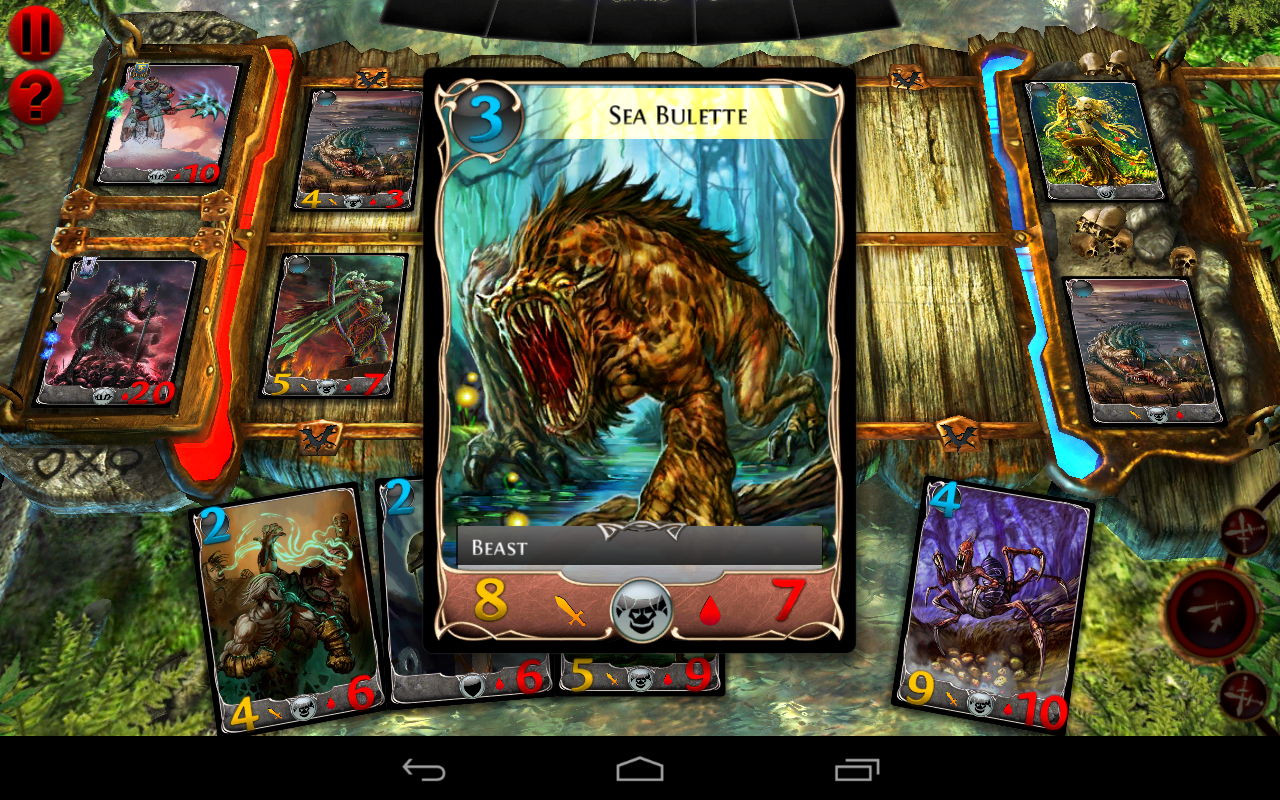
When creating maps for SteamWorld Quest, designers tend to make them easily recognizable, even if the player does not yet know in detail about their properties. If a player sees a card called “Heroic Strike” with the image of a swing sword, he will most likely understand what she is doing. But at the same time, Peter and Robert declare that for such games one of the most important elements is gradualness. It is important to know when it is time to enter new cards in order not to immediately overload the player.

Steamworld quest
“The complexity should increase quickly enough for the player to be constantly interested and want to learn more, but not so fast for it to bore him. This is especially important when we introduce new player-controlled characters, because we want them to immediately appear attractive and unique, while the player is not overwhelmed by new concepts. The balance here is very difficult to keep. ”
During the development process, Johansson and Olsen faced another problem - players were not interested in experiments with the interaction of cards and their collection for the future, but instantly used what came into the deck. Taking the Fate / Grand Order as an example, the developers came up with a system of chains, giving bonus effects in each move, if players use a certain combination of cards. Later, this system evolved into Heroic Chains: using three cards of the same hero in one turn.
“Be prepared to experiment a lot,” they add. “It is important to remember that debuilding is also a form of gameplay. Players will spend a lot of time in the UI, thinking through the cards in their collection, mentally trying out different ideas, collecting decks that seem powerful or interesting to them, and only after that will they move on to real fights. Do not limit your balancing ability to just a few variables and do not choose schemes that cannot be customized. ”
The key to success - experiments
Co-founder and chief game architect of Thing Trunk, Maciej Bedzytsky, and his team spent a lot of time finding the right balance. They sought to make the design of Book of Demons simple, but not too primitive. So they came up with the basic idea of dividing cards into three categories: skills, items, and spells.
“This system is not only easier to explain to players; it gives them more options for strategy, ”explains Bedzytsky. "The choice between a subject and a spell in conditions of a limited number of card slots is interesting."
But creating a balance of cards was also a long and complicated process. In the Book of Demons there are 40 archetypes of maps (not counting upgrades, magic or legendary options) for each of the three game classes. If we take into account the various interactions that players can create between different cards, it is almost impossible to achieve the absence of too powerful combinations. “A player can equip up to 10 cards, and this seems to be quite an acceptable number, but if we use combinatorics, we get 3 quadrillion possible combinations.”
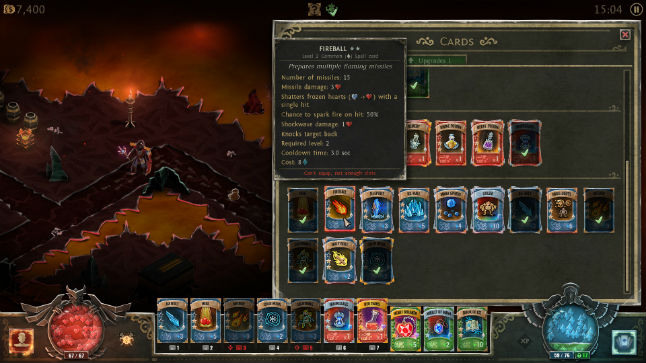
Book of Demons
Two and a half years in “early access” was the most important time for developing the design of the Book of Demons decks. It allowed developers to make hundreds, if not thousands of changes, and some maps were even re-created from scratch. Along with finding too powerful or weak cards and combinations, Thing Trunk wanted to provide more depth for hardcore players, which led to the creation of an upgrade system.
“Embedding a card system into a game is a fascinating process that allows you to use more abstract rules,” says Begiczy. “But this is by no means a magical solution that can improve any game. If you think that your game has a place for a card system, then I recommend making a quick prototype to check how it works. The game should be interesting already with a few simplest cards. If this is not the case, then it is worth returning to the design stage: the system cannot be made to work simply by adding more cards with exotic effects to it. ”
The idea of using cards in Slay The Spire came to the co-founder and developer of Mega Crit Games Anthony Giovanetti because he loved them. Thanks to games like Magic: The Gathering and Dominion, he became a fan of de-building. At the same time, from the point of view of mechanics, the roguelike aspects of the game have become a logical rationale for why a player constantly receives new cards added to his deck. Also a source of inspiration was the draft formats, for example, from the arena mode in Hearthstone.
“Card fights are a fundamental part of the game idea. Therefore, I don’t think that we had any particularly difficult problems in this area, ”says Giovanetti. "If you look at the battle in Slay the Spire as an analogue of the battle in the JRPG, then the cards turned out to be a huge and easy advantage in terms of increasing the depth of the round of turn-based battles."
In this project, Early Access demonstrated that players always demanded card amplification, and it was important to take this into account when making all sorts of changes to them. To maintain balance, it is necessary to treat such proposals realistically and rely on data. "Players may let you know that the card does not suit them, but they are not able to decide whether it is good or bad."
From the very beginning register the maps in the database.
Thanks to feedback from players, the Daily Challenges have also undergone major changes in the development process. At first, they were supposed to be tasks that show how far players can advance in them. But in the end they decided that it was better to use fancy modifiers. Players were still able to compete, but more important now is how they manage to win daily tasks, rather than just trying to complete them.
“Maps open up a huge space of opportunities, so you need to collect data on them and perform a test at the very early stages of development, otherwise the balance will be terrible,” adds Giovanetti.
Relationship manager and designer Lee Mei from Defiant says that in developing the Hand of Fate, the key element was keeping the balance of the player’s influence on the game. It began with the previous project for mobile devices, Heroes Call , in which randomness was used to create dungeons, but the player never saw it, because all the generation was performed in the background. After thinking about it, May said that Defiant could probably save a lot of time by creating a linear gameplay by hand, without using procedural generation.
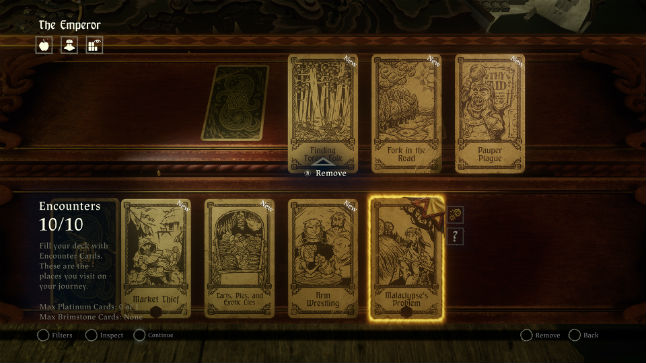
Hand of Fate 2
“Starting to investigate debuilding, we discovered a wonderful thing - the process of the game can still be randomized, but you can use the player in this and give him a feeling of influence on this randomization and its management,” explains May. “The deck replaces the dungeon master (dungeon master), and does not constitute a player’s units or combat moves. That is, the lessons that we learned during the development process are quite specific and less applicable in games like Gwent , Hearthstone or Slay the Spire . ”
Creative director Morgan Jeffit took into account what happened with Heroes Call and decided to go on a difficult path again: all the cards are shuffled and taken from the internal base, and not completely randomized. It is curious that this decision was influenced by his previous experience as a magician.
“All cards are physical objects, like their decks, so when the game needs to perform a search by deck, we actually shuffle the stack of game objects until we find the required card. It would be infinitely easier to imitate all this, but we refused to do so, because this is the prestige of the magician. Of course, this is crazy - magicians are known to cheat on cards, but we decided to choose this path. ”
The experience with both parts of Hand of Fates taught them the importance of keeping track of everything and storing them in a constantly up-to-date database. “We also know that a power creep is unavoidable, especially if you add content in waves, so get ready for multiple balance revisions,” says May. “Keep in mind that there is such a problem as having too much choice — if you give the player the opportunity to choose five cards from the deck, this will lead to a much more interesting decision-making process than if he had a choice of twenty cards.”
Game designer and screenwriter Alexis Kennedy, in his experience at Weather Factory 's Cultist Simulator , can also share useful tips for studios who want to focus on verbally abstract card-based gameplay.
From the point of view of art, the main priority should be the search for an art style that is both unique and cheap to create. And when you start adding text to your cards, always evaluate its appearance beforehand. "Solving the problem of detailed information on maps is the main difficulty in creating a UI," says Kennedy. “It’s not enough just to put this text in the tooltips.”

Cultist Simulator
The expectations of the players require you to closely monitor possible problems that may arise in the pile of cards. For example, you need to keep track of what happens when a card returns to an already non-existent deck, what happens when the second card returns and is placed on the previous one, and check if the properties of the card have changed. In addition, if most of the cards are constantly, then when they are destroyed, the players will react more actively.
Kennedy shares his concerns about the functionality of snapping to the grid and talks about how important this turned out to be for the game process as a whole. “I cannot believe that we released the game without binding the cards to the grid. I wanted the UI developer to leave it at the last moment, but he didn’t have enough time to work with sound effects. It was necessary to free him from this work and set the binding function much higher in the list of priorities. Approximately on the third day after the game was released, one of the players added a mod that includes a link. ”
“The feedback we collected generally came down to the fact that the players want the cards to go to the right place without any problems. Of course, this is a typical UI problem: each player has his own idea of what a “right place” is, ”he explains. "We implemented simple elements in the game to cope with this problem, but I think that in the next game we need to approach this issue from the other side - to make the unfolding of cards have obvious value and importance in the game."
Source: https://habr.com/ru/post/448130/
All Articles