“33 words about design”: who and why makes a movie about design in Russia
The Bang Bang Education School of Design has begun to raise funds for the film “33 words about design”, which will be devoted to contemporary design in Russia. In it, each of the 33 heroes in two minutes will try to answer the question of what Russian culture and aesthetics are. The school collects the main amount on its website, and a part - on the Planet crowdsourcing service. Last year, the same team made the movie “ 100 Years of Design ”, in which they talk about key objects and events in world design in the last century in an hour and a half.

Natasha Klimchuk, Tim Cherny and Olya Morozova - co-founders of the school and creators of both films answered Habr's questions about the new film and how it was working on the previous project.
')
You are collecting money for the new project yourself, and “100 years of design” was released with the support of Yandex publishing house. This time they did not want? Or do you want independence?
Tim Black: Wanted of independence.
Olya Morozova: We wanted to find out how much the audience, loudly responding to the “100 years of design”, wants to be involved in creating a new film. How curious is this topic for people and what is the general interest in design in Russia.
Natasha Klimchuk: We do not exclude that some big brand that invests in socially significant projects will want to support our new film. We didn’t do it on purpose: it didn’t go further than a few conversations, somehow it was immediately thought up that there would be support from people interested in design in Russia, and this support would warm us in the process of making the film.
I have a feeling that your previous film about design intentionally turned out in places like a “designer”, art-house. I'm right?
N: Yes, of course, and how else can there be a documentary film about design, where the designers themselves come up with content? There are several movie almanacs with directors who make a great art house. In our understanding, a good designer is the same director, he comes up with an idea, designs the experience and emotion of the user.
A: This is the rare case when a particular film seems to be for designers, turned out to be interesting to a wide audience.
And vice versa: there are small charming flaws in the film, when the CGI letter does not ideally fall on the plane of a real cube or the person is not perfectly distant from a green background. Is it possible to be inattentive to details when making and editing a film about design?
A: Everything is possible. We did not claim the quality of Hollywood, creating a "100 years of design." To me, on the contrary, all these shortcomings seem to be nice, the voices of the participants in their videos and such is the full involvement, experiment in everything. The budget for the creation of the film was a little more than one million rubles.
T: Why not. Design is not perfect. We appreciate the attention to detail, so that everything is in its place and for everything there is a rationale, but this is not necessary. This is a film to designers about designers. His goal was to tell about the history of design. So yes, why not.
Each new period in the “100 years of design” is told by different designers in a different entourage, they are filmed by different people, and the graphics are made by other guys. The result was eclectic - is it a conscious decision or a forced one?
N: I really love watching movie almanacs, festival short films or collections of music videos and cartoons. It's great that each passage had its own visual and rhythmic language, it does not allow the viewer to fall asleep, keeps in suspense.
A: This is the technique that we chose at the start of the film. Since there are a lot of participants and everyone talks about different things, they decided to visually decide all this in accordance with the style of the participants and the plot of their video.
It seems that in “33 words” there will not be a general idea, a leitmotif.
H: It will, of course. If in the first almanac each designer and director had the task to tell what was most important in their opinion during the five-year plan issued by him using one person, one date and one object as an example, then the new almanac will need to be told what modern design is in Russia. The film will have 33 different answers to this question.
Don't you think that 33 equally important storytellers for one film are too many and, no matter what they say, the story will merge into an unintelligible noise?
N: We don’t think that 33 is a lot. In the last film there were 21 storytellers, counting the final words of Dima Barbanel. Each had five minutes, and “100 years of design” lasted 104 minutes. And in the new film, everyone will have two minutes: we want to make the film shorter and more visually saturated. I just do not mind the stuffing of meanings and pictures, in my opinion, there are more chances for the viewer to catch their own sense of Russianness. One answer to this question can not be.
What was (and will be) the work of the producer with so many designers on the film? They are not professional directors and actors, but at the same time they have their own vision.
N: The process is not simple, but very interesting. In fact, Olya and I have long been engaged in organizing the creative work of a large number of people, so for us this is just another project in terms of time, but a completely new project in terms of the birth of a new entity - the movie.
A: Fun and nervous. All participants are very talented, it was interesting to watch and help them find their voice and visual language.
Tell us about the most stressful period of work on “100 years of design”. What mistakes you do not make while working on a new film?
H: It was easy, fun and interesting to invent, shoot and mount. I would like to say that now we will try very hard to ensure that the shooting does not take place at the last moment, but in 15 years of working with designers, it was rarely surprising.
A: There were a couple of technical errors related to rolling ID and translation into English, which we will no longer commit.
In "100 years of design," designers talk about things that are significant to themselves and phenomena within the framework of the chosen five-year plan. In addition to the obvious difference that the first film was about world design, and the new one was about design in Russia, what will be the basis for the concept of the new film?
A: The basis of the film is research. If in “100 years of design” we relied on certain time periods, then everyone will go to search for an answer to the questions: is there a design in Russia? What is he like? With all flowing thoughts and stories.
T: This film is not about design, but about designers. We want to understand who we are and what we do and how to describe it. When we talk about defining ourselves, we cannot talk about objects. Objects - the result of some ideas and ideas. And the carriers of these ideas are people. To come to realization, it makes sense to start with the question “who we are and what drives us”.
N: In the era of globalization, we will understand what defines us and where we are going. Like the first film - this is a social project of our school. What was the result of the first film, difficult to measure, but it was watched by many. Everyone who is engaged in design, and there were no indifferent people, heard about it. There is already interest in the new film, and a large number of people will definitely see it. Each designer will find for himself the answer to what modern Russian design is in Russia. Probably, both of these films work for our reputation (or against it), but for us exactly those meanings that are created in the process and change the industry for the better.
Since the new film will be about design in Russia, then you obviously distinguish our local design from the foreign one. So, what distinguishes Russian design from, for example, American or Swiss?
N: Other countries have a different language, mentality, history, economy, aesthetic and ethical traditions. And what traditions we have and what we want to carry to the world and to the future - we will see in the fall.
Design in Russia is different, and the answer here can not be one. But the fact that something distinguishes us from others is for sure. This is a language, cultural codes, mentality, territory, history. So we want to pull it all to the surface and give the viewer the opportunity to choose from this what he wants to carry to the future.
T: It's hard for me to speak for everyone, I see the difference, but I can't say what it is. Could - would not make a film.
And what if there is no Russian design? What if modern designers grew up, peeping into the work of Europeans and grew up with the thought that "they are cool, but we do not." And they studied, wanting to do as cool as somewhere. To the subway like in Barcelona, apartments like in Sweden, signs like in Lisbon, cars like in America. If you saw such a subtext, would you dare to accept it and put it through the film?
N: This is also a point of view that we will not cut out, if one of the participants we chose wants to say that.
In general, should and can in this global world design be national?
H: Design is not about nationality. It is about convenience, values, aesthetics and meanings. But it is better to enter globalization, understanding who you are. If you give up your culture and history, then deliberately. In our opinion, of course, one should not refuse, but take the best and carry it into the world.
33 words - 33 designers. 33 letters in the Russian alphabet. What is it like to choose 33 designers to participate in the film, and not choose the rest?
H: It is difficult. And, of course, this is a subjective choice. Not everyone whom they wanted was able to attract, although almost everyone we agreed to the project agreed. These are all amazing designers, with whom it will be very interesting to work, the ideas that they have already sent promise that the film will be cooler than the first.
T: There are not so many interesting people capable of expressing their attitude and having their attitude. Rather, we are in short supply. I barely had enough.
Now you are collecting two million rubles for a new film - is this enough for all your plans? What would be the ideal amount for a perfect movie with that title?
A: There is no limit, you can even think about a budget ten times more, rather, this is the amount by which we can give participants the opportunity in a quality format to visually reinforce their thoughts on the topic of design in Russia.
N: We thought that if 2000 people supported the film (and only at the premiere of the last film there were one and a half thousand viewers), it would greatly support us, and we would invest the rest of the money ourselves. Two or three million for a film is a small amount, of course, this is only the work of operators, musicians, sound engineers, equipment rental.
For us, the meanings are much more important than the visual side, this is not a blockbuster, this is a film that, as we believe, will affect the design industry in Russia. He, like our first film, popularizes design in Russia and will be of interest to all Russians. It is not about what design we are doing, but about what “Russianness” is, what it should be according to contemporaries. We do not want to delay the production process and make the perfect picture, it is more important for us to find and convey meanings. The idea is better than expensive production.
Why do you shoot these films at all? Who and what do you want to say? And why is it important to say, and not keep silent?
A: We are never silent, we need it most, and the question “what is modern design in Russia” has been hanging for a long time.
T: Silence is evil, the word is good. Understanding occurs only through naming. What is not named is not understood and not introduced into culture.
N: We like to think that we are helping to form a thinking design community and popularize good design. We make knowledge accessible by making films, courses, recording conversations with designers. We want to raise the overall visual level, and make the profession more meaningful. We invest in content, not in advertising, and it seems that our audience, which is constantly growing, appreciates this.
When and where can I see the new film?
A: In the autumn of 2019 there will be a rental in cinemas in Moscow and in ten large cities. Let's send to festivals to tell the whole world about Russian designers.

It is important to you what rating the “100 years of design” received (6.9 at the Kinopoisk) and will receive a new picture?
A: Who are important ratings at all? We definitely do not, after the sold-out and the semi-annual film tour everything is clear.
T: I do n't care, this is not a commercial project.
Natasha Klimchuk, Tim Cherny and Olya Morozova - co-founders of the school and creators of both films answered Habr's questions about the new film and how it was working on the previous project.
')
You are collecting money for the new project yourself, and “100 years of design” was released with the support of Yandex publishing house. This time they did not want? Or do you want independence?
Tim Black: Wanted of independence.
Olya Morozova: We wanted to find out how much the audience, loudly responding to the “100 years of design”, wants to be involved in creating a new film. How curious is this topic for people and what is the general interest in design in Russia.
Natasha Klimchuk: We do not exclude that some big brand that invests in socially significant projects will want to support our new film. We didn’t do it on purpose: it didn’t go further than a few conversations, somehow it was immediately thought up that there would be support from people interested in design in Russia, and this support would warm us in the process of making the film.
I have a feeling that your previous film about design intentionally turned out in places like a “designer”, art-house. I'm right?
N: Yes, of course, and how else can there be a documentary film about design, where the designers themselves come up with content? There are several movie almanacs with directors who make a great art house. In our understanding, a good designer is the same director, he comes up with an idea, designs the experience and emotion of the user.
A: This is the rare case when a particular film seems to be for designers, turned out to be interesting to a wide audience.
And vice versa: there are small charming flaws in the film, when the CGI letter does not ideally fall on the plane of a real cube or the person is not perfectly distant from a green background. Is it possible to be inattentive to details when making and editing a film about design?
A: Everything is possible. We did not claim the quality of Hollywood, creating a "100 years of design." To me, on the contrary, all these shortcomings seem to be nice, the voices of the participants in their videos and such is the full involvement, experiment in everything. The budget for the creation of the film was a little more than one million rubles.
T: Why not. Design is not perfect. We appreciate the attention to detail, so that everything is in its place and for everything there is a rationale, but this is not necessary. This is a film to designers about designers. His goal was to tell about the history of design. So yes, why not.
Each new period in the “100 years of design” is told by different designers in a different entourage, they are filmed by different people, and the graphics are made by other guys. The result was eclectic - is it a conscious decision or a forced one?
N: I really love watching movie almanacs, festival short films or collections of music videos and cartoons. It's great that each passage had its own visual and rhythmic language, it does not allow the viewer to fall asleep, keeps in suspense.
A: This is the technique that we chose at the start of the film. Since there are a lot of participants and everyone talks about different things, they decided to visually decide all this in accordance with the style of the participants and the plot of their video.
It seems that in “33 words” there will not be a general idea, a leitmotif.
H: It will, of course. If in the first almanac each designer and director had the task to tell what was most important in their opinion during the five-year plan issued by him using one person, one date and one object as an example, then the new almanac will need to be told what modern design is in Russia. The film will have 33 different answers to this question.
Don't you think that 33 equally important storytellers for one film are too many and, no matter what they say, the story will merge into an unintelligible noise?
N: We don’t think that 33 is a lot. In the last film there were 21 storytellers, counting the final words of Dima Barbanel. Each had five minutes, and “100 years of design” lasted 104 minutes. And in the new film, everyone will have two minutes: we want to make the film shorter and more visually saturated. I just do not mind the stuffing of meanings and pictures, in my opinion, there are more chances for the viewer to catch their own sense of Russianness. One answer to this question can not be.
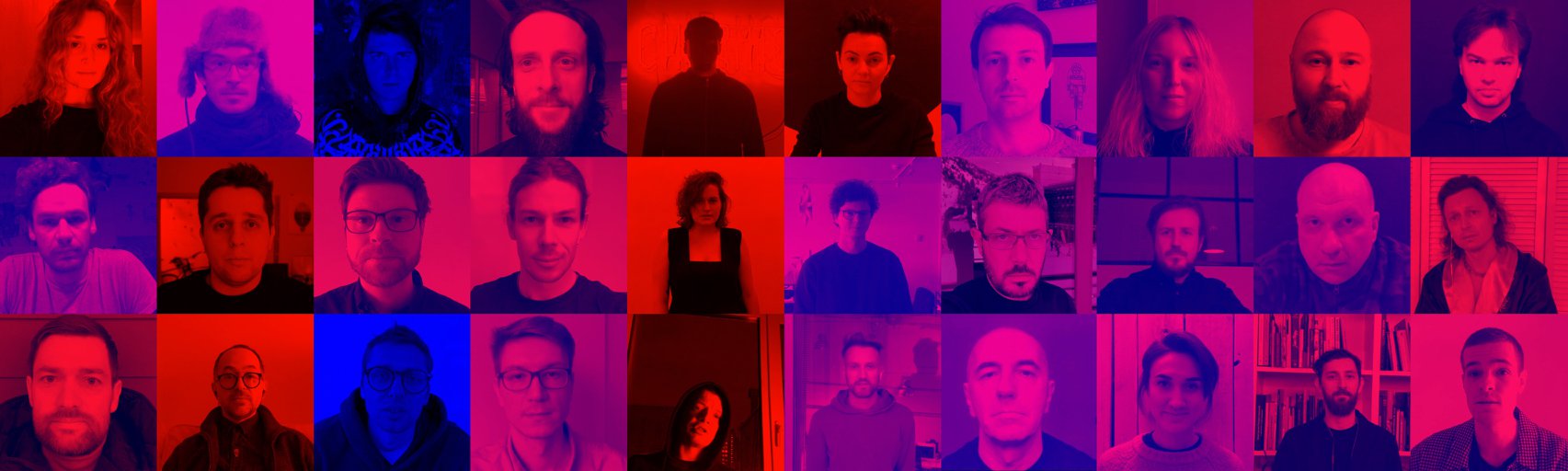
Who will say "33 words about design"
What was (and will be) the work of the producer with so many designers on the film? They are not professional directors and actors, but at the same time they have their own vision.
N: The process is not simple, but very interesting. In fact, Olya and I have long been engaged in organizing the creative work of a large number of people, so for us this is just another project in terms of time, but a completely new project in terms of the birth of a new entity - the movie.
A: Fun and nervous. All participants are very talented, it was interesting to watch and help them find their voice and visual language.
Tell us about the most stressful period of work on “100 years of design”. What mistakes you do not make while working on a new film?
H: It was easy, fun and interesting to invent, shoot and mount. I would like to say that now we will try very hard to ensure that the shooting does not take place at the last moment, but in 15 years of working with designers, it was rarely surprising.
A: There were a couple of technical errors related to rolling ID and translation into English, which we will no longer commit.
In "100 years of design," designers talk about things that are significant to themselves and phenomena within the framework of the chosen five-year plan. In addition to the obvious difference that the first film was about world design, and the new one was about design in Russia, what will be the basis for the concept of the new film?
A: The basis of the film is research. If in “100 years of design” we relied on certain time periods, then everyone will go to search for an answer to the questions: is there a design in Russia? What is he like? With all flowing thoughts and stories.
T: This film is not about design, but about designers. We want to understand who we are and what we do and how to describe it. When we talk about defining ourselves, we cannot talk about objects. Objects - the result of some ideas and ideas. And the carriers of these ideas are people. To come to realization, it makes sense to start with the question “who we are and what drives us”.
N: In the era of globalization, we will understand what defines us and where we are going. Like the first film - this is a social project of our school. What was the result of the first film, difficult to measure, but it was watched by many. Everyone who is engaged in design, and there were no indifferent people, heard about it. There is already interest in the new film, and a large number of people will definitely see it. Each designer will find for himself the answer to what modern Russian design is in Russia. Probably, both of these films work for our reputation (or against it), but for us exactly those meanings that are created in the process and change the industry for the better.
Since the new film will be about design in Russia, then you obviously distinguish our local design from the foreign one. So, what distinguishes Russian design from, for example, American or Swiss?
N: Other countries have a different language, mentality, history, economy, aesthetic and ethical traditions. And what traditions we have and what we want to carry to the world and to the future - we will see in the fall.
Design in Russia is different, and the answer here can not be one. But the fact that something distinguishes us from others is for sure. This is a language, cultural codes, mentality, territory, history. So we want to pull it all to the surface and give the viewer the opportunity to choose from this what he wants to carry to the future.
T: It's hard for me to speak for everyone, I see the difference, but I can't say what it is. Could - would not make a film.
And what if there is no Russian design? What if modern designers grew up, peeping into the work of Europeans and grew up with the thought that "they are cool, but we do not." And they studied, wanting to do as cool as somewhere. To the subway like in Barcelona, apartments like in Sweden, signs like in Lisbon, cars like in America. If you saw such a subtext, would you dare to accept it and put it through the film?
N: This is also a point of view that we will not cut out, if one of the participants we chose wants to say that.
In general, should and can in this global world design be national?
H: Design is not about nationality. It is about convenience, values, aesthetics and meanings. But it is better to enter globalization, understanding who you are. If you give up your culture and history, then deliberately. In our opinion, of course, one should not refuse, but take the best and carry it into the world.
33 words - 33 designers. 33 letters in the Russian alphabet. What is it like to choose 33 designers to participate in the film, and not choose the rest?
H: It is difficult. And, of course, this is a subjective choice. Not everyone whom they wanted was able to attract, although almost everyone we agreed to the project agreed. These are all amazing designers, with whom it will be very interesting to work, the ideas that they have already sent promise that the film will be cooler than the first.
T: There are not so many interesting people capable of expressing their attitude and having their attitude. Rather, we are in short supply. I barely had enough.
Now you are collecting two million rubles for a new film - is this enough for all your plans? What would be the ideal amount for a perfect movie with that title?
A: There is no limit, you can even think about a budget ten times more, rather, this is the amount by which we can give participants the opportunity in a quality format to visually reinforce their thoughts on the topic of design in Russia.
N: We thought that if 2000 people supported the film (and only at the premiere of the last film there were one and a half thousand viewers), it would greatly support us, and we would invest the rest of the money ourselves. Two or three million for a film is a small amount, of course, this is only the work of operators, musicians, sound engineers, equipment rental.
For us, the meanings are much more important than the visual side, this is not a blockbuster, this is a film that, as we believe, will affect the design industry in Russia. He, like our first film, popularizes design in Russia and will be of interest to all Russians. It is not about what design we are doing, but about what “Russianness” is, what it should be according to contemporaries. We do not want to delay the production process and make the perfect picture, it is more important for us to find and convey meanings. The idea is better than expensive production.
Why do you shoot these films at all? Who and what do you want to say? And why is it important to say, and not keep silent?
A: We are never silent, we need it most, and the question “what is modern design in Russia” has been hanging for a long time.
T: Silence is evil, the word is good. Understanding occurs only through naming. What is not named is not understood and not introduced into culture.
N: We like to think that we are helping to form a thinking design community and popularize good design. We make knowledge accessible by making films, courses, recording conversations with designers. We want to raise the overall visual level, and make the profession more meaningful. We invest in content, not in advertising, and it seems that our audience, which is constantly growing, appreciates this.
When and where can I see the new film?
A: In the autumn of 2019 there will be a rental in cinemas in Moscow and in ten large cities. Let's send to festivals to tell the whole world about Russian designers.
It is important to you what rating the “100 years of design” received (6.9 at the Kinopoisk) and will receive a new picture?
A: Who are important ratings at all? We definitely do not, after the sold-out and the semi-annual film tour everything is clear.
T: I do n't care, this is not a commercial project.
Source: https://habr.com/ru/post/445700/
All Articles