Phonetic alphabet: how the decision for aviation will help to transfer login by phone
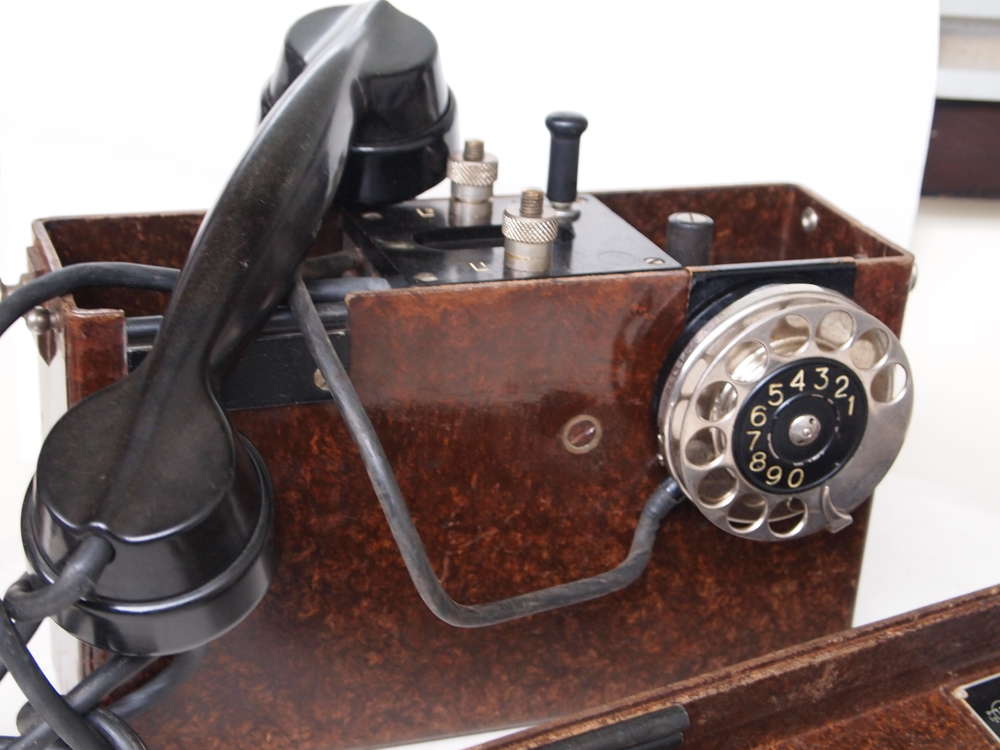
Probably, each of us had a case, then by phone it was necessary to transfer an e-mail or login in Telegram or Skype. And it begins: “Es as a dollar”, “In a Russian like U”, “Ash resembles a high chair”.
After a couple of minutes of this explanation, the majority says: “To hell with it, I will send it in Messenger / SMS”.
')
Just imagine that you have to spell a complicated login with your phone like “viewspymax”.
But if now there is an opportunity not to bother and send SMS or text message in the messenger, then a few decades ago, for some professions, radio was the only means of communication.
Historical background: prerequisites for creating a phonetic alphabet
The invention of the telephone at the end of the 19th century and its wide spreading began a new era in communication between people. After all, the phone allowed to talk to a man who is hundreds of kilometers away.
Unlike telegraph and letters, the telephone transmitted a live voice without losing speed in communication.
But immediately in the process of installation of telephones in major European cities a problem arose.
Using the phone, it was difficult to transmit street names, surnames, or individual letter codes. Similar to the sound of the letter is heard poorly, you can easily confuse the information. For example, the surname Dell easily turns into Bell.There is no such problem in telegraph communication, because all messages are transmitted by letter.
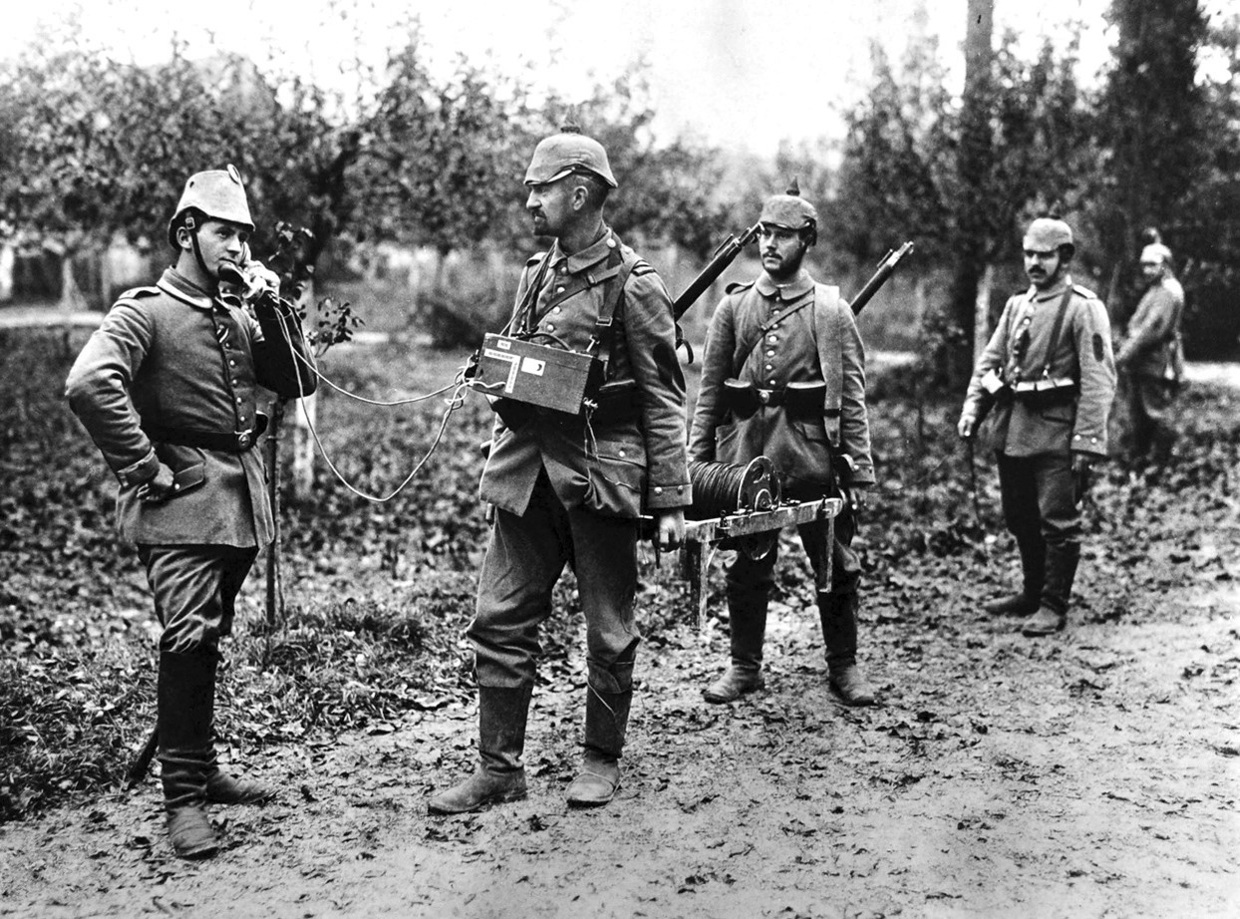
The problem was particularly acute during the First World War, because telephone communications were already actively used not only in headquarters, but also directly in the war zones.
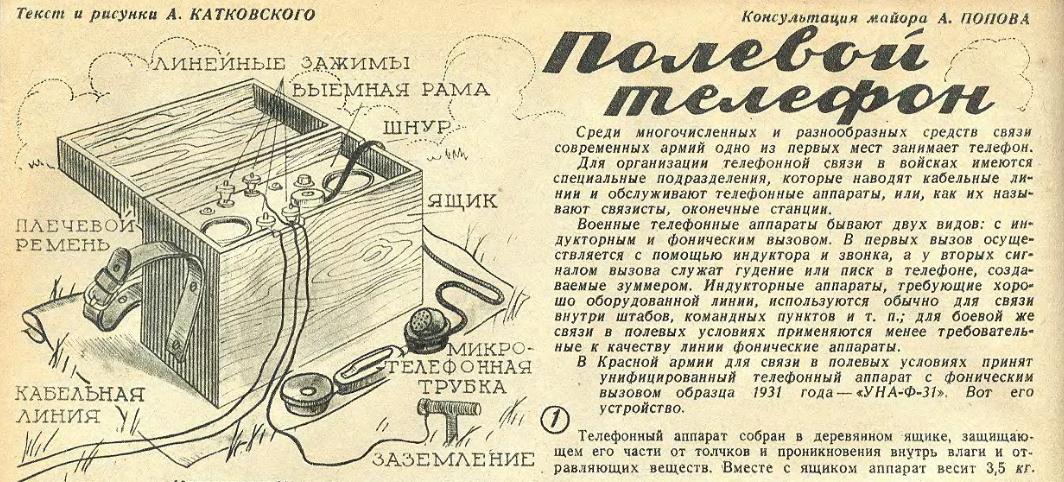
A mistake in military reports could have cost too much, so the British telecommunications operators used their own code language, which is a prototype of the modern phonetic alphabet.
Each individual letter picked up the word-landmark. For example, A - ack, B - beer.Such a system was widely used in all European languages, including Russian. During the First World War, it showed itself from the excellent side - errors in telephone reports were recorded infrequently.
As a result, the letter code turned into a set of several separate words.
For example, the code "BAC-42" will sound like "Beer, ack, Charley, forty two". A little longer, but the probability of an error when listening decreases tenfold.
After the war, with the spread of international telephone communication, another problem appeared - different word markers were settled in different countries. And the pilots of international flights had to ask the dispatchers several times for information.
Phonetic alphabet in English and Russian
A single variation of the phonetic alphabet was approved in 1927. The system was adopted as the official International Civil Aviation Organization and is used today by pilots and controllers.
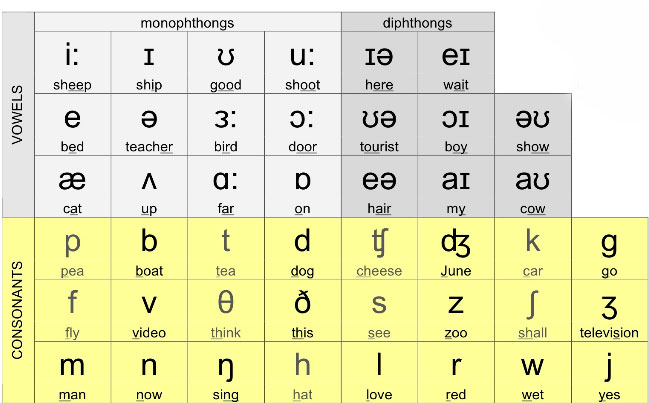
Interesting fact. Sometimes there is confusion with the concept of "phonetic alphabet". After all, exactly the same name is the system of characters for transcription.Later, the phonetic alphabet was refined several times. The words in it were changed to more comfortable ones.
To avoid such situations, the phonetic alphabet as a way of transcription is called the International Phonetic Alphabet, and the unified way of transmitting letters via telephone or radio communication is the ICAO Phonetic Alphabet (less commonly, the NATO phonetic alphabet is used).
The modern phonetic alphabet was approved in 1956. It is still used:
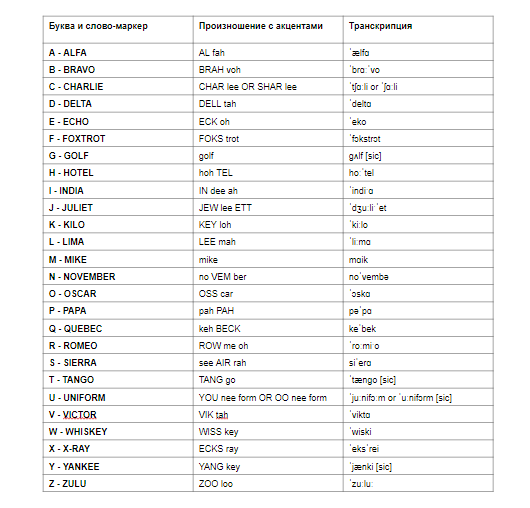
When choosing markers, symbols, experts were guided by several criteria:
- The word should be included in the vocabulary of three world languages: English, French and Spanish. However, it should have the same pronunciation in all these languages.
- The word must be easy to read and pronounce, and it must also be transmitted and perceived without any problems by telephone or radio.
- The favorite word should not have any negative associations and meanings.
In addition to the clarity of pronunciation, the absence of repetitions and identities in syllables among others was also taken into account.
The meaning of the word itself essentially plays a secondary role. Therefore, in the English phonetic alphabet, we see a vinaigrette from female and male names, place names, letters of the Greek alphabet, well-known objects and terms.
But the effectiveness of the system is very high. It allows you to reduce the number of auditory errors by several orders of magnitude.
Additional phonetic alphabet features
In addition to the designation of individual letters using the phonetic alphabet, you can send commands or actions using the so-called alpha codes.
The alpha code is a collection of three letters of the phonetic alphabet. Its value may be well known or vary depending on the operation.One of the most well-known alpha codes are:
- "Romeo Tango Bravo" - returning to base (return to base)
- Romeo Papa Alfa - meeting at base camp (rally at point A)
- Romeo Mike Victor - I request a medical helicopter (request medevac)
- "Hotel Alfa" - move in the indicated direction / move (haul ass!)
- "Hotel Echo" - explosives found (High Explosives)
During military and reconnaissance operations, the decoding of alpha codes is established right before the start of the mission, which provides another level of secrecy, even when the enemy intercepts the signal.
Sometimes alpha codes are used for internal humor on the channel.
For example, Bravo Sierra in English is bullshit. And you can guess the value of Foxtrot Uniform Charlie Kilo yourself.
But that is not all. After all, with the help of the phonetic alphabet, you can transfer direction.
- North - November
- South - Sierra
- West— Whiskey
- East - Echo
If you need, for example, the designation North-West, then everything is simple - November Whiskey. Sounds like a cure for autumn blues.
The ICAO phonetic alphabet also has a unified pronunciation of numbers.

Please note that some numbers here are pronounced differently than in life. There are several reasons, so we will analyze them immediately with examples.
- Four - four, but in the alphabet - fower. The thing is that the word has one syllable, which begins with a deaf consonant. In British English, pronounced [f [®], in American - [f [r]. Even with a little noise in the signal, the receiver may not be able to hear the number and miss it.
- Nine - nine, in the alphabet - niner, with the emphasis on the ending -er. There are several reasons. First, in order to have two syllables in a word, this reduces the chance that it will be missed by mistake. Secondly, it removes the possible phonetic consonance with the word Mike.
A few words about the Russian phonetic alphabet
The international phonetic alphabet is used for designations in Russian - each English word has a Russian letter equivalent. But between Russian-speaking countries and crews use the Russian phonetic alphabet.


As you can see, most of the markers in Russian are names. It is rather a historical peculiarity, because during the First World War the Russians also had a telephone message with the front, and the names were considered the most convenient for encoding - they were widely heard and therefore were well perceived when transmitting information.
After the unification of the phonetic alphabet of ICAO, the Russian version continues to be widely used in the navy and in aviation: both civil and military.
True, if you explain something with the help of the phonetic alphabet to a person who hears about it for the first time, then it can turn out even longer than “Es as a dollar”.
To make the task as simple as possible, it’s just worth explaining each letter. For example, you give the name Mkrtchyan by telephone. In order for the interlocutor to understand everything from the first time, you need to say: “M as Michael, K as Konstantin, R as Roman, T as Tatyana, H as Man, I as Jacob, H as Nikolay” .
If everything is correct, only one Mkrtchyan smiles in the world.
The phonetic alphabet is a salvation for all kinds of dispatchers (from taxis to aviation), secretaries, entrepreneurs and law enforcement officers. In general, for all those for whom a walkie-talkie or telephone is the main working communication tool.
Have you ever explained something with the help of the phonetic alphabet or its spontaneous analogue?
EnglishDom.com - online English learning platform

→ Crank in English on online courses from EnglishDom.com
According to the link - 2 months of premium subscription for all courses as a gift.
→ For live communication - choose individual training via Skype with a teacher.
The first trial lesson is free, register here . The promo code goodhabr2 - 2 lessons as a gift when buying from 10 lessons. The bonus is valid until 05/31/19.
Source: https://habr.com/ru/post/432364/
All Articles