An example of designing a digital device "on the fingers"
Hi, Habr! This is the beginning of a small cycle of two articles with step-by-step design of a digital device with an emphasis on practice. A minimum of "water" and a maximum of practice!

To get started, take the following output parameters: 0000110001110001
')
Note: There are many ways and programs for designing digital devices. Shown in the article may differ from the usual to you. This is normal.
The first step is to create a truth table using the formula

where N is the number of possible options, and i is the number of output signals.
In the present case, it will look like this:

Based on the data obtained, you can proceed to the construction of a truth table. For clarity, the input signals were designated as A, B, C and D, the output as F.
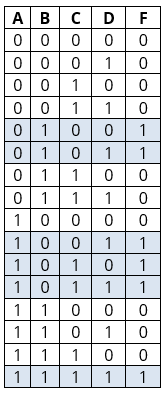
After the construction of the truth table, you can start to get the PDNF. This is done in two steps:
According to the results of the following PDNF:

The resulting PDNF must be reduced using Carnot cards.
Three steps to build Carnot maps:
The result was 4 groups:

The next step is to minimize the resulting groups. The general principle can be summarized as follows:
If 11 - the value does not change;
If 00 - is assigned a negative;
If 01 (or 10) - is deleted.
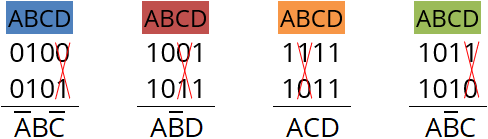
The resulting works are linked into a disjunction:

Then the composed expression is reduced to the basis of AND-NOT using the de Morgan law (the negation of a conjunction is the disjunction of negations, the negation of the disjunction is the conjunction of negations ):

Pay attention to the changes - double negation appeared (one for the “group” and one for the common) and the signs changed.
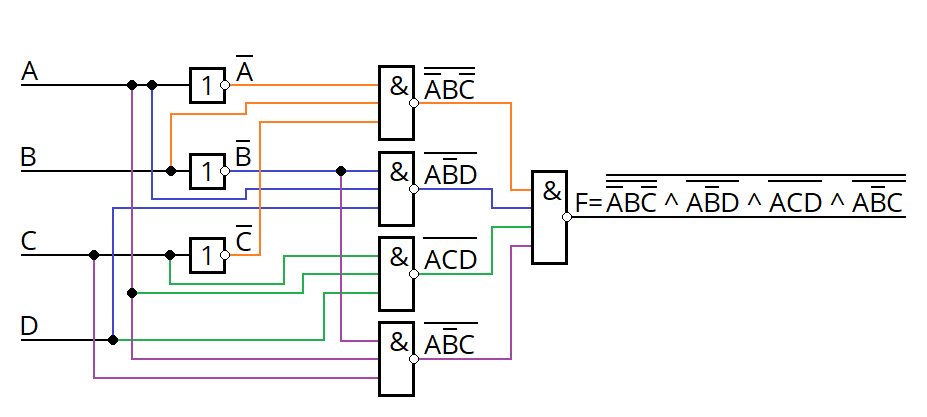
Optionally, you can also make a logical scheme. Why at will? Because further will be the compilation of an electronic circuit based on logic elements, and it, in its essence, is the same logical circuit, but with the ability to test its operability.
An example of a logic circuit:
Basic calculations completed. Now you can postpone a sheet with a pen and a ruler. Go to Electronics Workbench.
In this case, this stage acts as an "intermediate" and simplifies the process of transition from the expression in the basis of NAND to the electronic circuit based on the chips.

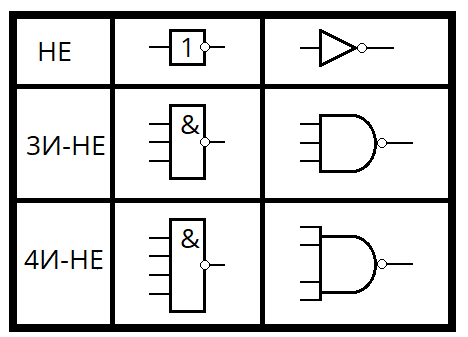
As you can see, the logic elements of the electronic circuit are different in appearance from those that were presented earlier (in the logic circuit). This is due to the fact that in Electronics Workbench the conditional graphic designation of logical elements is made according to ANSI standards, whereas the logic diagram shown earlier was performed in accordance with GOST 2.743-91.
Go ahead.
The operability of the electronic circuit is checked by the truth table. To do this, press the start button.

and start switching, making a comparison with the truth table.
Example:

IMPORTANT: you need to check every line. Custom check will not do anything.
On the basis of the available data, an electronic circuit is built on the basis of microcircuits (it will also be possible to orient according to the obtained circuit during the design of the printed circuit board).
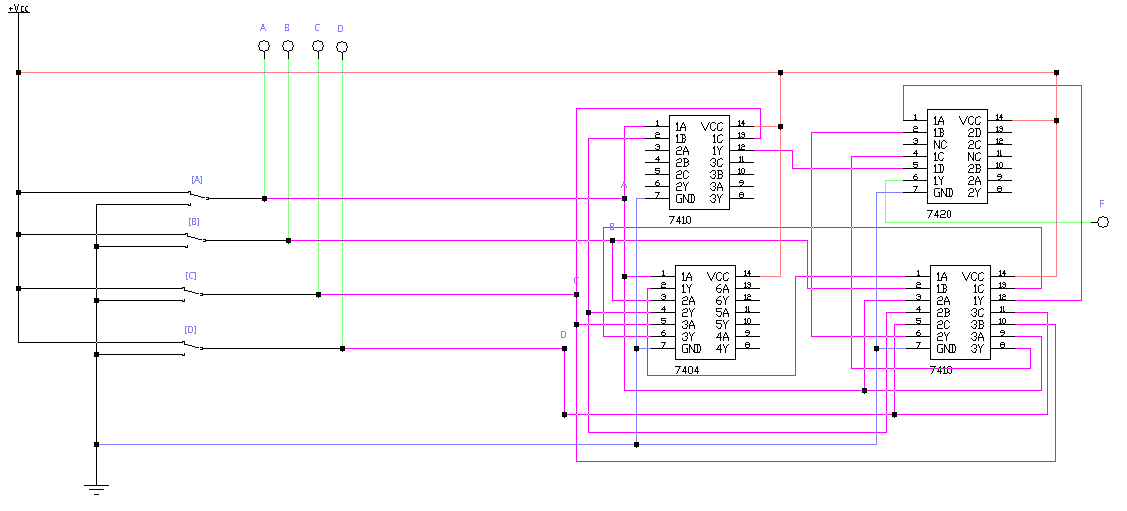
As you can see, in the resulting electronic circuit 4 chips were used - 7404 (analogue K155LN1), 7410 (analogue K155LA4), 7410 (analogue K155LA4) and 7420 (analogue K155LA1). In order to understand how to connect, you should refer to the actual image of the chip.
At first it may seem difficult, but over time you will realize that it is not so difficult.
IMPORTANT : do not forget to do the check.
To get started, take the following output parameters: 0000110001110001
')
Note: There are many ways and programs for designing digital devices. Shown in the article may differ from the usual to you. This is normal.
Tools, materials and more:
- Electronics workbench
- Ruler, pen and sheet (for general calculations)
- Basic knowledge of discrete mathematics, digital circuitry and the principle of the presented programs
- Conditional graphic designation of microcircuits 7404 (analogue K155LN1), 7410 (analogue K155LA4), 7410 (analogue K155LA4) and 7420 (analogue K155LA1)
- The actual image of the chips 7404 (analogue K155LN1), 7410 (analogue K155LA4), 7410 (analogue K155LA4) and 7420 (analogue K155LA1)
Beginning of work
1. Building a truth table and finding the perfect disjunctive normal form (SDNF)
The first step is to create a truth table using the formula
where N is the number of possible options, and i is the number of output signals.
In the present case, it will look like this:
Based on the data obtained, you can proceed to the construction of a truth table. For clarity, the input signals were designated as A, B, C and D, the output as F.
After the construction of the truth table, you can start to get the PDNF. This is done in two steps:
- Highlighted lines of the truth table, in which F = 1.
- The variable conjuncture is written for all selected lines according to the following formula: if the variable value is 1, then the variable itself is included in the conjunction. If the value is 0, then the negation of the variable is included. The resulting conjunctions must be tied into a disjunction.
According to the results of the following PDNF:
More clearly: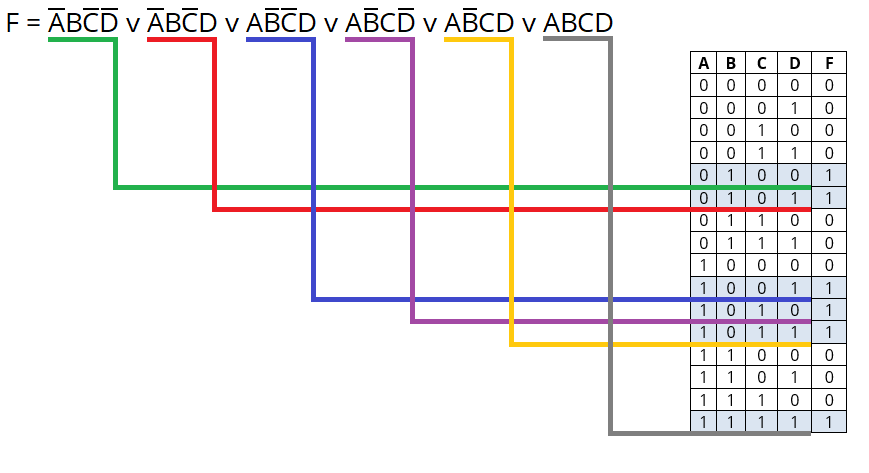
2. Creation of a Carnot map, minimization and reduction to the basis of N-AND
The resulting PDNF must be reduced using Carnot cards.
Three steps to build Carnot maps:
- since four variables are used (A, B, C and D), a table of 5 × 5 cells is constructed;
- the table is filled on the basis of the “coordinates” from the truth table (from the rows in which F = 1) or SDNF (the essence is the same. Just as it is more convenient for someone);
- in conclusion, adjacent cells are combined into groups. Groups must not contain zeros. Groups must be a multiple of two. Groups can intersect.
The result was 4 groups:
More clearly:
The next step is to minimize the resulting groups. The general principle can be summarized as follows:
If 11 - the value does not change;
If 00 - is assigned a negative;
If 01 (or 10) - is deleted.
The resulting works are linked into a disjunction:
Then the composed expression is reduced to the basis of AND-NOT using the de Morgan law (the negation of a conjunction is the disjunction of negations, the negation of the disjunction is the conjunction of negations ):
Pay attention to the changes - double negation appeared (one for the “group” and one for the common) and the signs changed.
Optionally, you can also make a logical scheme. Why at will? Because further will be the compilation of an electronic circuit based on logic elements, and it, in its essence, is the same logical circuit, but with the ability to test its operability.
An example of a logic circuit:
3. Electronic circuit based on logic elements
Basic calculations completed. Now you can postpone a sheet with a pen and a ruler. Go to Electronics Workbench.
In this case, this stage acts as an "intermediate" and simplifies the process of transition from the expression in the basis of NAND to the electronic circuit based on the chips.
More clearly: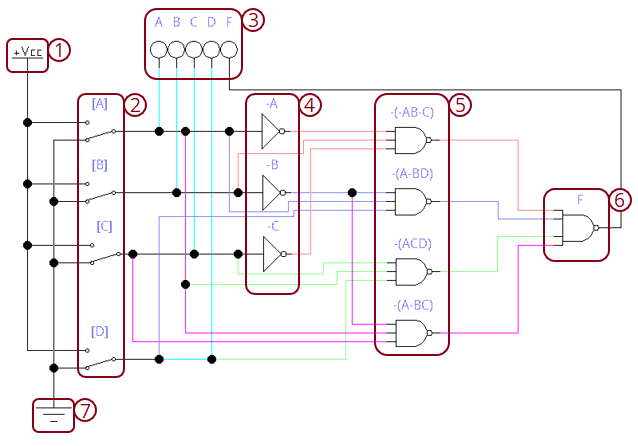
1 - Food;
2 - Switches used for signaling;
3 - Indicators (used for visual verification of performance);
4 - Logic elements such as "NOT";
5 - Logical elements of the type "3I-NOT";
6 - logical element of the type "4I-NOT";
7 - Grounding.
1 - Food;
2 - Switches used for signaling;
3 - Indicators (used for visual verification of performance);
4 - Logic elements such as "NOT";
5 - Logical elements of the type "3I-NOT";
6 - logical element of the type "4I-NOT";
7 - Grounding.
As you can see, the logic elements of the electronic circuit are different in appearance from those that were presented earlier (in the logic circuit). This is due to the fact that in Electronics Workbench the conditional graphic designation of logical elements is made according to ANSI standards, whereas the logic diagram shown earlier was performed in accordance with GOST 2.743-91.
Go ahead.
The operability of the electronic circuit is checked by the truth table. To do this, press the start button.
and start switching, making a comparison with the truth table.
Example:
IMPORTANT: you need to check every line. Custom check will not do anything.
4. Microchip based electronic circuit
On the basis of the available data, an electronic circuit is built on the basis of microcircuits (it will also be possible to orient according to the obtained circuit during the design of the printed circuit board).
As you can see, in the resulting electronic circuit 4 chips were used - 7404 (analogue K155LN1), 7410 (analogue K155LA4), 7410 (analogue K155LA4) and 7420 (analogue K155LA1). In order to understand how to connect, you should refer to the actual image of the chip.
Actual Images:


At first it may seem difficult, but over time you will realize that it is not so difficult.
IMPORTANT : do not forget to do the check.
To be continued...
Source: https://habr.com/ru/post/419601/
All Articles