Problems of designing new photo and video equipment
What powerful corporations with their enormous financial, intellectual and technological capabilities cannot do, one person can do. It seems paradoxical, but if you look backwards at the development of photographic equipment, it turns out that many innovative solutions for that historical period were proposed by photography enthusiasts, and not by a team of professionals.
The creator of the Leica camera, Oscar Barnac, was a self-taught engineer.
Victor Hasselblad was first and foremost an enthusiast, and specialized education helped him in his work. As a teenager, he was passionately fond of photography, constantly sketching his discoveries. Already then it was possible to find interesting solutions for improving cameras in his sketches. Without this experience, there would not have been a glorious start to Hasselblad.
')
Zenzaburo Yoshino, the creator of the Bronica line of cameras, was the developer of photographic equipment only by vocation, but by no means by education and specialty.
None of the above authors did so-called marketing research, they were photographers themselves and were very well aware of what opportunities the camera should have and how it should look. They looked further professionals.
Today is the time of "real professionals." This we hear, see and read in the media. How are the articles headlined? “The Olympiad“ I am a professional ”will become an important social elevator for students”, “In the restaurant business today is the time of professionals”, “Not everything is determined by technology, the main thing is people, real professionals”.
And who are the professionals? These are specialists in narrow areas, constrained by job descriptions and corporate ethics, people who can not cover the picture widely, globally. The head of the marketing department, brand manager, designer, etc., - their activities are very regulated and formalized, the ritual has long since replaced real life. This corporate machine can work successfully if innovative products are not developed.
A little story as professionals from Hasselblad designed the Lunar camera.
Experts from Hasselblad took the mirrorless Sony NEX as the basis for the Lunar. The name Lunar itself must have underlined that the Hasselblad 500 had traveled to the moon and returned to Earth with the astronauts of the Apollo 15 mission in 1971.
According to sources on the Internet, the successful Italian designer Roberto Cavalli (Roberto Cavalli) was invited to create the camera body, which is very strange, because he is a fashion designer, not an industrial one, it’s about the same as if AvtoVAZ asked Valentin Yudashkin make dashboard design.
There is an attempt to create a legend. The basis of the camera is taken Sony NEX-7 and "worn" in another building. In some instances, the Lunar part of the hull was made of precious wood of uniform light wood of beech, pear and mahogany. Was the option of finishing leather or carbon. In a pair of buttons embedded ruby crystals.
It was assumed that the happy owners of Lunar can demonstrate their exquisite taste and belonging to the caste of the elect. Hasselblad brand admirers were invited to become notorious fetishists, because if the price for the Sony NEX – 7 was $ 1,100, then Hasselblad Lunar reached $ 6,500

Sony NEX – 7 Lunar
This approach is possible when creating watches, fashionable things, interior items. But when creating photographic equipment, where functionality and ergonomics come first, design as pure art is unacceptable.
The final of this story in November 2014 Hasselblad closed the Italian design center in Treviso, opened by the company in 2012. The company's specialists have refused to create such clones of Sony cameras as models Lunar, Stellar, Solar and HV.
Ricoh Pentax has a similar story - the creation of the Pentax K-01 camera. It did without wood of precious woods, but the camera body is present as pure art. As a result, terrible ergonomics. The case is thick, does not fit into the hand, there is nothing to grasp, and on the back there is no supporting surface for the thumb.

The Pentax K – 01 was designed by Marc Newson, who designed bicycles, furniture, and even clothing design for the G – Star RAW.
After the failure of this model in the market, Ricoh Pentax experts came to the conclusion that people do not need mirrorless cameras, the company began to develop compact SLR cameras. There was an erroneous interpretation of the event, and the problems with ergonomics preferred not to notice.
In the history there are successful examples of cooperation with designers. For example, the design of the camera Canon T90. Work done by Luigi Colani. Canon T90, introduced in 1986 and further development of the entire Canon product line was based on the Colani bio-design style. Soon, other brands: Nikon, Minolta, Yashica and others began to imitate the style of Colani. You can match the forms of the Canon T90 and the modern Canon 5D camera.

1986 Canon T90 Modern Canon 5D Camera
The process of developing a new product, according to most marketers, consists of eight stages:
- generation of ideas,
- selection of ideas
- development of the concept and its verification,
- development of marketing strategy,
- business analysis
- development of the product itself,
- trial marketing,
- commercial production
Consider only the interpretation of the first paragraph.
“The generation of ideas is a systematic search for ideas about new products. The search for new ideas is mainly based on the internal sources of the organization (in the department of new technology, in the R & D service, in the marketing and sales department, etc.), studying the opinions of consumers, competitors, suppliers and distributors, consulting organizations, exhibitions and various publications, through the use of special methods of generating ideas. "
“Stages of development of a new product” www.managfine.ru/mfines-603-1.html
It seems to be true, there is only one problem, there is simply no one to generate ideas. There are often no people in an organization who are capable of generating new ideas. Why? This is the topic of the whole study, but for now only a fact. It turns out that there are no interesting ideas, accordingly there is no new product and no matter how strong the marketing department is and how big are the budgets.
Speaking of technical creativity, one cannot get around two topics, this is patent law and how innovative decisions are made by society.
Patent law, what function does it perform? It can be assumed that this is the protection of intellectual property, intangible assets. But if we analyze the patented inventions, a large part, which is about 75%, has no practical meaning, and in some patents not working diagrams are cited at all. In reality, an enterprise producing high-tech products is protected not so much by patents as by technological advantage, inaccessible to competitors and established sales channels. I have the impression that the main beneficiaries are patent agencies and patent attorneys. The inventor cannot independently patent the product, because it consists of several patents and requires “international patenting” (patenting in national patent offices), and these are very expensive expenses for the inventor.
The validity of a patent for an invention with a constant payment of fees of 20 years, about as many years, is required for the professional public to recognize technical solutions. Needless to say that the life of the inventor turns into hell. Patent law in the form in which it is today is a brake on technical progress. Without real production, patenting is pointless.
Collective technical creativity was ideologically cultivated in the USSR, innovative solutions were found in numerous design bureaus and a whole team of authors signed up under inventions. Sometimes it was fair, as everyone made a serious contribution to the common cause, and in many cases one person was the author of the key idea, and his name was not in the first lines of the list of co-authors. Often we do not know the real creators.
In the scientific community the same. I will cite examples of headlines from the Internet: “How future professors steal scientific work from students,” “Using administrative resources to seize foreign intellectual property,” “The problem of plagiarism in scientific studies,” “Assigning material resources to other people's intellectual work.” I will not dwell on this, but the phenomenon exists.
Such an attitude to inventors and to creative individuals greatly devalues intellectual work.
“New scientific truth triumphs not because its opponents admit that they are wrong, its opponents simply die out over time, and the younger generation is familiar with it from the very beginning.” (Max Planck). This statement is true for any significant new ideas.
To whom do they apply for the evaluation of a new idea, invention, theory? To the experts, and who can be considered experts, and can they be wrong?
“In 1955, the Ministry of Aviation Industry was commissioned to make a cruise missile for submarines. At the first meeting, the almost unknown young designer Vladimir Chelomey proposed folding the wing of the rocket, and hiding the rocket itself in a container. Against this point, all the leading aircraft designers and rocket men came forward. The elite of the defense industry called the young V. Chelomey an adventurer ”(Film“ Star Wars of Vladimir Chelomey ”). Video General Designers are the best experts. So why were they wrong?
I offer not a stylistic change of the camera body, but to make original developments at the concept level. This comes from dissatisfaction with the existing models of photo and video equipment on the market. There was a technological transition to the "figure", but conceptually in design nothing has changed. What makes a professional? These are Canon and Nikon DSLRs, in form - decisions of the last century. With all the revolutionary electronic fillings, the design looks very archaic, and although we do not ride on cars, repeating the shape of carriages. The design should be created from the functionality of the product, so you do not need to cram innovative content into the old forms.
Why can I do this?
I have the necessary long-term experience of the photographer, I had many models of cameras in my hands, from the simplest to the format camera Sinar P2. Only with the knowledge and experience of the photographer, and of various genres, can one undertake the creation of camera concepts. This is my difference from professional industrial designers. They always work within the framework of the technical task that other specialists have formulated.
I do not need to conduct marketing research. Outwardly, such studies may look very solid and thorough, and in fact contain errors, both at the stage of data collection and at the stage of their interpretation. Since a large number of specialists are involved, the research is turning into a kind of a “spoiled phone” children's game. In other words, the validity of the study is extremely low.
My work as a designer is a necessary experience for the following projects. I made these camera concepts enthusiastically.
Compact mirrorless camera format APC-C.
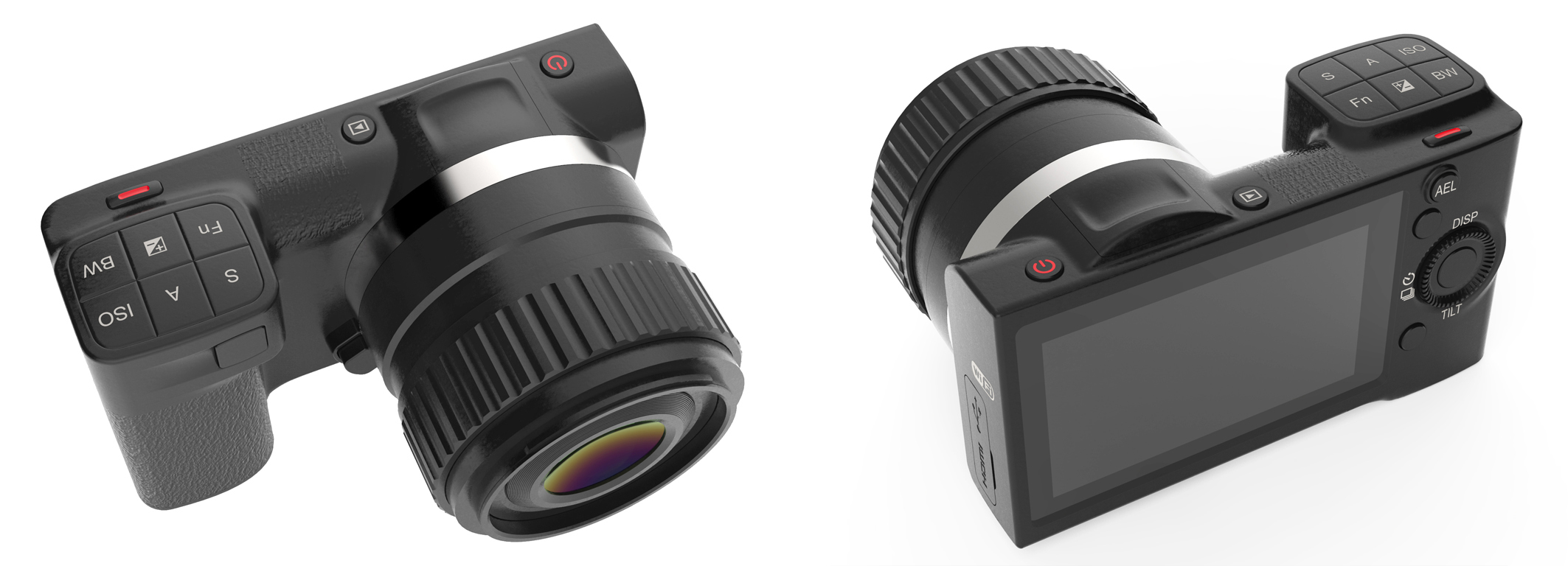
In a compact case, it is difficult to mark the control buttons, and smartphone control through the menu is inconvenient. Need quick access buttons, and to place them on a compact case seemed unreal, I managed to find a clean and simple solution.
Date published 01/18/2013 here . The transition of the form from the lens to the camera body in a modified form was borrowed by Sony at CES 2014, on January 5-10, introduced the Sony Alpha A5000 camera.
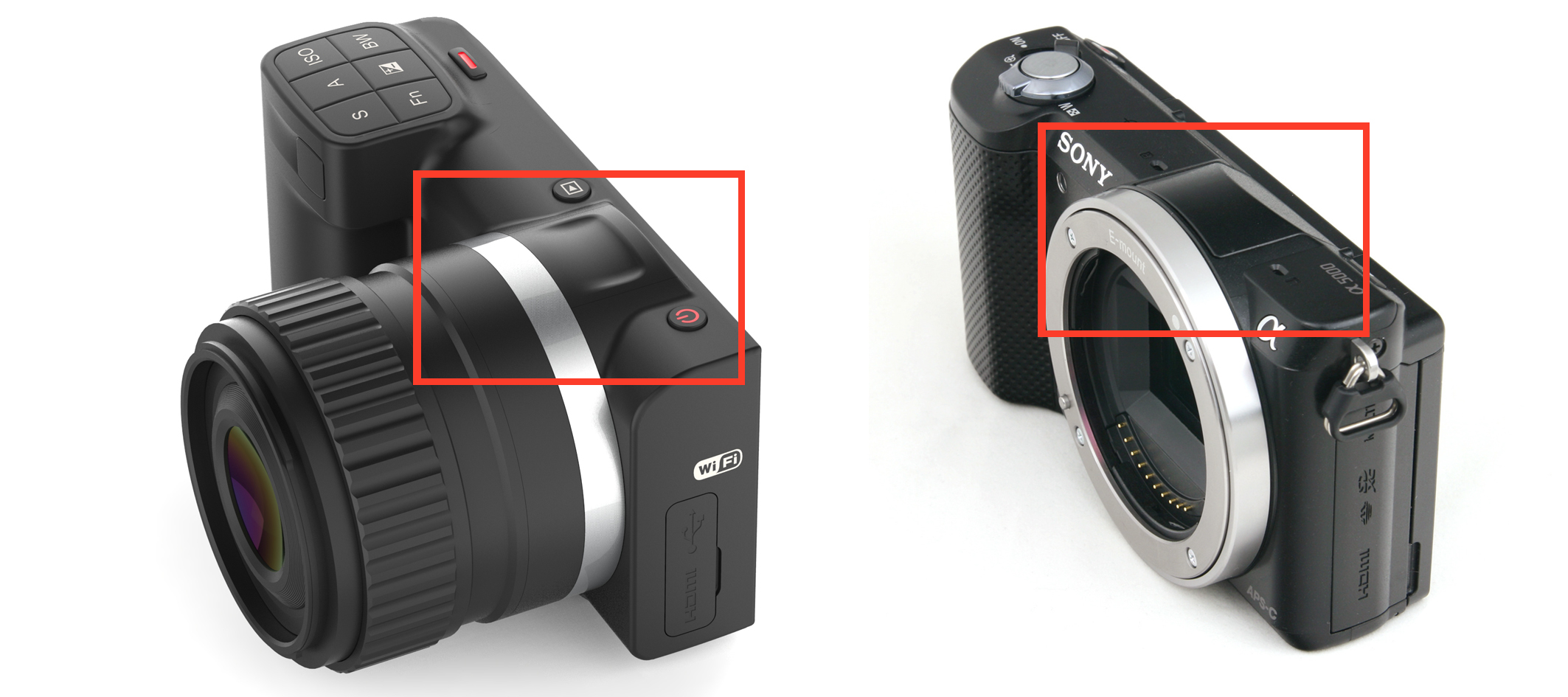
concept camera format APC-C. Sony Alpha A5000
In the same article, a technical solution is proposed - reducing the number of megapixels to produce high-quality images in low light conditions.
I will quote myself - “Night. A camera with a resolution of only 8 megapixels, its advantage is to get clean, with a wide dynamic range of images at light sensitivity up to 6400 ISO, there is an empty niche in the market. ”
This idea was implemented in 2014, the Sony A7s appeared, positioned as the most highly sensitive camera, the Panasonic GH5s camera was introduced at CES 2018, where the same principle is used, increasing the photosensitivity while reducing the number of megapixels.
Mirrorless full frame with tilt function.

Medium format camera concept

In order not to overload the article, I presented only images, in more detail here and here .
The presented works demonstrate the necessary experience for the implementation of the following projects. Today, I have both technical solutions and the design of photo and video equipment. Those decisions that were impossible in the past. This provides functionality for photographers and videographers who were not there before.
PS
I closed the topic, I believe that it is a luxury to engage in inventive activity, it is not possible to realize an individual invention and design solutions. Design and inventions will be ignored at first, and subsequently subjected to indiscriminate criticism and ridicule, as in the history of the inventors have been often. Then, after 15 years, someone picks up these ideas, and that person gets all the laurels. I am totally not attracted by this development of events.
The solutions found will probably never be published, just watching how many years it will take professionals to do something similar. The most difficult thing in design is to find a clean and simple solution with good functionality, it takes years, and copying a ready-made solution is very easy. Initially, I assumed that professionals would reach similar solutions quickly enough, but everything is not so simple. This is hampered by the psychological attitudes of the developers, as well as the general corporate culture, following the most secure marketing strategies.
In most cases, such safe marketing strategies are justified, but there comes a time when you need to do something fundamentally new, and following the same strategies leads to the death of the corporation. For example, the once mighty Kodak corporation, where is it now?
The creator of the Leica camera, Oscar Barnac, was a self-taught engineer.
Victor Hasselblad was first and foremost an enthusiast, and specialized education helped him in his work. As a teenager, he was passionately fond of photography, constantly sketching his discoveries. Already then it was possible to find interesting solutions for improving cameras in his sketches. Without this experience, there would not have been a glorious start to Hasselblad.
')
Zenzaburo Yoshino, the creator of the Bronica line of cameras, was the developer of photographic equipment only by vocation, but by no means by education and specialty.
None of the above authors did so-called marketing research, they were photographers themselves and were very well aware of what opportunities the camera should have and how it should look. They looked further professionals.
Today is the time of "real professionals." This we hear, see and read in the media. How are the articles headlined? “The Olympiad“ I am a professional ”will become an important social elevator for students”, “In the restaurant business today is the time of professionals”, “Not everything is determined by technology, the main thing is people, real professionals”.
And who are the professionals? These are specialists in narrow areas, constrained by job descriptions and corporate ethics, people who can not cover the picture widely, globally. The head of the marketing department, brand manager, designer, etc., - their activities are very regulated and formalized, the ritual has long since replaced real life. This corporate machine can work successfully if innovative products are not developed.
A little story as professionals from Hasselblad designed the Lunar camera.
Experts from Hasselblad took the mirrorless Sony NEX as the basis for the Lunar. The name Lunar itself must have underlined that the Hasselblad 500 had traveled to the moon and returned to Earth with the astronauts of the Apollo 15 mission in 1971.
According to sources on the Internet, the successful Italian designer Roberto Cavalli (Roberto Cavalli) was invited to create the camera body, which is very strange, because he is a fashion designer, not an industrial one, it’s about the same as if AvtoVAZ asked Valentin Yudashkin make dashboard design.
There is an attempt to create a legend. The basis of the camera is taken Sony NEX-7 and "worn" in another building. In some instances, the Lunar part of the hull was made of precious wood of uniform light wood of beech, pear and mahogany. Was the option of finishing leather or carbon. In a pair of buttons embedded ruby crystals.
It was assumed that the happy owners of Lunar can demonstrate their exquisite taste and belonging to the caste of the elect. Hasselblad brand admirers were invited to become notorious fetishists, because if the price for the Sony NEX – 7 was $ 1,100, then Hasselblad Lunar reached $ 6,500
Sony NEX – 7 Lunar
This approach is possible when creating watches, fashionable things, interior items. But when creating photographic equipment, where functionality and ergonomics come first, design as pure art is unacceptable.
The final of this story in November 2014 Hasselblad closed the Italian design center in Treviso, opened by the company in 2012. The company's specialists have refused to create such clones of Sony cameras as models Lunar, Stellar, Solar and HV.
Ricoh Pentax has a similar story - the creation of the Pentax K-01 camera. It did without wood of precious woods, but the camera body is present as pure art. As a result, terrible ergonomics. The case is thick, does not fit into the hand, there is nothing to grasp, and on the back there is no supporting surface for the thumb.
The Pentax K – 01 was designed by Marc Newson, who designed bicycles, furniture, and even clothing design for the G – Star RAW.
After the failure of this model in the market, Ricoh Pentax experts came to the conclusion that people do not need mirrorless cameras, the company began to develop compact SLR cameras. There was an erroneous interpretation of the event, and the problems with ergonomics preferred not to notice.
In the history there are successful examples of cooperation with designers. For example, the design of the camera Canon T90. Work done by Luigi Colani. Canon T90, introduced in 1986 and further development of the entire Canon product line was based on the Colani bio-design style. Soon, other brands: Nikon, Minolta, Yashica and others began to imitate the style of Colani. You can match the forms of the Canon T90 and the modern Canon 5D camera.
1986 Canon T90 Modern Canon 5D Camera
The process of developing a new product, according to most marketers, consists of eight stages:
- generation of ideas,
- selection of ideas
- development of the concept and its verification,
- development of marketing strategy,
- business analysis
- development of the product itself,
- trial marketing,
- commercial production
Consider only the interpretation of the first paragraph.
“The generation of ideas is a systematic search for ideas about new products. The search for new ideas is mainly based on the internal sources of the organization (in the department of new technology, in the R & D service, in the marketing and sales department, etc.), studying the opinions of consumers, competitors, suppliers and distributors, consulting organizations, exhibitions and various publications, through the use of special methods of generating ideas. "
“Stages of development of a new product” www.managfine.ru/mfines-603-1.html
It seems to be true, there is only one problem, there is simply no one to generate ideas. There are often no people in an organization who are capable of generating new ideas. Why? This is the topic of the whole study, but for now only a fact. It turns out that there are no interesting ideas, accordingly there is no new product and no matter how strong the marketing department is and how big are the budgets.
Speaking of technical creativity, one cannot get around two topics, this is patent law and how innovative decisions are made by society.
Patent law, what function does it perform? It can be assumed that this is the protection of intellectual property, intangible assets. But if we analyze the patented inventions, a large part, which is about 75%, has no practical meaning, and in some patents not working diagrams are cited at all. In reality, an enterprise producing high-tech products is protected not so much by patents as by technological advantage, inaccessible to competitors and established sales channels. I have the impression that the main beneficiaries are patent agencies and patent attorneys. The inventor cannot independently patent the product, because it consists of several patents and requires “international patenting” (patenting in national patent offices), and these are very expensive expenses for the inventor.
The validity of a patent for an invention with a constant payment of fees of 20 years, about as many years, is required for the professional public to recognize technical solutions. Needless to say that the life of the inventor turns into hell. Patent law in the form in which it is today is a brake on technical progress. Without real production, patenting is pointless.
Collective technical creativity was ideologically cultivated in the USSR, innovative solutions were found in numerous design bureaus and a whole team of authors signed up under inventions. Sometimes it was fair, as everyone made a serious contribution to the common cause, and in many cases one person was the author of the key idea, and his name was not in the first lines of the list of co-authors. Often we do not know the real creators.
In the scientific community the same. I will cite examples of headlines from the Internet: “How future professors steal scientific work from students,” “Using administrative resources to seize foreign intellectual property,” “The problem of plagiarism in scientific studies,” “Assigning material resources to other people's intellectual work.” I will not dwell on this, but the phenomenon exists.
Such an attitude to inventors and to creative individuals greatly devalues intellectual work.
“New scientific truth triumphs not because its opponents admit that they are wrong, its opponents simply die out over time, and the younger generation is familiar with it from the very beginning.” (Max Planck). This statement is true for any significant new ideas.
To whom do they apply for the evaluation of a new idea, invention, theory? To the experts, and who can be considered experts, and can they be wrong?
“In 1955, the Ministry of Aviation Industry was commissioned to make a cruise missile for submarines. At the first meeting, the almost unknown young designer Vladimir Chelomey proposed folding the wing of the rocket, and hiding the rocket itself in a container. Against this point, all the leading aircraft designers and rocket men came forward. The elite of the defense industry called the young V. Chelomey an adventurer ”(Film“ Star Wars of Vladimir Chelomey ”). Video General Designers are the best experts. So why were they wrong?
I offer not a stylistic change of the camera body, but to make original developments at the concept level. This comes from dissatisfaction with the existing models of photo and video equipment on the market. There was a technological transition to the "figure", but conceptually in design nothing has changed. What makes a professional? These are Canon and Nikon DSLRs, in form - decisions of the last century. With all the revolutionary electronic fillings, the design looks very archaic, and although we do not ride on cars, repeating the shape of carriages. The design should be created from the functionality of the product, so you do not need to cram innovative content into the old forms.
Why can I do this?
I have the necessary long-term experience of the photographer, I had many models of cameras in my hands, from the simplest to the format camera Sinar P2. Only with the knowledge and experience of the photographer, and of various genres, can one undertake the creation of camera concepts. This is my difference from professional industrial designers. They always work within the framework of the technical task that other specialists have formulated.
I do not need to conduct marketing research. Outwardly, such studies may look very solid and thorough, and in fact contain errors, both at the stage of data collection and at the stage of their interpretation. Since a large number of specialists are involved, the research is turning into a kind of a “spoiled phone” children's game. In other words, the validity of the study is extremely low.
My work as a designer is a necessary experience for the following projects. I made these camera concepts enthusiastically.
Compact mirrorless camera format APC-C.
In a compact case, it is difficult to mark the control buttons, and smartphone control through the menu is inconvenient. Need quick access buttons, and to place them on a compact case seemed unreal, I managed to find a clean and simple solution.
Date published 01/18/2013 here . The transition of the form from the lens to the camera body in a modified form was borrowed by Sony at CES 2014, on January 5-10, introduced the Sony Alpha A5000 camera.
concept camera format APC-C. Sony Alpha A5000
In the same article, a technical solution is proposed - reducing the number of megapixels to produce high-quality images in low light conditions.
I will quote myself - “Night. A camera with a resolution of only 8 megapixels, its advantage is to get clean, with a wide dynamic range of images at light sensitivity up to 6400 ISO, there is an empty niche in the market. ”
This idea was implemented in 2014, the Sony A7s appeared, positioned as the most highly sensitive camera, the Panasonic GH5s camera was introduced at CES 2018, where the same principle is used, increasing the photosensitivity while reducing the number of megapixels.
Mirrorless full frame with tilt function.
Medium format camera concept
In order not to overload the article, I presented only images, in more detail here and here .
The presented works demonstrate the necessary experience for the implementation of the following projects. Today, I have both technical solutions and the design of photo and video equipment. Those decisions that were impossible in the past. This provides functionality for photographers and videographers who were not there before.
PS
I closed the topic, I believe that it is a luxury to engage in inventive activity, it is not possible to realize an individual invention and design solutions. Design and inventions will be ignored at first, and subsequently subjected to indiscriminate criticism and ridicule, as in the history of the inventors have been often. Then, after 15 years, someone picks up these ideas, and that person gets all the laurels. I am totally not attracted by this development of events.
The solutions found will probably never be published, just watching how many years it will take professionals to do something similar. The most difficult thing in design is to find a clean and simple solution with good functionality, it takes years, and copying a ready-made solution is very easy. Initially, I assumed that professionals would reach similar solutions quickly enough, but everything is not so simple. This is hampered by the psychological attitudes of the developers, as well as the general corporate culture, following the most secure marketing strategies.
In most cases, such safe marketing strategies are justified, but there comes a time when you need to do something fundamentally new, and following the same strategies leads to the death of the corporation. For example, the once mighty Kodak corporation, where is it now?
Source: https://habr.com/ru/post/410751/
All Articles