How to change the use of visualization in the design in the era of virtual and augmented reality
Part 1. Visualization in design

Product development has changed over the past few years. With the spread of crowdfunding, there was a surge in start-up projects, the Internet of Things required to take into account the ability to connect to the global network in product development in all areas, and even the old guard - major manufacturers - is looking for ways to exploit network connectivity and mass customization.
At the same time, the product development environment itself has changed significantly. Of course, the key factor is still the time to launch a product on the market (especially in the field of consumer electronics), but today any organization is also faced with the issue of shortening the development cycle.
')
In addition to this, consumer requirements for purchased products are growing: for their money, they want to get more customization options, a wide range and high reliability. This is manifested in all areas - from the automotive industry to industrial automation and medicine.
Market Shift and Tool Changes
The shift also occurs in the product development tools. Developers and engineers are no longer limited to two-dimensional design tools: three-dimensional design is already an established standard.
With the proliferation of three-dimensional design tools, the benefits of using a basic three-dimensional model created during the development process to solve related problems have expanded. We are talking, for example, about modeling the operation of a product under real loads, prototyping and, of course, visualizing the exterior of the product.
In particular, the visualization has gone beyond the usual circle of users in the areas of industrial design and product design. Today, the majority of users of three-dimensional CAD in some way apply visualization and rendering in the design process.
This is mainly due to the need to minimize the number of physical prototypes and save time. Where the final form of the product was usually impossible to see before creating the first prototypes, using photo-realistic visualization technologies, anyone involved in the decision-making process can see and evaluate the appearance of a future product long before industrial designs become available.
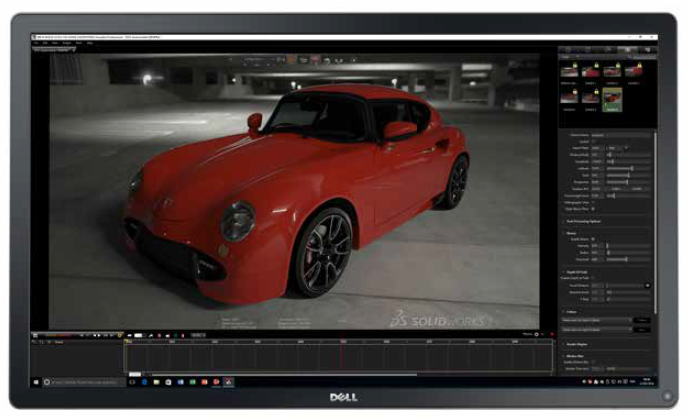
The SOLIDWORKS Visualize system from Dassault uses a hybrid rendering technology, making it very well suited for both reviewing design solutions and creating high-resolution resources (image provided by Dassault Systèmes).
Systems such as Autodesk’s VRED, 3DS Max and Maya, Luxion’s KeyShot, Chaos Group’s VRAY, Dassault Systèmes’s 3DExcite and CATIA’s Live Render have become the mainstay of the visualization industry. These systems can be combined into one category under the heading "Visualization with the help of the central processor". They use the computational capabilities of the Intel processor to perform computations and instantly display changes in the scene being processed. Xeon. Installed in the workstation.
After entering the data on geometry, light and materials, the system proceeds to the calculation of the final result and displays it.
Physically correct rendering (PBR)
Progress in the field of computing, which has been observed in recent years at the level of central and graphic processors, has led to another shift in the visualization mechanism. This shift is due to the spread of physically correct rendering (PBR).
Now, in the process of rendering the scene, users do not need to wait for the completion of the calculations to see the final result, since the results are displayed on the screen directly during rendering, and almost immediately you can see how the final product will look like.
PBR systems are most effective when building scenes. They use HDR images (images with high dynamic range) as the basic component of illumination, so users can concentrate on setting up the scene and getting the right result, without being distracted by creating lighting and building the scene. In addition, materials are usually more realistic, and some modern systems support the use of simulated materials obtained from real samples.
In the past, the creation of a photorealistic image was more creative than technical, but thanks to modern advances, it is quite possible for specialists to do this without the skills of working with visualization tools. Now they can create quite realistic images using real physical parameters as opposed to the artistic approach, which uses approximate correspondences.
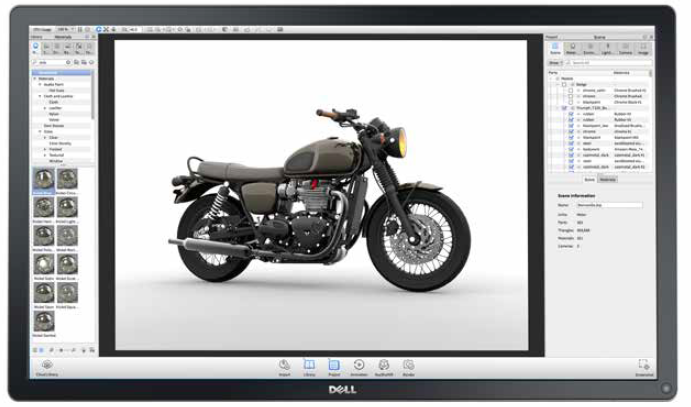
Luxion's Keyshot system combines rendering based on physical parameters and high-level links with the geometry used by CAD systems, so late-stage project change processing is fast.
This significantly reduces the computational cycle, so that creating a scene, finalizing and finalizing the scene takes much less time. Accelerating the process gives a number of advantages over the traditional physical model or prototype and combining several photographs. The decision on a product can be made faster and based on a much wider set of models and options, since now it takes only a few minutes to create them. To determine the most appropriate options, you can experiment with color schemes, materials and shapes without the need to create physical models.
In addition, you can create marketing materials and use them in advertising and in the process of developing product packaging long before the actual production begins. This is not only faster, but also a cheaper way, since it does not require the involvement of specialists to create an expensive prototype of the product and arrange long-term photography.
The development of graphics processors
In the recent past, the search began for possibilities of using graphics processors (graphics cards) to speed up rendering. If rendering with the help of a central processor is performed as an everyday task, there is a possibility that it will occupy all the system resources. However, the graphics processor transfers this load to a special-purpose chipset. Today, different manufacturers present new solutions in this area.
Recently, there has also been the emergence of new rendering technologies being developed by the largest suppliers of graphics cards. NVIDIA has developed its own IRAY technology, which is available as a standalone plug-in for Rhino or integrated into SOLIDWORKS Visualize and 3DS Max.

Conclusion
Ways of visualization and rendering in many companies have become an integral part of the product development process and have gone far beyond the usual areas of industrial design and product design.
Now users can easily import geometry, set lighting parameters, add materials, perform rework and create photorealistic images. This greatly facilitates the development of resources of primary importance for beginners and provides additional opportunities for experienced users. The prerequisite for this shift is the intensive integration and expansion of the processing power of the central processor, the creation of specialized graphics processors and the development of intelligent software.
Over time, however, new technologies will appear, with the help of which users will be able to go beyond the two-dimensional, flat images and animations. The revival of interest in hardware for virtual and augmented reality with a significant reduction in its value means that resources will become more interactive and provide a previously unattainable effect of presence. The following publications in our blog will be devoted to this.
Product development has changed over the past few years. With the spread of crowdfunding, there was a surge in start-up projects, the Internet of Things required to take into account the ability to connect to the global network in product development in all areas, and even the old guard - major manufacturers - is looking for ways to exploit network connectivity and mass customization.
At the same time, the product development environment itself has changed significantly. Of course, the key factor is still the time to launch a product on the market (especially in the field of consumer electronics), but today any organization is also faced with the issue of shortening the development cycle.
')
In addition to this, consumer requirements for purchased products are growing: for their money, they want to get more customization options, a wide range and high reliability. This is manifested in all areas - from the automotive industry to industrial automation and medicine.
Market Shift and Tool Changes
The shift also occurs in the product development tools. Developers and engineers are no longer limited to two-dimensional design tools: three-dimensional design is already an established standard.
With the proliferation of three-dimensional design tools, the benefits of using a basic three-dimensional model created during the development process to solve related problems have expanded. We are talking, for example, about modeling the operation of a product under real loads, prototyping and, of course, visualizing the exterior of the product.
In particular, the visualization has gone beyond the usual circle of users in the areas of industrial design and product design. Today, the majority of users of three-dimensional CAD in some way apply visualization and rendering in the design process.
This is mainly due to the need to minimize the number of physical prototypes and save time. Where the final form of the product was usually impossible to see before creating the first prototypes, using photo-realistic visualization technologies, anyone involved in the decision-making process can see and evaluate the appearance of a future product long before industrial designs become available.
The SOLIDWORKS Visualize system from Dassault uses a hybrid rendering technology, making it very well suited for both reviewing design solutions and creating high-resolution resources (image provided by Dassault Systèmes).
Systems such as Autodesk’s VRED, 3DS Max and Maya, Luxion’s KeyShot, Chaos Group’s VRAY, Dassault Systèmes’s 3DExcite and CATIA’s Live Render have become the mainstay of the visualization industry. These systems can be combined into one category under the heading "Visualization with the help of the central processor". They use the computational capabilities of the Intel processor to perform computations and instantly display changes in the scene being processed. Xeon. Installed in the workstation.
After entering the data on geometry, light and materials, the system proceeds to the calculation of the final result and displays it.
SOLIDWORKS Visualize
The Dassault Systèmes SOLIDWORKS Visualize program has recently entered the market of rendering systems. This program is based on IRAY technology, developed by NVIDIA, and offers a rich set of useful tools for product rendering (both image and animation), concept evaluation and creation of marketing materials at the stage preceding the start of production. The initial developer of the program is Bunkspeed (acquired by RTT, which two years ago took possession of Dassault Systèmes itself).
After changing the layout, the product became available to all current SOLIDWORKS customers. The system can simultaneously take advantage of calculated visualization and scenes with full ray tracing, which allows you to create highly efficient resources and use one system both for reviewing design decisions and for presentations to Management.
Physically correct rendering (PBR)
Progress in the field of computing, which has been observed in recent years at the level of central and graphic processors, has led to another shift in the visualization mechanism. This shift is due to the spread of physically correct rendering (PBR).
Now, in the process of rendering the scene, users do not need to wait for the completion of the calculations to see the final result, since the results are displayed on the screen directly during rendering, and almost immediately you can see how the final product will look like.
PBR systems are most effective when building scenes. They use HDR images (images with high dynamic range) as the basic component of illumination, so users can concentrate on setting up the scene and getting the right result, without being distracted by creating lighting and building the scene. In addition, materials are usually more realistic, and some modern systems support the use of simulated materials obtained from real samples.
In the past, the creation of a photorealistic image was more creative than technical, but thanks to modern advances, it is quite possible for specialists to do this without the skills of working with visualization tools. Now they can create quite realistic images using real physical parameters as opposed to the artistic approach, which uses approximate correspondences.
Luxion's Keyshot system combines rendering based on physical parameters and high-level links with the geometry used by CAD systems, so late-stage project change processing is fast.
This significantly reduces the computational cycle, so that creating a scene, finalizing and finalizing the scene takes much less time. Accelerating the process gives a number of advantages over the traditional physical model or prototype and combining several photographs. The decision on a product can be made faster and based on a much wider set of models and options, since now it takes only a few minutes to create them. To determine the most appropriate options, you can experiment with color schemes, materials and shapes without the need to create physical models.
In addition, you can create marketing materials and use them in advertising and in the process of developing product packaging long before the actual production begins. This is not only faster, but also a cheaper way, since it does not require the involvement of specialists to create an expensive prototype of the product and arrange long-term photography.
Interactive Configurators
In addition to the modular design, one of the most important ways to differentiate today is the production of individual orders, so many companies strive to give their customers the opportunity to select and customize the configuration of their products on the Internet. In this case, photo-realistic images increase the degree of trust, since the client can not only study the product characteristics according to his requirements, but also see how the selected configuration will look after the delivery of goods.
Of course, this necessitates the creation of resources for the visualization of each possible combination in the family of one product, which, in the absence of sufficient means for rendering, can become a deterrent.
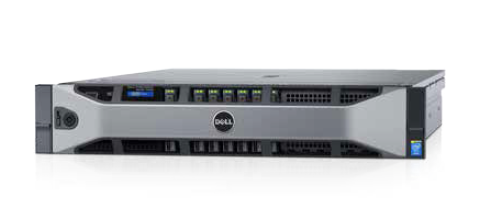
This is where rack systems come to the rescue, such as the Dell Precision Rack 7000 system equipped with an Intel Xeon processor. These systems can be integrated in parallel with the web servers used for the automation and computational capabilities required to create and integrate photo-realistic images of each individual product version, as well as other required resources (for volumetric models with circular rotation), which will provide complete interaction and realistic demonstration.
The development of graphics processors
In the recent past, the search began for possibilities of using graphics processors (graphics cards) to speed up rendering. If rendering with the help of a central processor is performed as an everyday task, there is a possibility that it will occupy all the system resources. However, the graphics processor transfers this load to a special-purpose chipset. Today, different manufacturers present new solutions in this area.
Recently, there has also been the emergence of new rendering technologies being developed by the largest suppliers of graphics cards. NVIDIA has developed its own IRAY technology, which is available as a standalone plug-in for Rhino or integrated into SOLIDWORKS Visualize and 3DS Max.
Conclusion
Ways of visualization and rendering in many companies have become an integral part of the product development process and have gone far beyond the usual areas of industrial design and product design.
Now users can easily import geometry, set lighting parameters, add materials, perform rework and create photorealistic images. This greatly facilitates the development of resources of primary importance for beginners and provides additional opportunities for experienced users. The prerequisite for this shift is the intensive integration and expansion of the processing power of the central processor, the creation of specialized graphics processors and the development of intelligent software.
Over time, however, new technologies will appear, with the help of which users will be able to go beyond the two-dimensional, flat images and animations. The revival of interest in hardware for virtual and augmented reality with a significant reduction in its value means that resources will become more interactive and provide a previously unattainable effect of presence. The following publications in our blog will be devoted to this.
Source: https://habr.com/ru/post/397625/
All Articles