For the first time registered gravitational waves: now officially
Today, at a special press conference, scientists of the LVC International Collaboration (LIGO) announced the first direct detection of gravitational waves from the confluence of two black holes with 5.1σ accuracy.
UPD Press Conference Record - Historical video now. By the way, perfectly explain what's what. He also added more links to materials to the end of the article.
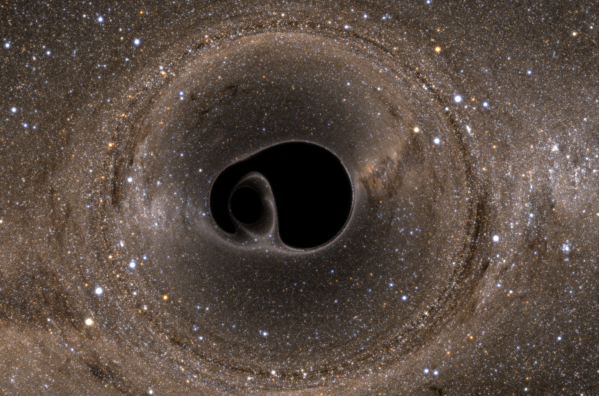
Image Credit: Bohn, Throwe, Hebert, Henriksson, Bunandar, Taylor, Scheel (see www.black-holes.org/lensing )
')
September 14, 2015 at 09:50:45 UTC, two LIGO detectors (located in the USA) simultaneously observed the gravitational wave signal GW150914. The signal with increasing frequency from 35 Hz to 250 Hz and the amplitude of the metric strain in 1x10 -21 . The signal corresponds to the predictions of the General Theory of Relativity (GTR) to merge two black holes with masses of 36 and 29 solar.
What is even more interesting, for the first time, this discovery makes it possible to say with confidence about the existence of black hole systems, and to characterize the dynamics of the black hole system from the standpoint of general relativity.
The research results are published today in Physical Review Letters.
Since the prediction of the existence of gravitational waves by Einstein in 1916, there have been many attempts to observe them. From the mid-seventies, work was carried out on solid-state detectors (Weber) - it was assumed that massive pieces of metal would resonate with gravitational waves, and a change in the length of these masses can be registered with quite sensitive instruments. However, this direction was not promising - too much noise did not allow to achieve the necessary sensitivity. Since the 70s, interferometric detectors began to develop.
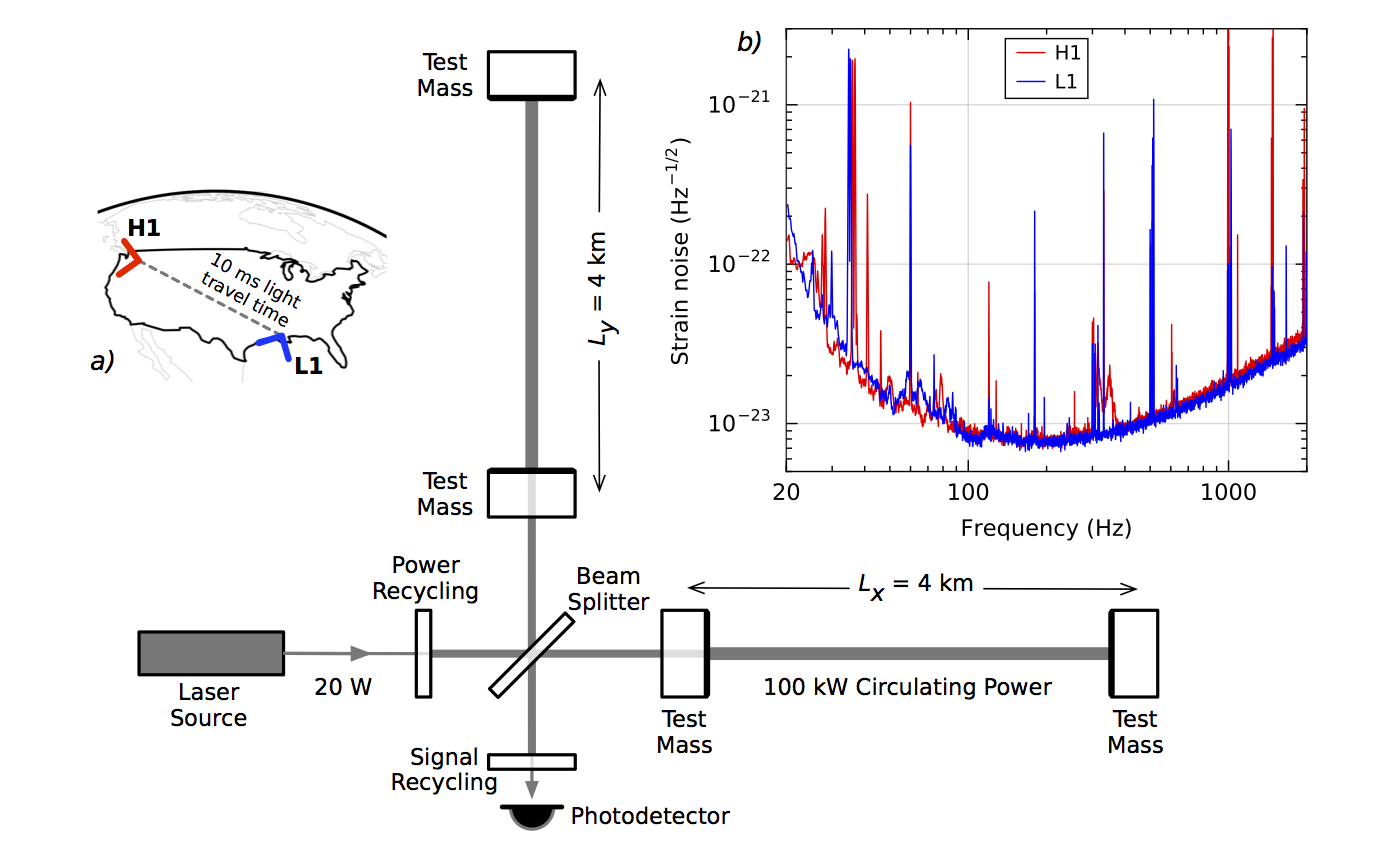
The gravitational wave changes the distance between the moving final mirrors of the interferometer, as a result of which a change in the interference pattern at the detector output is observed. To increase the sensitivity of this detector to the distance between the mirrors, the arms of the interferometer reach a length of 4 km, the optical power on the mirrors is 100 kW, and the mirrors themselves weighing 40 kg are fixed on high-quality (Q ~ 10 7 ) suspensions and equipped with an additional system of isolation from seismic noise.

In the USA, there are two identical detectors at a considerable distance from each other, which allows independent observation and then correlate the results to eliminate local noise and spurious signals. In addition, the presence of two (or more) detectors helps to triangulate the signal to determine the position in the sky.
At the beginning of September 2015, both detectors completed the multi-year update procedure and were fully operational at the time of detection.
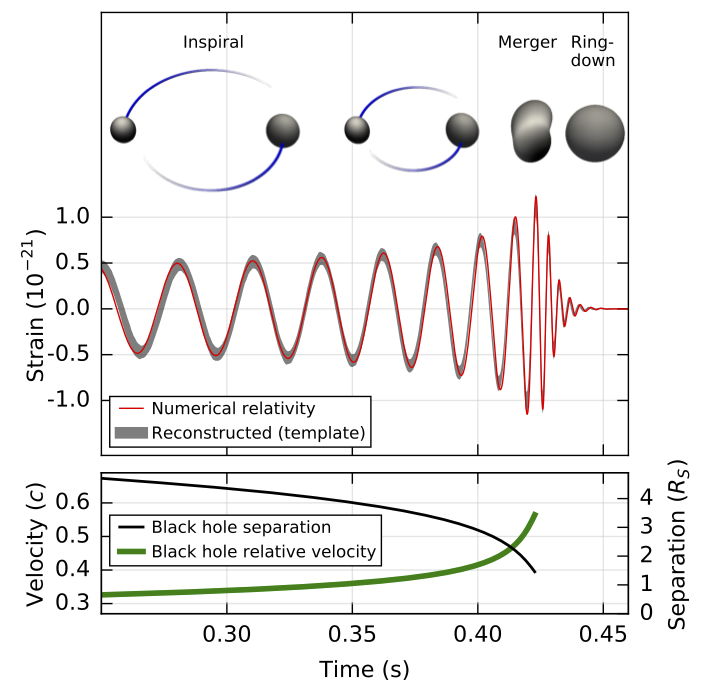
The signal detected by the detectors coincides with the predictions of GR for merging two black holes. For 0.2 seconds, two black holes rotating around each other converged due to the loss of rotational energy due to gravitational radiation and merged into one black hole. However, the total mass of this new black hole turned out to be 3 solar masses less than the sum of two old ones - the energy was radiated in gravitational waves.
Initially, two holes were extremely close to each other - at a distance of 350 km (despite the fact that the Schwarzschild radius for them is about 210 km). The distance (photometric) to the source is estimated at 410 Megaparsecs.
The signal was detected with very high confidence: a signal-to-noise ratio of 24 and a confidence of 5.1σ (corresponding to one false signal of 203,000 years).
Many checks were carried out on both the false signal and intentional injection. All of them showed a negative result.
Scientists continue to investigate the event, and more results from both data analysis and GR checks will be presented soon. On this page you can find detailed information about the event and other research results.
The gravitational-wave detector itself will be further improved, which will allow more events to be detected. An increase in sensitivity is expected several times more. At the same time, Advanced VIRGO detectors in Italy and KAGRA in Japan will soon begin work, and scientists are already planning to build new detectors for the development of gravitational-wave astronomy: ten-kilometer Einstein Telescope in Europe and the LISA space telescope with an interferometer length of 5 million kilometers.
In conclusion, add a couple of links and a good film about LIGO.
UPD Press Conference Record - Historical video now. By the way, perfectly explain what's what. He also added more links to materials to the end of the article.
Image Credit: Bohn, Throwe, Hebert, Henriksson, Bunandar, Taylor, Scheel (see www.black-holes.org/lensing )
')
September 14, 2015 at 09:50:45 UTC, two LIGO detectors (located in the USA) simultaneously observed the gravitational wave signal GW150914. The signal with increasing frequency from 35 Hz to 250 Hz and the amplitude of the metric strain in 1x10 -21 . The signal corresponds to the predictions of the General Theory of Relativity (GTR) to merge two black holes with masses of 36 and 29 solar.
What is even more interesting, for the first time, this discovery makes it possible to say with confidence about the existence of black hole systems, and to characterize the dynamics of the black hole system from the standpoint of general relativity.
The research results are published today in Physical Review Letters.
As detected
Since the prediction of the existence of gravitational waves by Einstein in 1916, there have been many attempts to observe them. From the mid-seventies, work was carried out on solid-state detectors (Weber) - it was assumed that massive pieces of metal would resonate with gravitational waves, and a change in the length of these masses can be registered with quite sensitive instruments. However, this direction was not promising - too much noise did not allow to achieve the necessary sensitivity. Since the 70s, interferometric detectors began to develop.
The gravitational wave changes the distance between the moving final mirrors of the interferometer, as a result of which a change in the interference pattern at the detector output is observed. To increase the sensitivity of this detector to the distance between the mirrors, the arms of the interferometer reach a length of 4 km, the optical power on the mirrors is 100 kW, and the mirrors themselves weighing 40 kg are fixed on high-quality (Q ~ 10 7 ) suspensions and equipped with an additional system of isolation from seismic noise.
In the USA, there are two identical detectors at a considerable distance from each other, which allows independent observation and then correlate the results to eliminate local noise and spurious signals. In addition, the presence of two (or more) detectors helps to triangulate the signal to determine the position in the sky.
At the beginning of September 2015, both detectors completed the multi-year update procedure and were fully operational at the time of detection.
What is detected
The signal detected by the detectors coincides with the predictions of GR for merging two black holes. For 0.2 seconds, two black holes rotating around each other converged due to the loss of rotational energy due to gravitational radiation and merged into one black hole. However, the total mass of this new black hole turned out to be 3 solar masses less than the sum of two old ones - the energy was radiated in gravitational waves.
Black Hole Fusion Simulation
Initially, two holes were extremely close to each other - at a distance of 350 km (despite the fact that the Schwarzschild radius for them is about 210 km). The distance (photometric) to the source is estimated at 410 Megaparsecs.
The signal was detected with very high confidence: a signal-to-noise ratio of 24 and a confidence of 5.1σ (corresponding to one false signal of 203,000 years).
Many checks were carried out on both the false signal and intentional injection. All of them showed a negative result.
What will happen next?
Scientists continue to investigate the event, and more results from both data analysis and GR checks will be presented soon. On this page you can find detailed information about the event and other research results.
The gravitational-wave detector itself will be further improved, which will allow more events to be detected. An increase in sensitivity is expected several times more. At the same time, Advanced VIRGO detectors in Italy and KAGRA in Japan will soon begin work, and scientists are already planning to build new detectors for the development of gravitational-wave astronomy: ten-kilometer Einstein Telescope in Europe and the LISA space telescope with an interferometer length of 5 million kilometers.
In conclusion, add a couple of links and a good film about LIGO.
Source: https://habr.com/ru/post/390457/
All Articles