Soviet cash register A1T-4-400-2
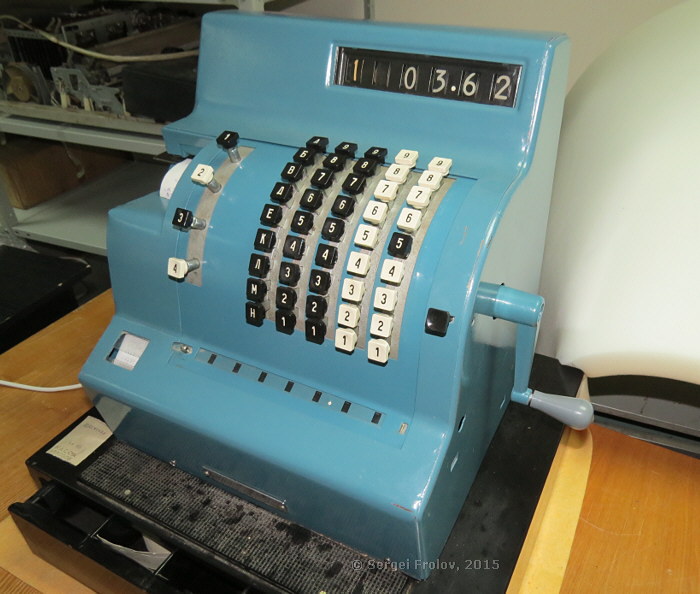
This article is devoted to the 1979 Soviet cash register A1T-4-400-2.
Such cash registers stood in almost all stores in the sixties and seventies of the last century. Below I will try to tell how these machines worked.
First of all - the handle on the right. All cash registers, since their invention in the 19th century, were operated by such a pen. This machine can also be controlled by a handle. To perform one action on knocking out a check, you must turn the handle twice (make two turns).
But 1979 was quite advanced, there was enough electricity, and an electric motor was installed in this cash register. The pen was "in case." In later cash registers of the type “OKA-4401” there was also a pen, the apparatus could also be started from it, but the guide already wrote that the pen was needed only for repairs and adjustments by the craftsmen.
')
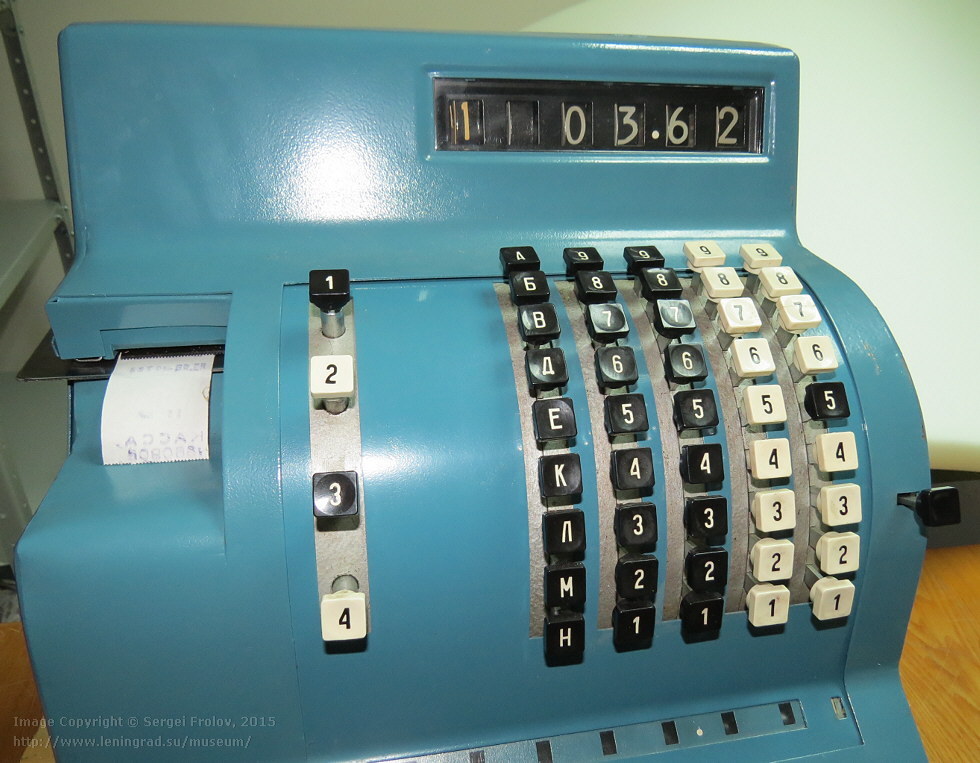
People often ask me: “Why do we need so many buttons?”. Everyone has become accustomed to modern calculators with ten numbers on the keyboard. It seems comfortable and natural. In those days, such a multi-key keyboard was also quite comfortable and natural. The fact is that each digit was supposed to be in a row with numbers. And the numbers are from 1 to 9, but there is no zero. To enter a price of 3 rubles 62 kopecks, you must skip the leftmost row of numbers (we don’t have tens of rubles), press the next 3 in the next row, 6 in the next and 2 in the rightmost. Buttons snap into place as you enter. To cancel the input there is a reset button (on the right).
Rows for convenience are made in different colors. This input method allows you to quickly check the correctness of input, is easily implemented, eliminates the chattering suppression schemes (one digit is not introduced from poor contact many times in a row) and other difficulties.
On the left there is a tricky row with letters ABCD EKLMN. The so-called "conventional signs". This was intended to protect against counterfeit, but I really do not remember that it was widely used. The trick is that for some groups of goods (for example, with a high price), store employees agreed that all checks punched today will be marked with the letter “E”. If the seller is brought a check with another letter, this will lead to additional questions. EKLMN I separated by a space. There was such a joking curse. Why I think about such an order of letters (to exclude characters that can be turned into others), but I don’t know whether these letters are connected with the etymology of the censorship curse word “Öklmn”.
Well, the numbers of departments. Such cash machines allowed to beat out checks in four departments. For example, in meat, fish, groceries and vegetables-fruits. When you click on the number of the department, the cash desk was launched and the check got out.

This is a window for the control tape. All operations for stamping a check are duplicated on a control tape. In the event of some kind of malfunction (revenue counters, breaks, etc.), it was possible to recover revenue from the control tape and check operations.

Behind the buyer displayed the amount of the check. The cashier also displayed the department number and code symbol.

Schild The device, as I said, was made in 1979. At that time, electronic cash machines of the “Electronics 302” type were already in use, were included in the popularity of OKA-4401, and these were produced for some time. Pay attention to the six-digit serial number.
In the name of the car A1T-4-400-2 functionality is encoded:
A1 - model name
T - for trade (there were also P for restaurants, they differed in that instead of buttons on the numbers of the department keys were set - their own for each waiter)
4 - the number of departments
3 or 4 - the number of rows for the amounts entered (3 if you do not need to beat tens of rubles)
0 - the number of keys (4 - for the restaurant model)
0 - the number of operational counters (in this model, one check for one purchase, there are no counters)
2 - design
“MADE IN THE USSR” implies that the device was prepared for export. Below on the box sheet will be confirming the inscription "Export". I do not know exactly where such devices were exported. In the GDR for sure. I have instructions in German.

And this is a check. Usually the store was one or two cash registers for the entire hall.
Shopping took place as follows:
- if the price is known in advance, then just getting a check in the right department and with this check the goods were bought.
- and if the price is unknown (for example, it is necessary to weigh three hundred grams of sausage), then the product is first weighed (plus or minus some gram to one piece). The seller wrapped the sausage in paper, wrote the amount on it with a pencil, the buyer went to the cashier and made a check for that amount.
The check shows the amount. Instead of zero, they put crosses - protection against corrections. Next side is the department number and the current check number.
In the middle there is a date, and below is the number of the cash register or some customized logo.
So, in short, there was a work with the cash register. And now the tool and the insides.
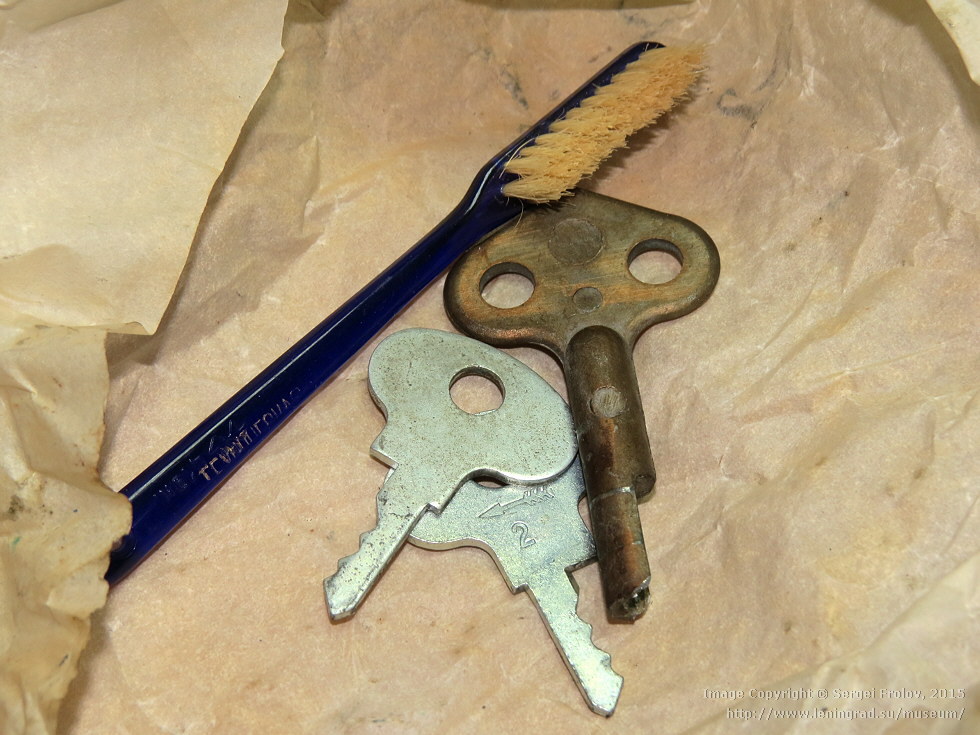
Several keys were attached to the cash register machine. One key to turn on cash and work. One key for taking meter readings (usually from a senior cashier). And one key to reset the counters. The kit included a bottle of paint and a brush for wiping fonts.
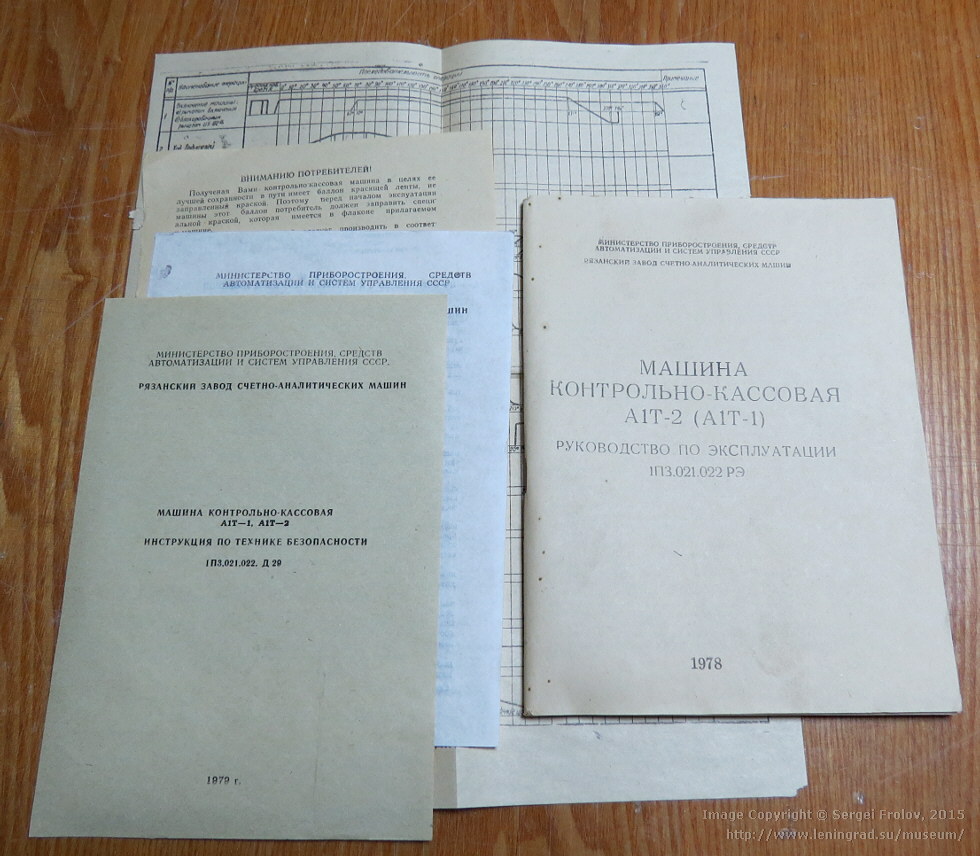
A set of instructions.
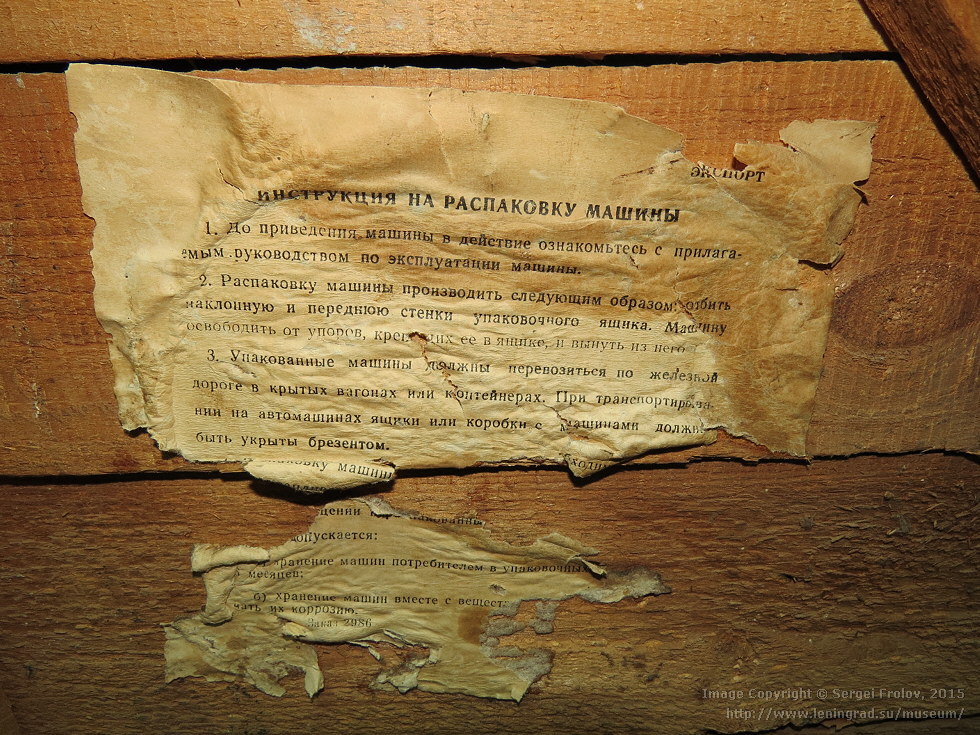
And this is the unpacking instructions on the box.

Counters. All operations for each department are summarized on these counters.
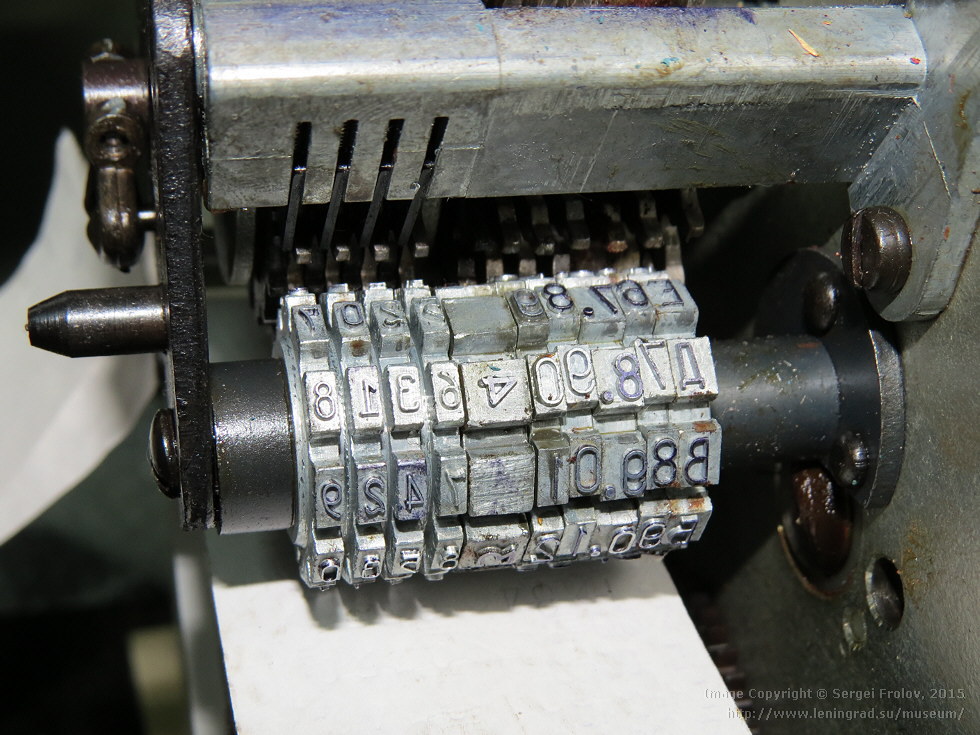
Here are encoded and knocked checks.
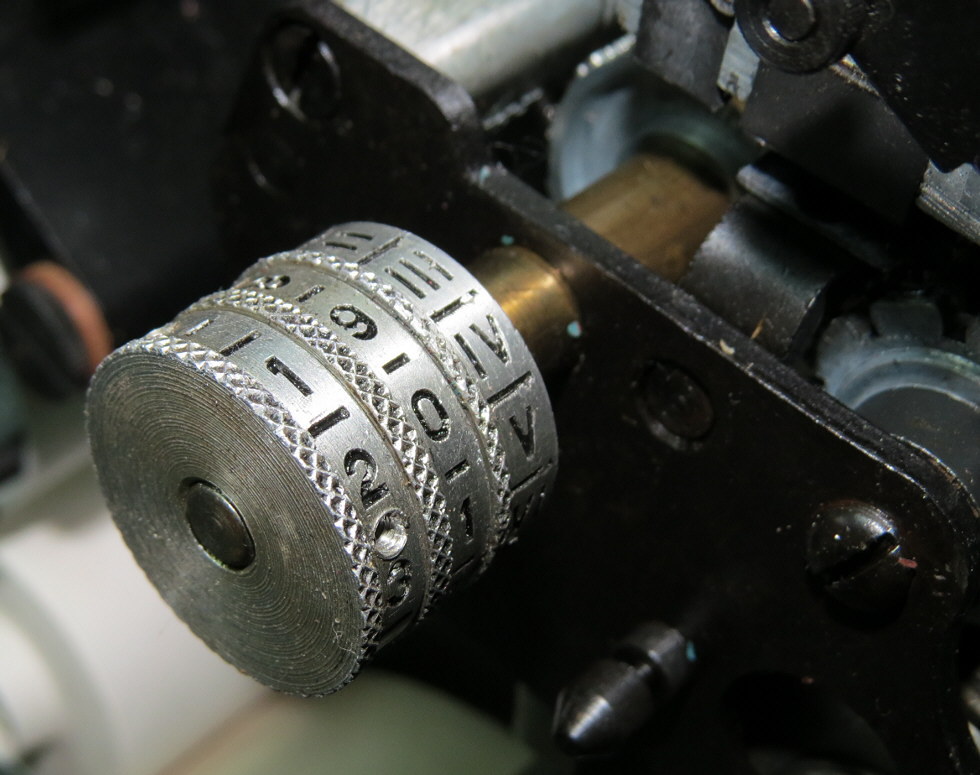
Here is the date.
The weight of this cash register together with a box is 65 kg.
For a similar model called "KIM-2" I shot a video with his work. It's about the same here.
The sound of his work can not be described in words.
That's all. If you have questions, ask.
Source: https://habr.com/ru/post/376385/
All Articles