Observatories LIGO and Virgo registered another gravitational wave
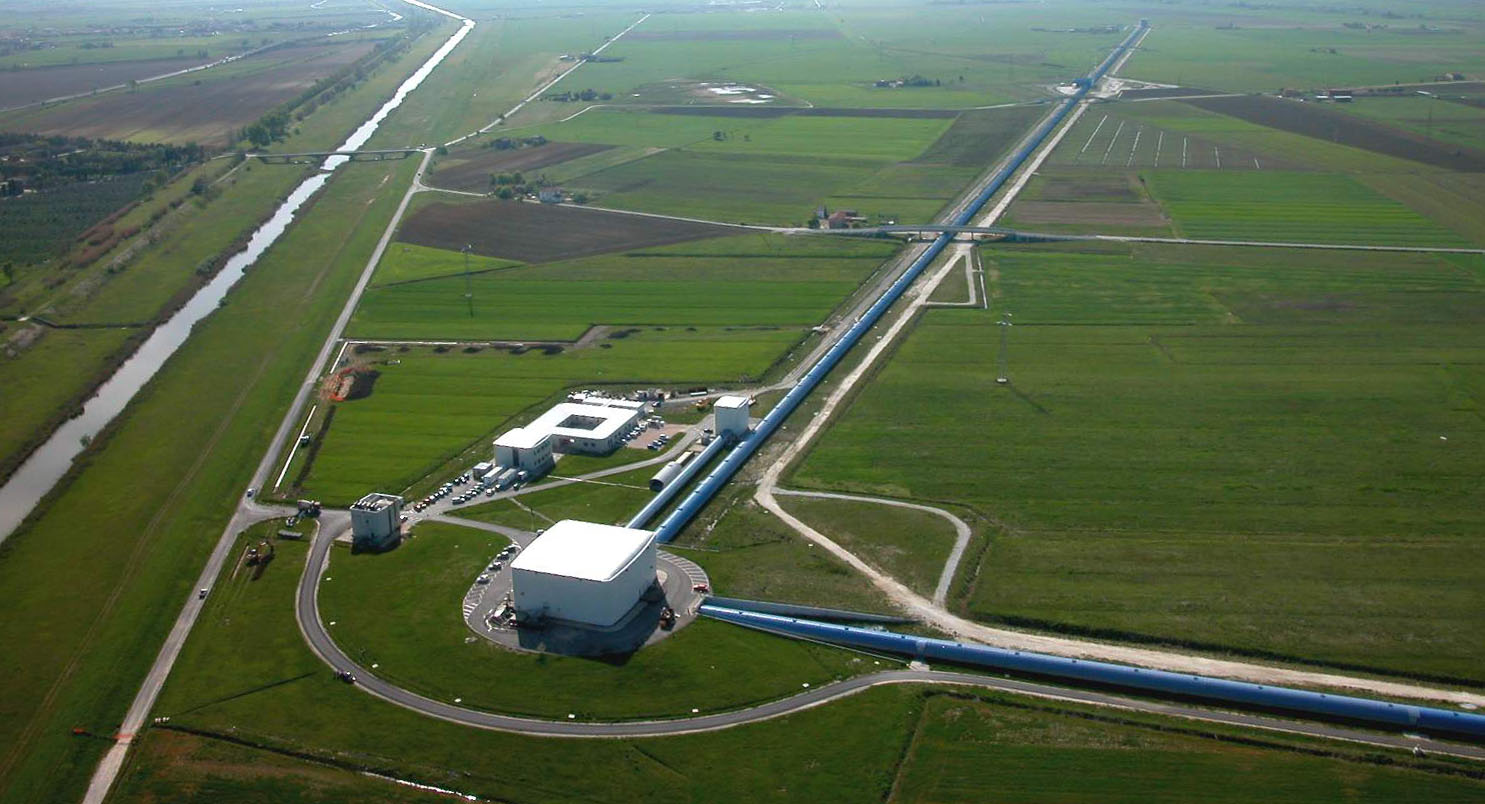
The French-Italian Virgo detector, an aerial view of the central building, the three-kilometer-long western shoulder and the beginning of the northern shoulder (when space-time is compressed, the length of the shoulders changes: one gets longer and the other shorter). Other buildings are offices, workshops, computer rooms and an interferometer control room. Photo: The Virgo collaboration / CCO 1.0
In August, three detectors on two continents registered a gravitational wave signal — oscillations of the space-time tissue — from a pair of black holes in the process of merging. The event was observed in the GW170814 area, it was announced on September 27, 2017 by the LIGO conglomeration ( LIGO press release, the National Science Foundation press release , a scientific article about the event ). The merger of black holes was registered on August 14, 2017 at 10:30:43 UTC.
This is the fourth gravitational wave recorded by the LIGO observatories, but this is the first time that gravitational waves are registered by three different detectors at once, including the European Virgo. The work shows the result of improved localization of cosmic events through a global system of gravitational waves combined into a single network of observatories. The discovery was attended by two LIGO conglomeration detectors in the states of Louisiana and Washington (USA), as well as the Virgo detector located near Pisa (Italy). He first participated in the detection of gravitational waves.
“Less than a year ago, the National Science Foundation of the United States announced that the Laser Interferometric Gravitational Wave Observatory (LIGO) was the first to register gravitational waves in the world that resulted from the confluence of two black holes in a galaxy over a billion light years, said the Director of the National Science Foundation France Cordova (France Córdova). “Today we are pleased to announce the first discovery made in partnership between the Virgo gravitational-wave observatory and the LIGO scientific collaboration, the first time that gravitational waves were observed by these observatories located thousands of kilometers apart. This is a remarkable milestone in the growing international scientific effort to uncover the extraordinary secrets of our universe. ”
')
In addition to the first case of such cooperation, registration by three detectors finally dispelled skeptics of doubts that gravity is transmitted by waves, and space-time can be compressed: “Virgo, which is located on another continent and differs significantly in design from two identical LIGO detectors, registers gravitational waves , allows you to completely forget about the already extremely unlikely possibility that the previous events were caused by some earthly reasons ", - said Farid Khalili, professor Financials Skog of the Faculty.

The event in the GW170814 region is registered at the last stage of the merger of two black holes with masses of 31 and 25 solar masses at a distance of about 1.8 billion light years from the solar system. As a result of the merger, a rotating black hole with a mass of about 53 solar masses was formed, that is, three solar masses were transformed into the energy of gravitational waves.
The Virgo detector was recently updated to the second generation; it became operational on August 1, 2017. Scientists were lucky to register gravitational waves within two weeks after starting work. At the same time, the same wave was detected by the LIGO detectors.
Starting Virgo after a six-year upgrade is a very important event. The fact is that when an event is recorded by three detectors at once, it is much more accurate to localize its coordinates and distance. In particular, the stellar region GW170814 has an area of only 60 square degrees (1 steradian is 3282.806 square degrees, and the total angle is 41252.96125 square degrees). This is more than ten times less than could be determined using only two LIGO interferometers. In our case, the event location is located in a small area in the constellation of Hours in the night sky of the southern hemisphere of the Earth.
Such an accurate determination of coordinates is important because many mergers of compact objects — for example, neutron star fusions — usually result in the emission of broadband electromagnetic radiation in addition to gravitational waves. That is, other instruments can register it, and not just the laser-interferometric gravitational-wave observatory.
Immediately after the registration of the anomaly, 25 observatories around the world were aimed at the GW170814 region, but no additional radiation followed, as should be the case with black holes.
Scientists note that during the next launch of LIGO in the autumn of 2018, they hope to register gravitational waves more often: maybe every week or more. Then we will know for sure when the fabric of space-time, in which we are, oscillates.
The scientific article about the event GW170814 was accepted for publication in the journal Physical Review Letters .
Source: https://habr.com/ru/post/370855/
All Articles