UX-design in Russia and the CIS "under the microscope"
Perhaps we start with a small educational program regarding the main object of this topic. Namely - with the concept of UX-design!
Translated from English, User Experience means “user experience”. What impressions users experience when interacting with the interface developed by the designer, how easy it is and whether they achieve their goals.
UX-design is a multifaceted concept, which includes the following disciplines:
')

Today, UX-design is not fully used by companies, but it has great prospects and will be appreciated in the very near future.
In the event that you live in Russia or in neighboring countries, you can learn the User Experience in two ways: on your own or on special courses.
This is due to the fact that in educational institutions they do not teach UX-design. Accordingly, information on this direction can be obtained either from the Internet (read articles, watch videos, chat with designers), or by completing courses.
As for the latter, it is likely that there you will be taught only the basics of UX-design, which will help you find a job, but will not make you into practice. To gain practical skills in User Experience Design you will definitely need to participate in real projects.
At first, it is better to take on simple tasks, and as the level of knowledge and competence grows, raise the bar and move on to more complex and responsible designs.
Despite the fact that for beginners in UX-design it is quite problematic to find a good job, since few companies will agree to risk the end result of their projects, it is still possible. The lack of personnel allows us to hope for the best. Of course, the first job will be something like an internship, but if successful, the newly-born UX designer will be able to subsequently get a good job with an excellent salary.
However, the use of User Experience design is not complete without “pitfalls”. Few people talk about this, but problems exist, and they have not yet been solved.
A full user experience design experience requires a multitude of competencies. The implementation of the latter is not without serious time and intellectual costs. Young specialists feel it especially acutely, having a small amount of basic knowledge behind them and almost no experience of participating in real projects.
Many companies that create digital products limit the list of responsibilities of a UX designer.
There are 2 main areas:
At the same time, duties are excluded from:
The main focus of domestic companies have traditionally been on UI-design. They can be understood, since at the same time the result of the work is immediately visible, which can be shown to the client and developers, and then used in the future. As for UX-analytics, its importance is not clearly expressed and therefore is not evaluated by companies at 100%.
In most cases, customers are looking for exactly the designers of user interfaces, which often become ordinary graphic or web designers. And since in the process of project implementation it becomes necessary to use basic UX techniques, they indicate UX / UI Designer in their summaries, although in fact they know little about UX.
In fact, in order not to become outsiders, real UX designers have to limit their potential and focus on the UI - the more popular direction that companies really want to pay for.
Unfortunately, such a serious reduction in the scope of its activities contributes to the fact that the designer ceases to see the meaning in the User Experience Design. The same conclusion can be made in relation to UI-designers.
For 6 years, I pored over the design of web services and mobile applications. My work was carried out both in the office and on a remote basis. However, taking into account how companies limit the UX designer in his duties, I was constantly haunted by the feeling that my potential would not be revealed, and I would get stuck in a routine.
It was necessary to adapt to the requirements of the authorities and customers, to limit their imagination and creative impulses in order to avoid disruptions of established deadlines.
Another reason for the emergence of existential crisis was the competition with UI-specialists. Those of them who had impressive experience could in the shortest possible time provide the client with mocaps / wireframes in accordance with their TK. Of course, sometimes their decisions could not boast of creativity and had logical inconsistencies, but a good study of UI-design and quick results were taken by customers with a bang.
In order not to be on the sidelines, I began to use their approaches, and instead of long reflections I used visual memory. But, as practice has shown, the whole meaning of UX-design was lost from this, which really hurt my professional EGO and did not give rest.
This went on for quite some time. However, at some point, my patience turned out to be 0, and I said to myself, “Enough! Something needs to be changed. ” And these were not just words. I stopped working only on my “uncle” and started to implement my own ideas and projects.
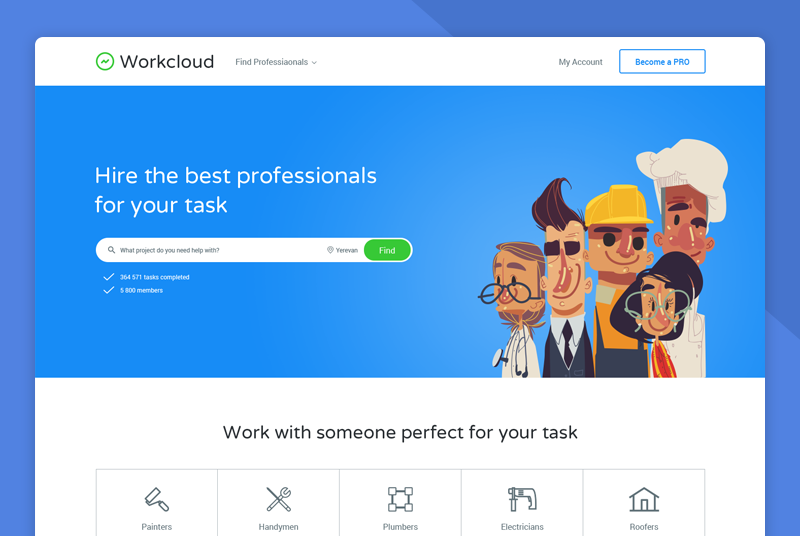
Below is one of my recent work. So far, the development is in full swing, but soon it will be a full-fledged online service for searching and ordering services of offline specialists.
Every day I looked at the project from various points of view and tried to apply those techniques that have been preserved in my remote corners of consciousness. My thoughts flowed without haste, I thought about what the result would be. I tried to visualize individual UX-templates and mentally fill them with information.
On one of these days, I suddenly realized that the work of the User Experience designer was more in intellectual reflections than in any actions. Some readers may say that I am a “captain of evidence”, however, when you are employed, you have to give up long-term reflections, since it is difficult to explain to the customer how long it will take and how much it will affect the result.
In order to overcome the crisis that had arisen, I only needed to do my favorite thing and start working on creating my own projects. Here, no one limited me in the flight of fancy and did not rush over time. Is this not a UX designer's dream?
For many years of practice, I have gained enough experience in User Experience Design and therefore I want to give 5 important tips to those who want to learn UX design and do not know where to start.
Tip number 1: Between self-study and courses I recommend giving preference to the second.
Courses will provide an opportunity to learn basic practices, to obtain basic knowledge, which later will be useful when participating in real projects.
Tip # 2: Learn Google's Material Design Guidelines and Apple's Human Interface Guidelines.
The information that you learn from them will help you to avoid many mistakes in the design of interfaces and will allow you to understand the basic principles of user interaction with the design shell.
Tip number 3: Daily explore digital products, design and draw interfaces.
Despite the fact that it is rather related to UI-design, the interweaving of the latter with UX is beyond doubt. In addition, it contributes to the development of visual memory and accelerates the process of finding interface solutions that will reflect your ideas.
Tip # 4: Do not be lazy to explain and show employers the meaning and benefits of UX design.
Many companies have little idea what User Experience Design is and why they need it. If you competently tell about it and give good examples, the employer will certainly be interested in your candidature and consider a resume.
Tip # 5: Try not to get too hung up on current tasks.
Routine has always harmed creativity, so read more books, attend conferences and create your own projects. This will not allow you to get bogged down in the monotony of official duties and will allow you to avoid an existential crisis.
Translated from English, User Experience means “user experience”. What impressions users experience when interacting with the interface developed by the designer, how easy it is and whether they achieve their goals.
UX-design is a multifaceted concept, which includes the following disciplines:
')
- information architecture;
- visual design;
- usability;
- interactive design;
- interaction between man and computer.
Today, UX-design is not fully used by companies, but it has great prospects and will be appreciated in the very near future.
How to become a UX-designer and where to start
In the event that you live in Russia or in neighboring countries, you can learn the User Experience in two ways: on your own or on special courses.
This is due to the fact that in educational institutions they do not teach UX-design. Accordingly, information on this direction can be obtained either from the Internet (read articles, watch videos, chat with designers), or by completing courses.
As for the latter, it is likely that there you will be taught only the basics of UX-design, which will help you find a job, but will not make you into practice. To gain practical skills in User Experience Design you will definitely need to participate in real projects.
At first, it is better to take on simple tasks, and as the level of knowledge and competence grows, raise the bar and move on to more complex and responsible designs.
Despite the fact that for beginners in UX-design it is quite problematic to find a good job, since few companies will agree to risk the end result of their projects, it is still possible. The lack of personnel allows us to hope for the best. Of course, the first job will be something like an internship, but if successful, the newly-born UX designer will be able to subsequently get a good job with an excellent salary.
However, the use of User Experience design is not complete without “pitfalls”. Few people talk about this, but problems exist, and they have not yet been solved.
What difficulties do UX designers face?
A full user experience design experience requires a multitude of competencies. The implementation of the latter is not without serious time and intellectual costs. Young specialists feel it especially acutely, having a small amount of basic knowledge behind them and almost no experience of participating in real projects.
Many companies that create digital products limit the list of responsibilities of a UX designer.
There are 2 main areas:
- development of interaction scenarios and information architecture;
- design and visual design of user interfaces.
At the same time, duties are excluded from:
- business and target audience analysis;
- strategy development and analysis;
- A / B testing;
- analysis of competitors' products;
- supervising design modifications to increase conversion.
The main focus of domestic companies have traditionally been on UI-design. They can be understood, since at the same time the result of the work is immediately visible, which can be shown to the client and developers, and then used in the future. As for UX-analytics, its importance is not clearly expressed and therefore is not evaluated by companies at 100%.
In most cases, customers are looking for exactly the designers of user interfaces, which often become ordinary graphic or web designers. And since in the process of project implementation it becomes necessary to use basic UX techniques, they indicate UX / UI Designer in their summaries, although in fact they know little about UX.
In fact, in order not to become outsiders, real UX designers have to limit their potential and focus on the UI - the more popular direction that companies really want to pay for.
Unfortunately, such a serious reduction in the scope of its activities contributes to the fact that the designer ceases to see the meaning in the User Experience Design. The same conclusion can be made in relation to UI-designers.
How to overcome the existential crisis UX-designer in my face
For 6 years, I pored over the design of web services and mobile applications. My work was carried out both in the office and on a remote basis. However, taking into account how companies limit the UX designer in his duties, I was constantly haunted by the feeling that my potential would not be revealed, and I would get stuck in a routine.
It was necessary to adapt to the requirements of the authorities and customers, to limit their imagination and creative impulses in order to avoid disruptions of established deadlines.
Another reason for the emergence of existential crisis was the competition with UI-specialists. Those of them who had impressive experience could in the shortest possible time provide the client with mocaps / wireframes in accordance with their TK. Of course, sometimes their decisions could not boast of creativity and had logical inconsistencies, but a good study of UI-design and quick results were taken by customers with a bang.
In order not to be on the sidelines, I began to use their approaches, and instead of long reflections I used visual memory. But, as practice has shown, the whole meaning of UX-design was lost from this, which really hurt my professional EGO and did not give rest.
This went on for quite some time. However, at some point, my patience turned out to be 0, and I said to myself, “Enough! Something needs to be changed. ” And these were not just words. I stopped working only on my “uncle” and started to implement my own ideas and projects.
Below is one of my recent work. So far, the development is in full swing, but soon it will be a full-fledged online service for searching and ordering services of offline specialists.
Every day I looked at the project from various points of view and tried to apply those techniques that have been preserved in my remote corners of consciousness. My thoughts flowed without haste, I thought about what the result would be. I tried to visualize individual UX-templates and mentally fill them with information.
On one of these days, I suddenly realized that the work of the User Experience designer was more in intellectual reflections than in any actions. Some readers may say that I am a “captain of evidence”, however, when you are employed, you have to give up long-term reflections, since it is difficult to explain to the customer how long it will take and how much it will affect the result.
In order to overcome the crisis that had arisen, I only needed to do my favorite thing and start working on creating my own projects. Here, no one limited me in the flight of fancy and did not rush over time. Is this not a UX designer's dream?
5 Tips for the Future UX Designer
For many years of practice, I have gained enough experience in User Experience Design and therefore I want to give 5 important tips to those who want to learn UX design and do not know where to start.
Tip number 1: Between self-study and courses I recommend giving preference to the second.
Courses will provide an opportunity to learn basic practices, to obtain basic knowledge, which later will be useful when participating in real projects.
Tip # 2: Learn Google's Material Design Guidelines and Apple's Human Interface Guidelines.
The information that you learn from them will help you to avoid many mistakes in the design of interfaces and will allow you to understand the basic principles of user interaction with the design shell.
Tip number 3: Daily explore digital products, design and draw interfaces.
Despite the fact that it is rather related to UI-design, the interweaving of the latter with UX is beyond doubt. In addition, it contributes to the development of visual memory and accelerates the process of finding interface solutions that will reflect your ideas.
Tip # 4: Do not be lazy to explain and show employers the meaning and benefits of UX design.
Many companies have little idea what User Experience Design is and why they need it. If you competently tell about it and give good examples, the employer will certainly be interested in your candidature and consider a resume.
Tip # 5: Try not to get too hung up on current tasks.
Routine has always harmed creativity, so read more books, attend conferences and create your own projects. This will not allow you to get bogged down in the monotony of official duties and will allow you to avoid an existential crisis.
Source: https://habr.com/ru/post/350578/
All Articles