The history of trade cash registers
Modern trade can not be imagined without the use of cash registers. Cash with us everywhere: in supermarkets, cafes, gas stations and mail. From July 1, 2017, cash registers must be used even when paying for goods in online stores. And who and when was the first who thought up to keep records of financial receipts with the help of the cash register? The whole history of trading cash registers is in our material.

The emergence of new machines for receiving money has fundamentally changed the concept of retail, which until the end of the XIX century was conducted under a simplified scheme. Prior to the invention of the cash register, the buyer gave the seller money, in return received the goods (or service), and the seller assumed all responsibilities for recording financial income. You do not need to be very insightful to understand - such control of sales revenue was very conditional.
The first person to think about the need to control cash flow was James Jacob Ritti. The future inventor of the cash register in 1871 opened a bar in the city of Dayton (Ohio) called Pony House. Despite the considerable number of visitors, the business did not bring any money, as the establishment's staff constantly concealed the proceeds from the owner. It was impossible to solve the problem of dismissing unscrupulous sellers - the same thing happened to new people.
')

James Ritty - inventor of the first cash register
The decision came unexpectedly during Ritty's voyage from the USA to Europe. James entered the ship’s engine room and saw a tachometer, a round sensor that counted the number of revolutions of the propeller shaft. Looking at this sensor, James thought that a similar device could be assembled, which would also count money received from Pony House customers. Returning home, inspired by James, he designed a prototype cash register.
This device was completely different from the usual box office. To indicate the amount of income used round dial, because of which the device from a distance could be taken as a normal watch in a wooden case. Moreover, the first cash register, like the clock, had arrows: a long (“minute”) showed cents, and a short (“hourly”) signaled dollars. Under this dial were buttons, each of which corresponded to the price of a particular product. For example, if a visitor acquired a drink for 35 cents, the cashier had to press a button with this value, after which the counter adjusted the position of the hands on the dial.

The first working model of the cash register
The first model of the cash register was imperfect. The sly salesman could only pretend to use the cashier, or press a button with a lower face value. And when no one saw, he acted even more simply - he moved the arrows back. Therefore, James made changes to the design - wheels with numbers appeared at the box office, and their movement was synchronized by a transmission mechanism. Thanks to the “adder”, the device learned how to calculate the total amount of the order, and also acquired a form that subsequently did not change for many years.

To accustom visitors to the institution to the checkout, Ritti hung a bell on the device, which made a ring after the visitor had calculated. This model has received the nickname "incorruptible cashier Ritti."
However, in the second modification of the cash register with time, a significant drawback was revealed. Once a strong scandal broke out at the establishment - a disgruntled visitor accused the bartender of cheating him. The evidence, of course, was not - the cash register showed a new amount of revenue, and nothing more. Then James decided to refine his offspring, endowing it with a special paper tape, on which every operation carried out by the cashier was fixed.
So in the third modification of the cash register, all operations were accompanied by perforation of paper, by which it was possible to track the actions of the cashier. Probably, the well-known expression “punch a check” has appeared since then.
In addition, under the cashier now there was a mandatory box for money - at first the simplest pull-out, divided into sections for different denominations. It also had pinch rolls for bills. Over time, a lock appeared in the drawer. Interestingly, for more than a hundred years, the cash drawer has hardly changed.

After all the main disadvantages of the first modifications of the cash register were eliminated, James Ritty patented his invention. He then tried to set up a serial production, but quickly abandoned this venture and sold the patent, focusing on the development of the restaurant business.

James Ritty and his brother create the first samples of cash registers
In 1884, John Patterson, who is rightfully called the man who created the modern sales technology, bought the rights to manufacture cash registers. Having received a patent for the production of a promising device, the businessman created the company The National Cash Register Company (which, by the way, today also produces POS equipment).
In 1906, the first cash register on the push-button motor was invented in NCR. He was created by one of NCR’s most talented engineers, Charles Kettering, who in just five years at the company received more than twenty patents for various inventions. The NCR engineering team made all the new improvements to the cash registers, and it was under John Patterson that these devices became what we were used to seeing.

Classic cash register of The National Cash Register Company
When Patterson took up cash registers, he had to go into debt and rely on his entrepreneurial intuition. But he firmly believed that the future of cash registers. Interestingly, Patterson did not impose cash registers on customers, but worked to create a need for cash vouchers (that is, in fact, he did not sell the product itself, but benefited from its use). For NCR sellers, a whole textbook was written, which they had to memorize before going to potential customers. As a result, from 1884 to 1911 more than a million cash registers were sold in the world, and by 1917 The National Cash Register Company controlled about 95% of the market.
Some of the methods that John Patterson used in his business strategy were truly innovative (and are still used today). For example, NCR often simply bought up its competitors. As soon as John saw on sale a cash register model with functions that were lacking in his own products, he immediately did everything to buy out the manufacturer or force it to wind down the business.
Secondly, the company meticulously studied the competitors' cash desks in order to better understand their shortcomings. For example, it is reliably known that in February 1892 a circular was circulated within the company with instructions on how to hack the cash drawer of a competitor’s cash register - Simplex Cash Register.
This box office worked quite unusual. She had no buttons, but there were holes for the balls. Each hole corresponded to a certain amount. After installing the balls in the desired position in a small window raised the box with the price tag. So the buyer could see the invoice. Once inside the box office, the balls accumulated, and at the end of the day the owner could compare the proceeds with the number of balls.

Alternative type of cash register from Simplex Cash Register
NCR sellers received detailed instructions from management explaining how easy it is to deceive this cashier and get cash from there. The instructions included a lead bullet and horsehair. The trick was simple - instead of a ball one could insert a bullet into the hole, and pulling the horsehair, which had been planted under the box beforehand, could easily open the box and get money from the cash register. Of course, after such a demonstration, many owners of such cash registers were in a hurry to replace them with NCR devices.
Unfortunately for Patterson’s company, this instruction triggered a claim to NCR by the federal government and, in accordance with antitrust laws, in 1913 the company was found guilty of dishonest sales.
However, Patterson was not afraid of lawsuits and actively argued in court with competitors. A funny incident occurred in 1894. Drawing attention to the growing popularity of cash registers, a certain Michael Heinz from Detroit created the Heintz Cash Register company, which released its cash register. A distinctive feature of this model was that instead of the usual bell ringing, the end of the operation was reported ... cuckoo. Yes, yes, a mechanical cuckoo, which poked its head out of the cash register and bit it.

Past such Patterson could not pass. He sued Heinz Cash Register, accusing a competitor of copyright infringement. In court, representatives of the "box office with the cuckoo" stated that they had made a fundamentally new product, replacing the classic bell with a bird. But John insisted that it was not, and in proof of this, he presented the text of the original patent. And indeed, it was the bell that was not registered in the James Ritty patent - it indicated “a sound device for notification”. The court decision decided to silence the cuckoo forever. Although it would probably be funny to hear at the checkout that your money is “koo-ku”.
In the Soviet Union, their own production cash registers did not appear immediately. For a long time in restaurants and retail outlets imported samples were used, mostly of outdated design. Separate pre-war developments, such as those produced by the Kiev plant named after the 13th anniversary of the October Revolution, were not particularly popular, mainly due to low reliability.

Moreover, there were not even places in the country where it would be possible to repair damaged imported equipment. In 1923, the only enterprise at that time was opened for repairing typewriters, calculating and cash registers - the Precision Mechanics Bureau of the 1st Moscow State University.
The first more or less successful versions of domestic-made cash registers, such as the A1T or a line of CMM devices, appeared in the second half of the last century. Initially, these models were exclusively mechanical and were driven by a rotary knob. Later, their design became electromechanical, they worked from the usual network. But even when electrified samples appeared in department stores and grocery stores in the second half of the 70s, you could still see the handle “for the plant” on the side of the cash register, which was used in emergency cases when there was no electricity.

Cash register KIM-2
When looking at the keyboard of the Soviet cash registers, a modern person necessarily has a question: why do we need so many repeating buttons?
Early models of the Soviet box office had a limited set of registers. Each register was entered by its own set of numbers. For dozens of rubles, the first vertical column of buttons from “1” to “9” was used, for units of rubles - the second vertical column, etc. The numbers “zero” did not exist at all, a cross was put in its place - it was a kind of protection against check fakes. Also on the keyboard was a short column of buttons - "1", "2", "3", "4". These were the numbers of the departments for which the product was knocked out.
Another tricky feature designed to protect against fraudsters is the letter code. So that a person could not get the goods on a fake check, the cashier had to regularly negotiate with the seller and change the control letter of the check. Thus, if a person hands the seller a check, and he does not see the “secret letter”, he knows that the check is a fake.
The buttons were fixed, and the check was punched through - using the enter button - only when all the information was typed. If the cashier was wrong, he could do a "reset" by pressing the current key combination with a special button.

Model KIM-3-SP
The first models of cash registers manufactured in the USSR were distinguished by low reliability. However, the situation radically changed when the “Oka” model was made on the basis of the Swedish prototype.
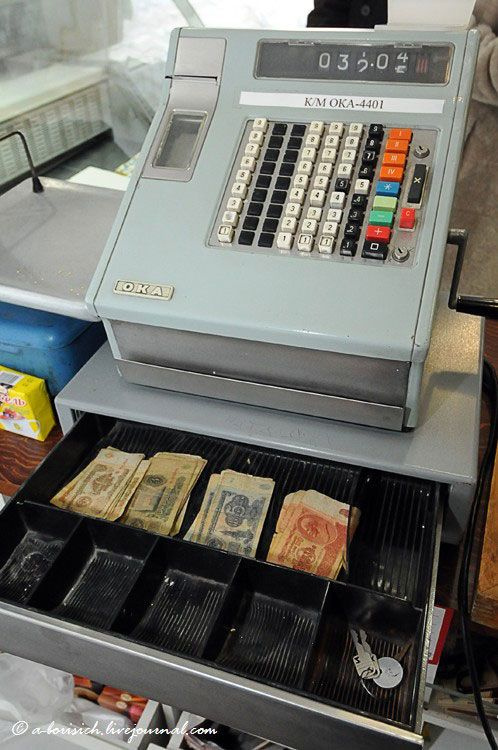
Cash register "Oka 4401"
Since the beginning of the 80s of the last century, such a cash desk stood in almost every Soviet store. She refueled with two rolls of tapes at once: one for the buyer, the second for keeping the control protocol. The control tape was displayed under the window on the panel next to the buttons, so that the cashier could quickly see his mistake or view the history of actions.
A whole set of keys was attached to the checkout. The first allowed to turn on the cash register, the second served to reset the sensors, and the third - to read the counters. And the “business card” of the domestic cash register was a box for cash, which at the end of the calculation literally flew out of the main body.
In the eighties, the first electronic cash registers appeared. The most popular among them was the Spark-302A. She looked like a giant calculator and had a built-in memory on magnetic cores. Such a ticket office was often used at Sberbank and at the post office.

Soviet cash register Iskra-302A
In our age of “smart things”, cash registers have become real little computers. A modern box office that meets all legal requirements consists of the following components:
In order to understand the diversity of modern cash registers, you can focus on the lettering in the names of models:
Modern online cash registers for outlets are usually equipped with a built-in modem that provides online data transfer to the Federal Tax Service, a SIM card slot, a waterproof keyboard, and a Li-ion battery (in case of a power outage).

Cashier ATOL 90F
There are also portable cash desks designed specifically for couriers. They are lighter and more compact (sometimes weighing up to 300 grams), can work autonomously for a long time, and are equipped with Bluetooth and Wi-Fi data interfaces.
But modern multifunctional POS-terminals look more like a classic desktop than a cash register. In any POS-terminal, you can accurately recognize the familiar components - the system unit, monitor, keyboard, printer. However, unlike conventional PCs, the terminal, of course, is not used for gaming and web surfing, but is intended for use in various retail outlets.

Multifunctional POS-terminal "ATOL House Shop"
The operating system and software on it are already installed, all the equipment from the kit is compatible and requires a minimum of time for assembly and configuration. Since such devices are created for continuous active operation, the terminals are for the most part much more reliable than ordinary desktops. In the system block of terminals, as a rule, there are no cooling fans. This not only implies quiet operation, but also prevents dust from getting inside the case and, as a result, reduces the risk of electronics failure.
Cash registers, issued over the past hundred and fifty years, are very different in appearance and function. But there is something that unites the first James Ritty box office and modern POS terminals. This is an easy handling.
The main user of such devices is a regular cashier, who often has a very vague idea of how a cash register functions. Therefore, manufacturers of cash registers have always paid great attention to the simplicity of their use and gave them a resemblance to recognizable objects. At different times, the design of the cash register resembled a clock, a typewriter, a desk calculator, etc. And the more complicated the “filling” of cash registers was, the more important it was to make the device more friendly and reliable. And whatever form the device takes, its main function remains unchanged - to help a person keep track of cash transactions. After all, cash checks are the only component of the business, the essence of which has not changed in the last hundred years.
The emergence of new machines for receiving money has fundamentally changed the concept of retail, which until the end of the XIX century was conducted under a simplified scheme. Prior to the invention of the cash register, the buyer gave the seller money, in return received the goods (or service), and the seller assumed all responsibilities for recording financial income. You do not need to be very insightful to understand - such control of sales revenue was very conditional.
1871-1884: the first box office of James Jacob Ritty
The first person to think about the need to control cash flow was James Jacob Ritti. The future inventor of the cash register in 1871 opened a bar in the city of Dayton (Ohio) called Pony House. Despite the considerable number of visitors, the business did not bring any money, as the establishment's staff constantly concealed the proceeds from the owner. It was impossible to solve the problem of dismissing unscrupulous sellers - the same thing happened to new people.
')
James Ritty - inventor of the first cash register
The decision came unexpectedly during Ritty's voyage from the USA to Europe. James entered the ship’s engine room and saw a tachometer, a round sensor that counted the number of revolutions of the propeller shaft. Looking at this sensor, James thought that a similar device could be assembled, which would also count money received from Pony House customers. Returning home, inspired by James, he designed a prototype cash register.
This device was completely different from the usual box office. To indicate the amount of income used round dial, because of which the device from a distance could be taken as a normal watch in a wooden case. Moreover, the first cash register, like the clock, had arrows: a long (“minute”) showed cents, and a short (“hourly”) signaled dollars. Under this dial were buttons, each of which corresponded to the price of a particular product. For example, if a visitor acquired a drink for 35 cents, the cashier had to press a button with this value, after which the counter adjusted the position of the hands on the dial.
The first working model of the cash register
The first model of the cash register was imperfect. The sly salesman could only pretend to use the cashier, or press a button with a lower face value. And when no one saw, he acted even more simply - he moved the arrows back. Therefore, James made changes to the design - wheels with numbers appeared at the box office, and their movement was synchronized by a transmission mechanism. Thanks to the “adder”, the device learned how to calculate the total amount of the order, and also acquired a form that subsequently did not change for many years.
To accustom visitors to the institution to the checkout, Ritti hung a bell on the device, which made a ring after the visitor had calculated. This model has received the nickname "incorruptible cashier Ritti."
However, in the second modification of the cash register with time, a significant drawback was revealed. Once a strong scandal broke out at the establishment - a disgruntled visitor accused the bartender of cheating him. The evidence, of course, was not - the cash register showed a new amount of revenue, and nothing more. Then James decided to refine his offspring, endowing it with a special paper tape, on which every operation carried out by the cashier was fixed.
So in the third modification of the cash register, all operations were accompanied by perforation of paper, by which it was possible to track the actions of the cashier. Probably, the well-known expression “punch a check” has appeared since then.
In addition, under the cashier now there was a mandatory box for money - at first the simplest pull-out, divided into sections for different denominations. It also had pinch rolls for bills. Over time, a lock appeared in the drawer. Interestingly, for more than a hundred years, the cash drawer has hardly changed.
After all the main disadvantages of the first modifications of the cash register were eliminated, James Ritty patented his invention. He then tried to set up a serial production, but quickly abandoned this venture and sold the patent, focusing on the development of the restaurant business.
James Ritty and his brother create the first samples of cash registers
The first box office of our time: "The National Box Office Company" by John Patterson
In 1884, John Patterson, who is rightfully called the man who created the modern sales technology, bought the rights to manufacture cash registers. Having received a patent for the production of a promising device, the businessman created the company The National Cash Register Company (which, by the way, today also produces POS equipment).
In 1906, the first cash register on the push-button motor was invented in NCR. He was created by one of NCR’s most talented engineers, Charles Kettering, who in just five years at the company received more than twenty patents for various inventions. The NCR engineering team made all the new improvements to the cash registers, and it was under John Patterson that these devices became what we were used to seeing.
Classic cash register of The National Cash Register Company
When Patterson took up cash registers, he had to go into debt and rely on his entrepreneurial intuition. But he firmly believed that the future of cash registers. Interestingly, Patterson did not impose cash registers on customers, but worked to create a need for cash vouchers (that is, in fact, he did not sell the product itself, but benefited from its use). For NCR sellers, a whole textbook was written, which they had to memorize before going to potential customers. As a result, from 1884 to 1911 more than a million cash registers were sold in the world, and by 1917 The National Cash Register Company controlled about 95% of the market.
Some of the methods that John Patterson used in his business strategy were truly innovative (and are still used today). For example, NCR often simply bought up its competitors. As soon as John saw on sale a cash register model with functions that were lacking in his own products, he immediately did everything to buy out the manufacturer or force it to wind down the business.
Secondly, the company meticulously studied the competitors' cash desks in order to better understand their shortcomings. For example, it is reliably known that in February 1892 a circular was circulated within the company with instructions on how to hack the cash drawer of a competitor’s cash register - Simplex Cash Register.
This box office worked quite unusual. She had no buttons, but there were holes for the balls. Each hole corresponded to a certain amount. After installing the balls in the desired position in a small window raised the box with the price tag. So the buyer could see the invoice. Once inside the box office, the balls accumulated, and at the end of the day the owner could compare the proceeds with the number of balls.
Alternative type of cash register from Simplex Cash Register
NCR sellers received detailed instructions from management explaining how easy it is to deceive this cashier and get cash from there. The instructions included a lead bullet and horsehair. The trick was simple - instead of a ball one could insert a bullet into the hole, and pulling the horsehair, which had been planted under the box beforehand, could easily open the box and get money from the cash register. Of course, after such a demonstration, many owners of such cash registers were in a hurry to replace them with NCR devices.
Unfortunately for Patterson’s company, this instruction triggered a claim to NCR by the federal government and, in accordance with antitrust laws, in 1913 the company was found guilty of dishonest sales.
However, Patterson was not afraid of lawsuits and actively argued in court with competitors. A funny incident occurred in 1894. Drawing attention to the growing popularity of cash registers, a certain Michael Heinz from Detroit created the Heintz Cash Register company, which released its cash register. A distinctive feature of this model was that instead of the usual bell ringing, the end of the operation was reported ... cuckoo. Yes, yes, a mechanical cuckoo, which poked its head out of the cash register and bit it.
Past such Patterson could not pass. He sued Heinz Cash Register, accusing a competitor of copyright infringement. In court, representatives of the "box office with the cuckoo" stated that they had made a fundamentally new product, replacing the classic bell with a bird. But John insisted that it was not, and in proof of this, he presented the text of the original patent. And indeed, it was the bell that was not registered in the James Ritty patent - it indicated “a sound device for notification”. The court decision decided to silence the cuckoo forever. Although it would probably be funny to hear at the checkout that your money is “koo-ku”.
Cash registers in the USSR
In the Soviet Union, their own production cash registers did not appear immediately. For a long time in restaurants and retail outlets imported samples were used, mostly of outdated design. Separate pre-war developments, such as those produced by the Kiev plant named after the 13th anniversary of the October Revolution, were not particularly popular, mainly due to low reliability.
Moreover, there were not even places in the country where it would be possible to repair damaged imported equipment. In 1923, the only enterprise at that time was opened for repairing typewriters, calculating and cash registers - the Precision Mechanics Bureau of the 1st Moscow State University.
The first more or less successful versions of domestic-made cash registers, such as the A1T or a line of CMM devices, appeared in the second half of the last century. Initially, these models were exclusively mechanical and were driven by a rotary knob. Later, their design became electromechanical, they worked from the usual network. But even when electrified samples appeared in department stores and grocery stores in the second half of the 70s, you could still see the handle “for the plant” on the side of the cash register, which was used in emergency cases when there was no electricity.
Cash register KIM-2
When looking at the keyboard of the Soviet cash registers, a modern person necessarily has a question: why do we need so many repeating buttons?
Early models of the Soviet box office had a limited set of registers. Each register was entered by its own set of numbers. For dozens of rubles, the first vertical column of buttons from “1” to “9” was used, for units of rubles - the second vertical column, etc. The numbers “zero” did not exist at all, a cross was put in its place - it was a kind of protection against check fakes. Also on the keyboard was a short column of buttons - "1", "2", "3", "4". These were the numbers of the departments for which the product was knocked out.
Another tricky feature designed to protect against fraudsters is the letter code. So that a person could not get the goods on a fake check, the cashier had to regularly negotiate with the seller and change the control letter of the check. Thus, if a person hands the seller a check, and he does not see the “secret letter”, he knows that the check is a fake.
The buttons were fixed, and the check was punched through - using the enter button - only when all the information was typed. If the cashier was wrong, he could do a "reset" by pressing the current key combination with a special button.
Model KIM-3-SP
The first models of cash registers manufactured in the USSR were distinguished by low reliability. However, the situation radically changed when the “Oka” model was made on the basis of the Swedish prototype.
Cash register "Oka 4401"
Since the beginning of the 80s of the last century, such a cash desk stood in almost every Soviet store. She refueled with two rolls of tapes at once: one for the buyer, the second for keeping the control protocol. The control tape was displayed under the window on the panel next to the buttons, so that the cashier could quickly see his mistake or view the history of actions.
A whole set of keys was attached to the checkout. The first allowed to turn on the cash register, the second served to reset the sensors, and the third - to read the counters. And the “business card” of the domestic cash register was a box for cash, which at the end of the calculation literally flew out of the main body.
In the eighties, the first electronic cash registers appeared. The most popular among them was the Spark-302A. She looked like a giant calculator and had a built-in memory on magnetic cores. Such a ticket office was often used at Sberbank and at the post office.
Soviet cash register Iskra-302A
Nowadays
In our age of “smart things”, cash registers have become real little computers. A modern box office that meets all legal requirements consists of the following components:
- case, inside which must be a real time clock.
- fiscal drive (FN) - a cryptographic means of protecting fiscal data, which records the data in uncorrectable form, stores it and transfers it to the controlling authorities. It is the transfer of the accumulated data that distinguishes the FN from the EKLZ (electronic protected control tape), which was used in earlier versions of cash registers for uncorrectable accumulation of information about all the payment documents drawn up on the device and shift closure reports.
- devices for printing checks. However, in the era of online payments, printing a paper check for some types of trade is no longer necessary. Therefore, today there are already online cash registers that generate only an electronic check and do not print it on paper.
In order to understand the diversity of modern cash registers, you can focus on the lettering in the names of models:
- "FS" - cash offices only for payments on the Internet (do not contain a device for printing inside the case);
- “FA” - cash offices only for embedding into automatic devices (vending, payment terminals);
- "FB" - automated systems BSO;
- "F" - all others that can be used in any of the options.
Modern online cash registers for outlets are usually equipped with a built-in modem that provides online data transfer to the Federal Tax Service, a SIM card slot, a waterproof keyboard, and a Li-ion battery (in case of a power outage).
Cashier ATOL 90F
There are also portable cash desks designed specifically for couriers. They are lighter and more compact (sometimes weighing up to 300 grams), can work autonomously for a long time, and are equipped with Bluetooth and Wi-Fi data interfaces.
But modern multifunctional POS-terminals look more like a classic desktop than a cash register. In any POS-terminal, you can accurately recognize the familiar components - the system unit, monitor, keyboard, printer. However, unlike conventional PCs, the terminal, of course, is not used for gaming and web surfing, but is intended for use in various retail outlets.
Multifunctional POS-terminal "ATOL House Shop"
The operating system and software on it are already installed, all the equipment from the kit is compatible and requires a minimum of time for assembly and configuration. Since such devices are created for continuous active operation, the terminals are for the most part much more reliable than ordinary desktops. In the system block of terminals, as a rule, there are no cooling fans. This not only implies quiet operation, but also prevents dust from getting inside the case and, as a result, reduces the risk of electronics failure.
Eventually
Cash registers, issued over the past hundred and fifty years, are very different in appearance and function. But there is something that unites the first James Ritty box office and modern POS terminals. This is an easy handling.
The main user of such devices is a regular cashier, who often has a very vague idea of how a cash register functions. Therefore, manufacturers of cash registers have always paid great attention to the simplicity of their use and gave them a resemblance to recognizable objects. At different times, the design of the cash register resembled a clock, a typewriter, a desk calculator, etc. And the more complicated the “filling” of cash registers was, the more important it was to make the device more friendly and reliable. And whatever form the device takes, its main function remains unchanged - to help a person keep track of cash transactions. After all, cash checks are the only component of the business, the essence of which has not changed in the last hundred years.
Source: https://habr.com/ru/post/335362/
All Articles