Approaches to design in virtual reality

Although the development of virtual reality technology (VR) is gaining momentum, however, there is still a shortage of methods and design guidelines. In my project for a bachelor's degree, I focused on the user interface, UX, and the problems posed by virtual reality technology.
Historically, digital interfaces are created to match the characteristics of two-dimensional displays. Designers have to enter content and navigation into the frames of screens, transforming the experience of interacting with the real world into icons and other interface elements. But stuffing a virtual environment with two-dimensional elements destroys the immersive effect necessary for VR. Therefore, the design in VR does not imply the transfer of the usual two-dimensional techniques in the three-dimensional environment, and the search for a new paradigm.
My research is based on literature that explores human perception and the environment, for example, The Ecological Approach to Visual Perception , Inquiry by Design and The Poetics of Space . Although the bulk of the work on environmental psychology was written in the 1970s, all this knowledge is fully applicable to virtual reality. Designers need to expand their knowledge in various disciplines: archeology, architecture, sound and light scenography, and physics in order to be able to create a fully controlled interaction experience, shaping VR in such a way that it guides users as needed by developers.
')
In my project, I propose solutions for different problems using the example of a neutral VR environment, in the form of different characteristic situations (similar to the Cardboard Design Lab application). These situations cover only part of the wide variety of new types of interactions and solutions offered by VR. New opportunities will be opened before us thanks to the parallel development of mixed reality (MR, mixed reality). Although there are certain intersections between UI and UX between VR and MR, each of these technologies requires different approaches from designers.
The future of these environments depends on the content they create. Today, VR products most often simulate real life, but when the frenzy of novelty passes, the content will be adapted to the particular environment. This will again require the introduction of new design solutions, but for now we need to concentrate on creating a solid foundation for this future stage.
VR design solutions
The role of the earth
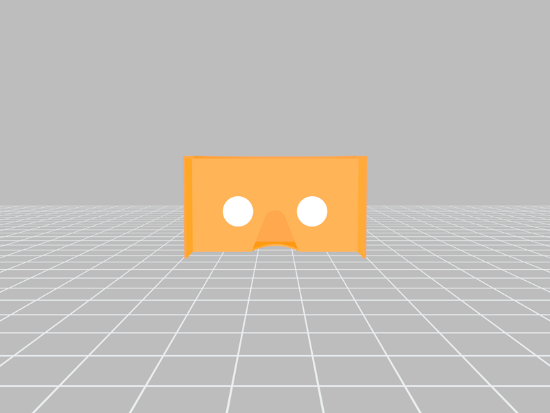
“When the plane flies in the clouds, nothing is visible from the outside, and this can be very disorienting. And when the clouds end, and the pilot can see the earth, the sky and the horizon, a sense of orientation reappears ” (James Gibson, 2015, p. 19). With a poor design experience of interaction in VR, users can also experience disorientation, which inevitably leads to motion sickness. Seeing the earth and the horizon in VR is just as important as in the real world.
Atmosphere
An atmospheric (aerial) perspective can help users understand the scale of a virtual environment, which adds realism. The essence of this phenomenon is simple: "The farther the object, the more air and obstacles are between the object and the observer, therefore, a far-away object is seen less clearly than the one that is closer." (Bruce Goldstein, 2013, p. 230). This gradual wilting of the landscape is necessary in order to give the user an idea of the depth and distance.

Masaccio used the atmospheric perspective to create the illusion of depth
Terrain features
James Gibson, in The Ecological Approach to Visual Perception (p. 62), outlines eight basic properties of the relief.
- The earth’s surface is rarely an open, level space. Usually she is cluttered up. Open space allows you to move along the ground in any direction, and cluttered - only in the aisles .
- The path provides foot movement from one place to another, between other properties of relief.
- An obstacle is an object the size of an animal that can be encountered.
- Barrier is a special kind of obstacle, usually blocking the field of view and movement.
- Water barrier does not allow to move on foot.
- The edge of the cliff limits the ability to get closer to some object. This is a danger zone, land animals avoid such places.
- A step is a unit of measure that can be used to determine the duration of a descent or ascent.
- The possibility of foot movement depends on the slope , it is determined by the angle of the surface texture.

Relief properties: passage, path, obstacle, barrier, water obstacle, edge of the cliff, step and slope
Using these properties as building blocks when creating a virtual environment, you can create an intuitive interaction experience.
Influence of sound environment
VR does not need to make any effort to change the surrounding space, although such unexpected and stunning changes can confuse the user and cause nausea. Therefore, it is advisable to accurately sum it up by the time the environment changes, smoothly pre-amplifying the sound background characteristic of the new place, and then showing the place itself. Sound design prepares the brain, which softens the surprise factor.
The short film La Jetée (1962) is almost entirely composed of ordinary photographs, but the sound design allows the viewer to embed a mental image of the intended space.
User management using objects
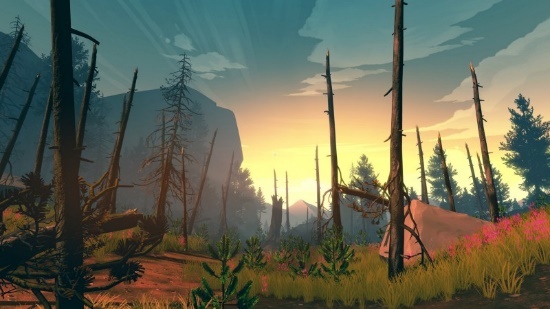
In a cluttered space, it can be difficult to lead a user along a certain path without traditional navigation interface elements. But it can destroy the effect of immersion. But you can direct gently and unobtrusively, with the help of small changes in the surrounding world. For example, in the game Firewatch, the user's attention to the route was drawn with the help of growing flowers . Of course, the choice of a specific decision depends entirely on the context (the flowers will not fit the Martian landscape).
Context-dependent reticle
In a non-monitored VR (for example, Gear VR, Google Cardboard) sights are used to display the user's line of sight . The image of the focus point helps to navigate in space, and also simplifies movement and interaction with objects. Different tasks require different reactions from the sight.
- State of rest: the scope should be of the minimum size, suggesting only the location of the center of the frame.
- Movement: the scope is activated when the user looks at any object that can be approached. In this case, the sight turns into a larger pointer, activating the illumination of the highlighted area with a circle, moving depending on the user's point of view.
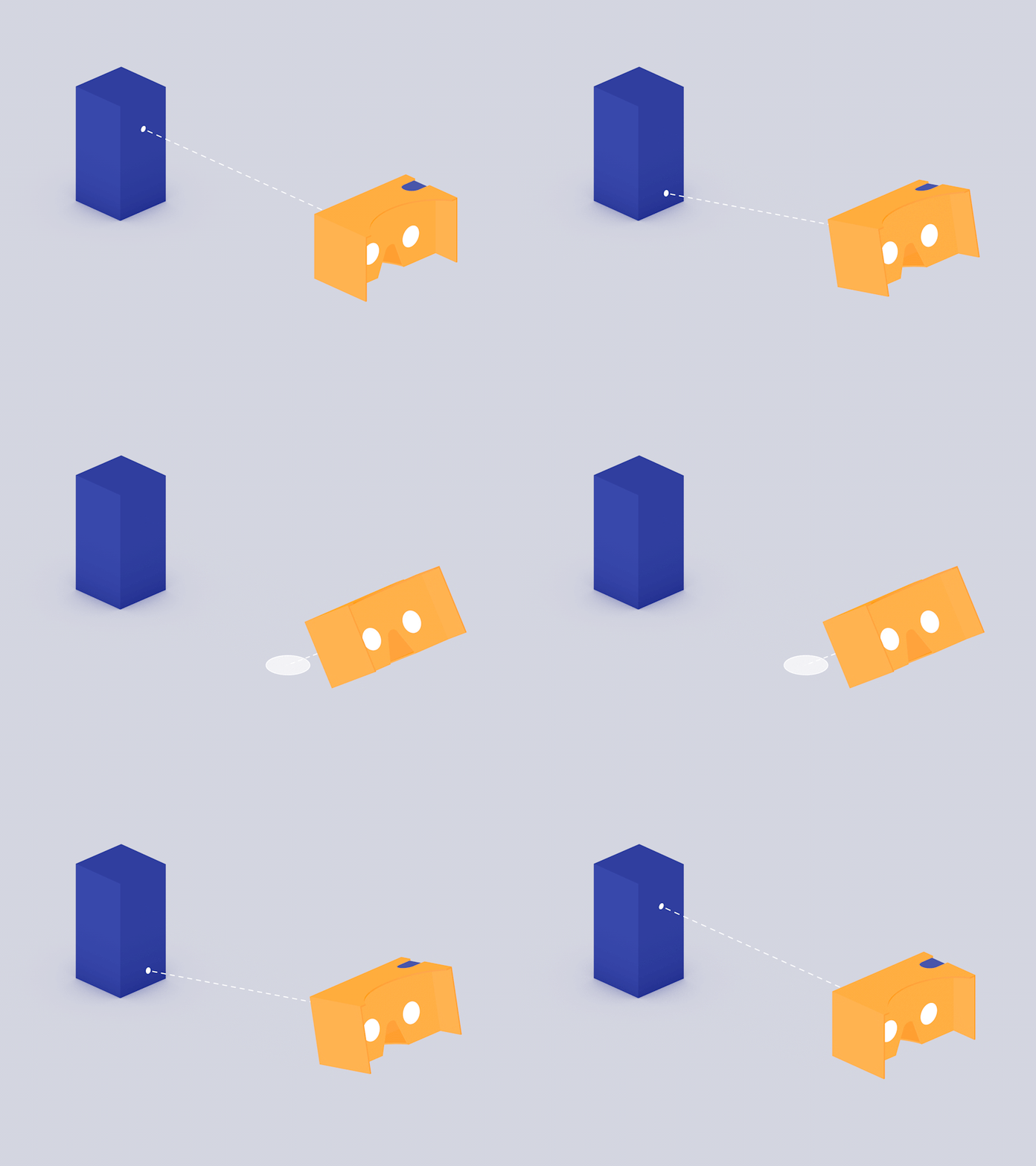
The difference between the state of rest and the movement of the sight
- Interaction with objects: when the user pays attention to an object with which you can interact, the scope must react to this.

Transition between a state of rest and interaction with objects
- The color of the sight must adapt to the level of ambient brightness, switching between dark and light modes to be equally noticeable in any light.
- Object as a sight: replacing the sight with some three-dimensional object can be a hint for interaction (for example, a sight in the form of a key indicates that you need to open the lock).
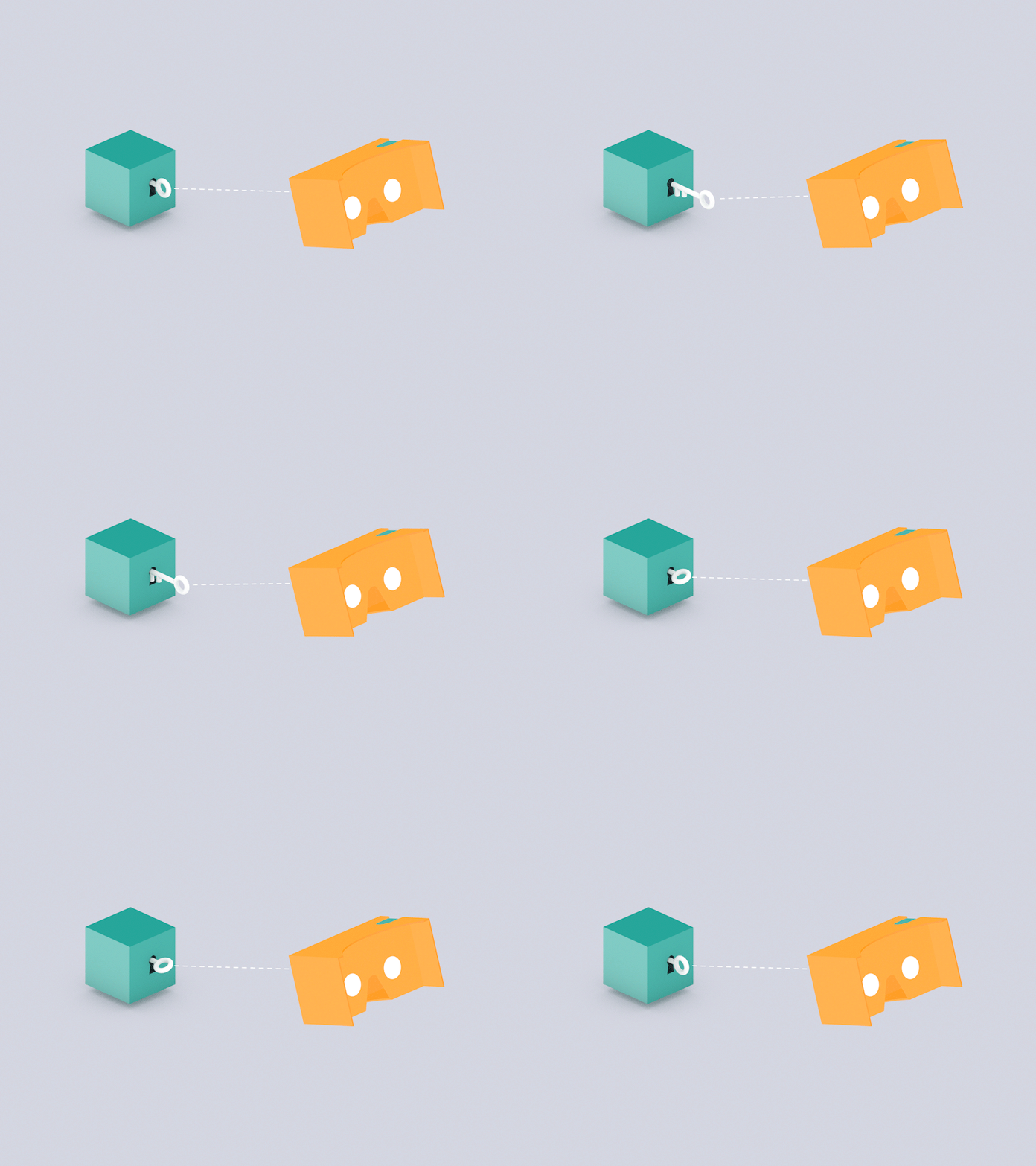
Interactive objects
If not every object can be interacted with, then the user should be given a hint as to which objects are interactive. The contextual scope is usually useful, but sometimes, to avoid confusion, the interactive objects themselves must also be changed. The change can be very small, for example, when looking at an object, it can be shaded or make a weak sound that describes its behavior (for example, a light switch can click).
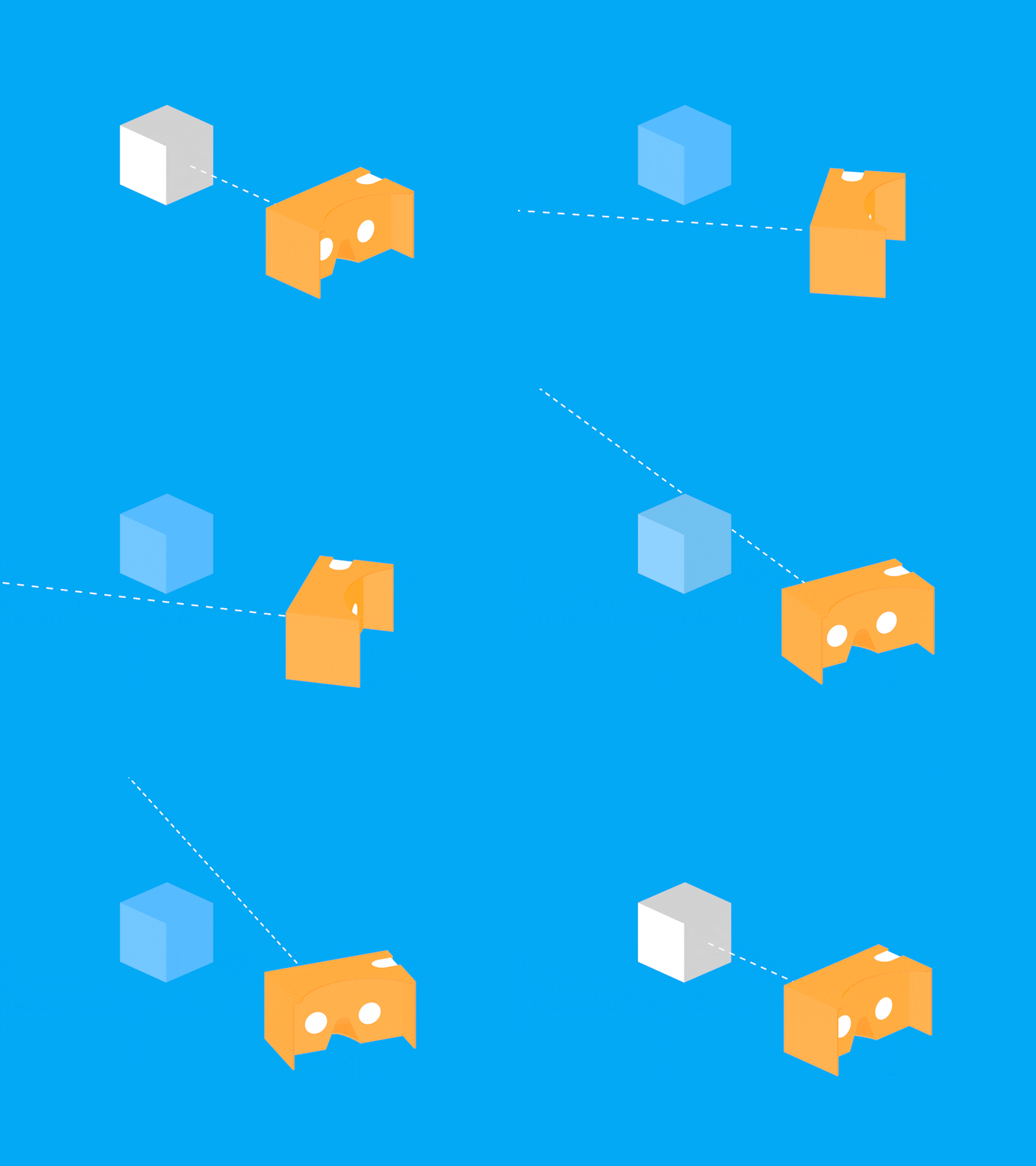
Interactive object changes when looking
Conclusion
VR is a new developing environment, potentially capable of having an effect on society, comparable to the advent of radio or television. And today we can lay the foundations in the development of interfaces and interaction experience for this environment without applying existing solutions by default.
useful links
- Moggridge, Bill. Designing Interactions. Cambridge, MA: The MIT Press, 2007. Print.
- Google Inc. Cardboard Design Lab. Google Play Store , Vers. 1.0.
- Gibson, James J. The Ecological Approach To Visual Perception . New York, NY: Psychology Press, 2015. Print.
- Goldstein, E. Bruce. Sensation and Perception . 9th ed. Belmont, CA: Wadsworth Publishing, 2013. Print.
- “Display Reticle.” VR Design Guidelines. Google Design.
Source: https://habr.com/ru/post/318780/
All Articles