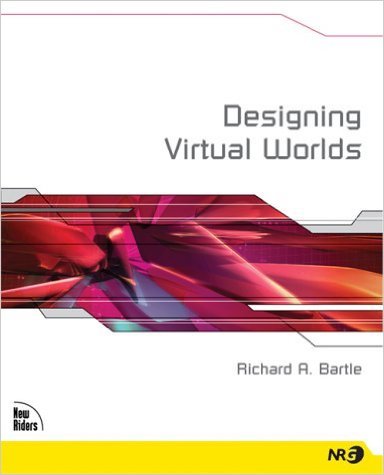
Translation of Richard Bartle's book Designing Virtual Worlds. Chapter 1. Basics
 Start here
Continued here
Richard A. Bartle (Richard Allan Bartle)
Certified specialist in artificial intelligence. One of the creators of the very first MUD (1978), which gave rise to the entire industry of massively-multiplayer games, the boom of which we are now seeing. In the future, Richard firmly engaged in research of virtual worlds and their inhabitants. As an independent consultant, he has participated in almost every such project over the past 20 years.
(Who wants to help with the translation of the fundamental book on game development, write in a personal or mail magisterludi2016 <dog> yandex.ru)
')
The basics
(many thanks for the translation to Vladislav Zadumov (zadumov.v <dog> gmail.com), who professionally translates from English and Japanese)As a rule, people want to break up various virtual worlds into categories, to make it easier for them to discuss what interests them specifically, or to find the world that best suits their needs. Potential players, for example, will want to know what the world looks like, and what the setting is in it: If they want to play the space pirate, the Fantasy World setting is unlikely to help them with this. Marketers and investors are more concerned with the longevity of the product and the demographic statistics of its users: They may not be interested in spending time in the virtual world themselves, but they will be very interested in those who are immersed in this world. Designers also have their own, theoretical problems that they need to solve, in addition to the need to understand the desires of players and marketers.
If you look at the virtual worlds from the point of view of their historical development, the categories used most often stand out quite easily:
- Appearance
- Genre
- Code base
- Lifetime
- Player Base
- Degree of variability
- Degree of immutability
Let's look at them in order.
Appearance
Beginners tend to believe that the appearance of the virtual world is very important; old players are more concerned with other features.
Virtual worlds are usually divided into text-based (text) or graphic-based (graphic). The former describe locations, objects, and other players with words, while the latter use images.
However, between the two extremes there are many options. To access the textual virtual world, the player needs some kind of program to connect. This can be a direct connection — for example, starting the game server in the console and entering commands upon its requests — or indirectly, using the client. If a client is used, then it can be “stupid,” “smart,” or individually customized.
Strictly speaking, a “stupid” client does nothing but accept input (the results of which he sends to the server) and output answers (which is all that the server sends back). However, few clients are so “stupid” - even telnet is capable of some editing functions, such as backspacing. The simplicity of "stupid" customers is not accidental, it allows you to use them to achieve more goals.
Even when we are dealing with a “stupid” client - or we do without a client at all - the virtual world does not have to consist solely of a lifeless text. Individual letters, words, sentences and paragraphs can be colored by the server (usually using ANSI encoding, which most PCs can recognize), so that the resulting text is more attractive and meaningful.
Smart clients are designed for use with certain types of applications; in this case, the text virtual worlds. Such clients provide additional input options (such as macros or triggers) and output management tools (for example, local saving logs and line breaks). Although these features could be installed from the server side and transferred to the “stupid” clients as results, most of the authors of modern servers are not tied to this, as they know that there are now so many [52] good clients freely available, that players are almost guaranteed to use one of them.
[52] http://www.mudconnect.com/resources/Mud_Resources:Mud_Clients.html contains a list of resources with customers.
An individually configured client only works with a small subgroup of virtual worlds that has a common protocol with it (usually there is only one such world). The client sends packets with information describing the input to the server. The server responds with packets telling the client what to output. Although the input protocol is usually not very complicated, the output may contain embedded codes that will cause the client to execute commands, such as switching fonts, playing sound effects and music, or displaying images. In the case of the textual virtual world, pictures will by definition be static, resulting in something like an illustrated book rather than a film. However, this is an excellent example of how far the text world can be developed before it is classified as a graphic one.
As a rule, the virtual worlds of the first and second generation were used by “stupid” clients, the third generation - by “smart” ones, and the fourth generation - individually configured.
The fifth-generation virtual worlds (graphics) also use customized clients, but they display information differently. Packages received by the client contain information that can be used by the client to render the scene. It will be either in 2½D (tessellated), or in 3D (first-person view), although there is no doubt that “real” 3D (using some kind of stereoscopic device for imparting depth to the scene) on the way to full BP is not far off.
Therefore, for a beginner who does not know and is not interested in the mechanisms of work, the difference between the virtual world with moving pictures and the world without them is obvious; most likely this fact led to the choice of one world instead of another. However, for the old player who understands the mechanisms of creation and operation of the virtual world (server side), the graphic and text worlds are essentially the same, whatever the client is - the difference, albeit rather significant, is only in the interface
Genre
Another category, important both for beginners and, to a much lesser extent, for designers, is a genre [53].
[53] I use this word to refer to both the topic / setting and the category of content (usually expressed as being acceptable to children).
A newbie will look at a set of virtual worlds and say: “This is medieval fantasy, this is Cyberpunk — science fiction, this is a horror about vampires, this is about Greek mythology, this is asexual Japanese Anime, this is about stylized Gangsters”, and so on.
Again, from the point of view of design, the virtual world for the most part is built regardless of the genre. Of course, you do not need to prescribe magic in a world based on Venice of the 16th century, and you do not need firearms in a world where players will be fishes. However, most of the basic functionality will not greatly change from genre to genre.
But it also happens that the genre has important features. For example, why there are so few virtual worlds about the Wild West? Because it is very difficult to justify the reason why the character of Vasya Novyky cannot enter the store, buy a revolver and put the entire drum in the back of a character that Petya has been playing for five years already. No wonder that revolvers are called “levelers” [54]!
[54] There is also a problem (noticed by Damion Schubert) that enemies do not become “bigger”. Except for the problems in real life, which will appear because of the killing of virtual Indians and Mexicans, what will happen when a character gains experience and moves up the level? Will he kill the "big" Indians and Mexicans?
In Fantasy, science fiction and even horror, there are ways to do this in such a way, without breaking the narrative, there are similar ways in worlds based on a hundred or more years ago. And this is not the only problem - there are many more. For example:
- Detectives do not work very well as a genre, because players do not want to reveal clues to each other. This means that the game seems to counteract their communication, while most designers, on the contrary, would prefer that they communicate.
- The same type of comedy as a genre. The player laughs when something funny happens the first time, but by the tenth time similar jokes are already annoying.
- Novels do not work in virtual worlds. But sex works. Even if you start from the first, everything quickly comes down to the last.
- Heroes or loners are not well transported into virtual worlds. It’s stupid when 5,000 people run, playing Indiana Jones, Lara Croft, James Bond or Doctor Who. In the real world, there would not be enough room for them, let alone a virtual one.
These problems may be obvious to you, but there are those who do not see them [55]. And even if this is not the case, why would any businessman want to sponsor the development of an unverified (as part of the possibility of creating a virtual world) genre? Is it not more likely that he would prefer to choose the genre that is already known to be created?
[55] The only genre that I haven’t met in all the years of my work as a consultant for the design of virtual worlds is comedy. Everything else I have seen how people try, some more than once.
In general, the most important thing in genres is the ability to attract players. From this point of view, the choice of a genre becomes a problem of marketing, rather than design (although designers really need to understand their markets). Someone from the “effective managers” may think that millions of people have seen films about Batman, and this will be reason enough for them to insist on this choice - regardless of whether Gotham City is a good setting for the virtual world or not.
Fortunately, most designers can avoid the dangers of a bad genre. Of course, there are a lot of dangers in good genres too, and their examples will become obvious later in the book. One of them is the licensing problem. Licensing is generally a sore subject in the gaming industry as a whole. The following arguments are usually given:
Behind:
- People know and trust the brand, so more players will come.
- You attract the attention of the media and competitors.
- You get free advertising from other products under a related license.
- The design of the general idea has already been made.
Vs:
- You will have to pay large sums for the license, so the costs inevitably increase.
- Free advertising can be bad or just not help.
- Some license assumptions may be necessary for the sake of gameplay. This can annoy both fans (and this is worse) and license holders.
- The general idea of the world is what designers love to do the most.
Within the framework of virtual worlds, the decision to “license or not” is usually made by someone other than the future designers of the world. This imposes a framework on the creative process, because designers must fit the franchise. Although many license holders are quite liberal, there are those who shake their worlds and will not allow anything uncanonical, despite the problems caused by the new media. This can pose big problems for the designer. Sometimes, even those things that are part of the world of the setting can go beyond the scope, for example, the license for Lord of the Rings will not always include the material mentioned in the Hobbit, although they occur in the same fantasy world.
However, strange as it may be, licenses can also facilitate the work of a designer — at least where it concerns virtual worlds [56]. A guaranteed hit such as Star Wars Galaxies or The Sims Online can risk things like unlicensed games, simply because if they screw up, it won’t kill the game. An innovation with a 75% chance of success can be easily tested in a licensed graphic virtual world, while in an unlicensed one it will not be touched, based on the fact that “Chance is 1 to 4, what does this produce 15 million dollars of investment? You are crazy?".
[56] As for ordinary computer games, the license is often a big sign of “Caution: Secondary Product!”
For a competent design team, a world with a sufficiently large license cannot fail, except if they have conceived that it will fail (at least for this moment).
To be continued
Translation plan
Acknowledgments (done )
About the Author
About the Technical Reviewers (done )
Preface ( done )
Introduction ( done )
Who Should Read This Book? ( done )
Overview
Chapter 1 . Introduction to Virtual Worlds
Some Definitions ( done )
What they are and whence they came ( 50% done )
The Past Affects the Future
The Basics ( 30% complete )
Influences on Virtual Worlds
The designer
Chapter 2 . How to Make Virtual Worlds
Development
On Architecture
Theory and practice
Chapter 3 . Players
Who are these people?
Player types
Other categorizations
The Celebration of Identity
Anonymity
Role playing
Masquerading
Community
Influence Through Design
Chapter 4 . World design
Scope
Major Decisions
Geography
Population
Physics
Reset strategy
Chapter 5 . Life in the Virtual World
Advancement
Character Generation
The virtual body
Groups
Combat
Crafting
The elder game
The whole picture
Chapter 6 . It's Not a Game, It's a ...
Points of View
Making Sense of Virtual Worlds
Virtual Worlds as Subfields
Virtual Worlds as Tools
Virtual Worlds as ... Virtual Worlds
Conclusion
Chapter 7 . Towards a Critical Aesthetic
A Theory of Virtual Worlds
The story of story
The Critical Aesthetic in Use
Chapter 8 . Coda: Ethical Considerations
Censorship
Players as People
Groups of Players as Groups of People
Yourself
Acknowledgments (done )
About the Author
About the Technical Reviewers (done )
Preface ( done )
Introduction ( done )
Who Should Read This Book? ( done )
Overview
Chapter 1 . Introduction to Virtual Worlds
Some Definitions ( done )
What they are and whence they came ( 50% done )
The Past Affects the Future
The Basics ( 30% complete )
Influences on Virtual Worlds
The designer
Chapter 2 . How to Make Virtual Worlds
Development
On Architecture
Theory and practice
Chapter 3 . Players
Who are these people?
Player types
Other categorizations
The Celebration of Identity
Anonymity
Role playing
Masquerading
Community
Influence Through Design
Chapter 4 . World design
Scope
Major Decisions
Geography
Population
Physics
Reset strategy
Chapter 5 . Life in the Virtual World
Advancement
Character Generation
The virtual body
Groups
Combat
Crafting
The elder game
The whole picture
Chapter 6 . It's Not a Game, It's a ...
Points of View
Making Sense of Virtual Worlds
Virtual Worlds as Subfields
Virtual Worlds as Tools
Virtual Worlds as ... Virtual Worlds
Conclusion
Chapter 7 . Towards a Critical Aesthetic
A Theory of Virtual Worlds
The story of story
The Critical Aesthetic in Use
Chapter 8 . Coda: Ethical Considerations
Censorship
Players as People
Groups of Players as Groups of People
Yourself
Brief description of the chapters in Russian
Richard Bartle - co-author of the first virtual world MUD1 (1978), is at the forefront of the design of online projects since their inception. A specialist and former teacher in the field of artificial intelligence, Richard is now deeply engaged in the research of virtual worlds. As an independent consultant, he has participated in almost every such project over the past 20 years.
In general, from this book you will learn:
What are virtual worlds and how are they developed?
Why do people play them and why stop playing
How they are designed and how they should be designed.
Where they come from and what to expect in the future
What are the applicable theories
That these worlds are art
Designing Virtual Worlds is a monumental work of probably the most famous person in the online gaming industry. This is a real scientific work, examining in detail all the foundations and all aspects of the development, production and support, game design of online projects, psychology and sociology of communities of players that are necessarily formed around MMO games, cultural and social influences of the real world on the virtual world and vice versa.
1. Introduction to Virtual Worlds
The history of virtual worlds from the beginnings. As a whole generation of text worlds developed, this was typical for free and commercial projects. How player communities evolved and how the foundations of online community management were born. Why graphic MMOs instantly supplanted text, and why everyone so underestimated this transition in the face of Ultima Online. What cultural and pop cultural phenomena influenced online development (and how Sierra closed the Lord of the Rings Online, and bit its elbows after the film was released). Why from the very beginning it was clear that virtual worlds are a service, a management of expectations, and a prediction of consequences.
2. How to Make Virtual Worlds
The main technical solutions that existed before and are used now. The basics of the client-server model from the point of view of game designer. Command and graphical interfaces.
3. Players
Why do people live in virtual worlds, what attracts them and what keeps them. In this chapter, Richard sets out in detail his theory of the Bartlow types of motivation in a new, three-dimensional modification. These 8 types plus sequence theory (main / secondary sequence) make it possible to describe the development of practically any character with time. The second important point is their impact on the community as a whole, how important are different types in different online communities. The methods by which a game designer can directly influence the creation and evolution of guilds and player associations, explicit and implicit, through sociology, the economy of the world, or directly through laws, are considered.
4. World Design
Various design issues of the world itself are addressed through dichotomies: an open / closed economy, intimate or large-scale, meaningful or decorative, personal stories or an epic saga, endless or cyclical. Richard examines in detail the technological foundations of creating worlds, since they directly affect a higher level of design — geography and world division, physics and movement, NPCs and their capabilities. A separate chapter is devoted to the time and features of real-time communication with the virtual.
5. Life in the Virtual World
What is the essence of life in the virtual world? In development, both avatar and the player himself in the real world. Players receive only intangible changes, characters can also receive tangible (as far as applicable to records in the database) changes. Levels, skills, caps - all this is well known to the inhabitants of the IMO worlds. What is social interaction and social life online, what signs are typical for online associations, and what game designers can make them. It is impossible not to disassemble in detail the combat systems, both PvE and PvP, since the vast majority of worlds are based on combat. And a whole chapter is devoted to irreversible death (permanent death), as one of the horror stories among online developers.
Can the Campbell Monomith Apply to Online Worlds? Bartl believes that yes, of course, and gives a detailed explanation of how to link the classic presentation of the “hero's path” with the theory of developmental sequences.
6. It's not a Game, it's a ...
Very difficult for the reader, but also as informative part. If MMOG is not a game, then what is it? This is the world. This is Wednesday, this place. This is society, this is culture, this is a special ethnography and anthropology. This is a way of self-study and teaching. This is a search for self-identification and self-realization, and sometimes it is a search for a better self, the growth of a personality. This is a new precedent in the laws of all countries. This is undoubtedly an art that has an unpredictable future. It is a tool, and it is very flexible and versatile. Online worlds are already interesting to architects and geographers, sociologists and psychologists, economists and even politicians (beginners for sure). Virtual worlds are also part of something larger, such as literary theories (as an example of an interactive narrative), drama, the science of human-computer interaction. Virtual worlds attract post-modernists, experts in the field of artificial intelligence, teachers and even lawyers.
7. Towards a Critical Aesthetic
The current and often debated topic of the absence of criticism in computer games and their non-recognition by the general public as an art form did not pass by Bartle. In virtual worlds, perhaps even more rights to be considered an art form, but unfortunately so far this is a dream. In this chapter, Richard gives the basics of the theory of classification and criticism of the IMO worlds - symbolism, direction, drama and conflict, world structure, etc.
8. Ethical Considerations
For nearly 30 years of working with the online worlds, Bartle has faced many ethical and moral issues. There is no perfect solution, and this chapter does not attempt to derive "an ideal set of laws on culture and ethics." Just a reason to think and decide, preferably even before the start of development, what ethical issues may be relevant in your world and how they can be solved. Deception, fraud, theft, insult and attack, religion, disability and mental deviations, social attitudes - all of these aspects of the real world will somehow be reflected in your virtual universe. And how to manage them is up to you, game designers.
In general, from this book you will learn:
What are virtual worlds and how are they developed?
Why do people play them and why stop playing
How they are designed and how they should be designed.
Where they come from and what to expect in the future
What are the applicable theories
That these worlds are art
Designing Virtual Worlds is a monumental work of probably the most famous person in the online gaming industry. This is a real scientific work, examining in detail all the foundations and all aspects of the development, production and support, game design of online projects, psychology and sociology of communities of players that are necessarily formed around MMO games, cultural and social influences of the real world on the virtual world and vice versa.
1. Introduction to Virtual Worlds
The history of virtual worlds from the beginnings. As a whole generation of text worlds developed, this was typical for free and commercial projects. How player communities evolved and how the foundations of online community management were born. Why graphic MMOs instantly supplanted text, and why everyone so underestimated this transition in the face of Ultima Online. What cultural and pop cultural phenomena influenced online development (and how Sierra closed the Lord of the Rings Online, and bit its elbows after the film was released). Why from the very beginning it was clear that virtual worlds are a service, a management of expectations, and a prediction of consequences.
2. How to Make Virtual Worlds
The main technical solutions that existed before and are used now. The basics of the client-server model from the point of view of game designer. Command and graphical interfaces.
3. Players
Why do people live in virtual worlds, what attracts them and what keeps them. In this chapter, Richard sets out in detail his theory of the Bartlow types of motivation in a new, three-dimensional modification. These 8 types plus sequence theory (main / secondary sequence) make it possible to describe the development of practically any character with time. The second important point is their impact on the community as a whole, how important are different types in different online communities. The methods by which a game designer can directly influence the creation and evolution of guilds and player associations, explicit and implicit, through sociology, the economy of the world, or directly through laws, are considered.
4. World Design
Various design issues of the world itself are addressed through dichotomies: an open / closed economy, intimate or large-scale, meaningful or decorative, personal stories or an epic saga, endless or cyclical. Richard examines in detail the technological foundations of creating worlds, since they directly affect a higher level of design — geography and world division, physics and movement, NPCs and their capabilities. A separate chapter is devoted to the time and features of real-time communication with the virtual.
5. Life in the Virtual World
What is the essence of life in the virtual world? In development, both avatar and the player himself in the real world. Players receive only intangible changes, characters can also receive tangible (as far as applicable to records in the database) changes. Levels, skills, caps - all this is well known to the inhabitants of the IMO worlds. What is social interaction and social life online, what signs are typical for online associations, and what game designers can make them. It is impossible not to disassemble in detail the combat systems, both PvE and PvP, since the vast majority of worlds are based on combat. And a whole chapter is devoted to irreversible death (permanent death), as one of the horror stories among online developers.
Can the Campbell Monomith Apply to Online Worlds? Bartl believes that yes, of course, and gives a detailed explanation of how to link the classic presentation of the “hero's path” with the theory of developmental sequences.
6. It's not a Game, it's a ...
Very difficult for the reader, but also as informative part. If MMOG is not a game, then what is it? This is the world. This is Wednesday, this place. This is society, this is culture, this is a special ethnography and anthropology. This is a way of self-study and teaching. This is a search for self-identification and self-realization, and sometimes it is a search for a better self, the growth of a personality. This is a new precedent in the laws of all countries. This is undoubtedly an art that has an unpredictable future. It is a tool, and it is very flexible and versatile. Online worlds are already interesting to architects and geographers, sociologists and psychologists, economists and even politicians (beginners for sure). Virtual worlds are also part of something larger, such as literary theories (as an example of an interactive narrative), drama, the science of human-computer interaction. Virtual worlds attract post-modernists, experts in the field of artificial intelligence, teachers and even lawyers.
7. Towards a Critical Aesthetic
The current and often debated topic of the absence of criticism in computer games and their non-recognition by the general public as an art form did not pass by Bartle. In virtual worlds, perhaps even more rights to be considered an art form, but unfortunately so far this is a dream. In this chapter, Richard gives the basics of the theory of classification and criticism of the IMO worlds - symbolism, direction, drama and conflict, world structure, etc.
8. Ethical Considerations
For nearly 30 years of working with the online worlds, Bartle has faced many ethical and moral issues. There is no perfect solution, and this chapter does not attempt to derive "an ideal set of laws on culture and ethics." Just a reason to think and decide, preferably even before the start of development, what ethical issues may be relevant in your world and how they can be solved. Deception, fraud, theft, insult and attack, religion, disability and mental deviations, social attitudes - all of these aspects of the real world will somehow be reflected in your virtual universe. And how to manage them is up to you, game designers.
Bartle 's article "Worms, clubs, diamonds, spades: players of virtual worlds"
Source: https://habr.com/ru/post/265813/
All Articles