MegaFon Login 2 (MS3A): twice as good
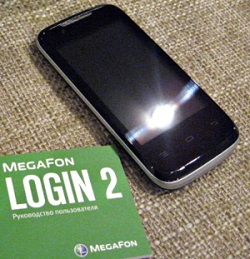 In April, I wrote a review of a very budget Android phone - MegaFon Login (SP-A1) . The idea of a full-fledged Android-smartphone cheaper than $ 100 was then well received by the majority, but the “childhood diseases” of the first model (dim screen, uncalibrated touchscreen, glitches in the 3G module) were sent down to earth. It was possible to use the device, but it was not convenient.
MegaFon promised to correct these shortcomings and released Login 2 in early December. He thinks that he has nothing in common with the first model, except positioning as the cheapest Android smartphone. The price, by the way, remained at the same level - 1990 rubles + contract.
I offer a small report on the results of almost a month of using this device.
')
The company has already reported on its blog about the technical characteristics of the device:
- Support GSM, WCDMA, GPRS, 3G (HSPA +), Wi-Fi, Bluetooth 3.0, GPS
- Screen - 3.5 ″ 320 × 480 px, capacitive, multitouch
- The processor - MediaTek MT6572M, 2 cores, 1 GHz
- Graphics processor - Mali 400
- Memory - 512 MB RAM, 4 GB ROM
- Main camera - 3.2 megapixel with flash, front - 0.3 megapixel
- Connectors - MicroUSB, 3.5 mm for headphones, MicroSD up to 32 GB
- Battery - Li-ion 1500 mAh
- FM radio with RDS, accelerometer, proximity and illumination sensors
- The size is 119.9 × 62.5 × 12.5 mm, weight is 112 g.
- Android 4.2.2.

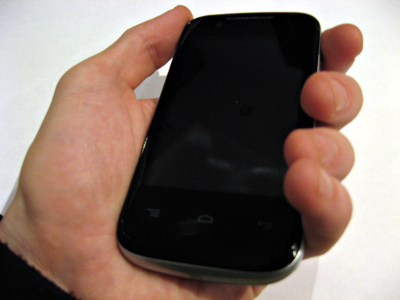
The differences from the first version are immediately visible: twice as powerful CPU and GPU (the result is 9700 points in Antutu Benchmark) , a front camera and sensors are added, the battery capacity has grown to the minimum acceptable size (the memory capacity has also been increased to 1A) . The phone has become lighter and thinner, but slightly longer, and its back panel is now made of matte plastic.
It is better to purchase a MicroSD card right away - a phone without it will not be able to update the firmware to the latest version. In addition, the available user surplus internal memory anyway quickly run out.
Yes, I recommend trusting the store employee with the installation of a microSD card in this phone. Seriously.
The phone works only with MegaFon SIM cards, and its unlocking most likely does not make sense, since 3G module is configured for HSPA +, the modes of which are specific to the operator.
I like the look of the second model more. Firstly, there is no longer a strangely shaped “Home” button that stands out, and secondly, the bevels in the upper and lower parts of the case, reminiscent of the old “female” Samsung models, have disappeared. The phone began to look more serious and neat.


The camera on the rear panel also changed for the better.
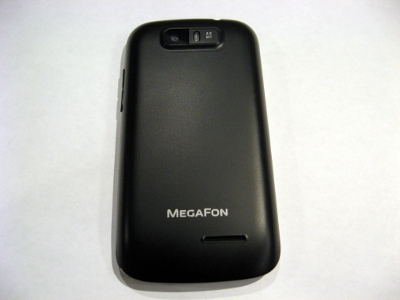

The inscriptions “3.2 MP”, however, are not worth believing too - this is an interpolation with 2 Mp. In this connection, the camera to the “minimally acceptable” mark, if it falls short, then with difficulty. The quality of the pictures is low. For some reason, even lower than in the first model.


The flash in the phones of this price category is long overdue at the top end of the device and honestly called a flashlight. The benefit of the program that implements this function is now pre-installed.
The screen and touchscreen are transformed. The light sensor does not allow the screen to blind the eyes in the dark, the increased brightness does not allow the sun to blind the screen (although everything is relative, of course, the screen is excellent relative to the first model).
The touchscreen works, typing is quite possible out of the box, no need to calibrate and patch. Of course, typing in a vertical orientation does not give much joy with this screen size and quite big fingers. Perhaps the male half of the population should pay attention to the MegaFon Optima - this is the same phone, but with a bigger screen.
The speaker of the phone remained the same - the interlocutor is heard normally when talking in it, but it is better to use headphones to listen to music. And this, in principle, is correct.
For three weeks of use, I did not manage to detect any glitches in my work on GSM, 3G and Wi-Fi networks. There is no support for 4G in the device, but it is not too much for him and is needed - 3G is enough.
GPS is also working properly, although sometimes it may take a few minutes to think about when starting.
Added: this is because the default A-GPS in the settings is disabled. In the included - not tupit.


Compared to the first version, the software “garbage” has decreased: a set of mobile applications from Mail.ru has been replaced with the aforementioned flashlight program. Remained applications from Yandex and MegaFon (Yandex browser, GetUpps !, Replace beep, Megaphone-Money and Megafon-Navigation) . The first two of them can be turned off, the rest can be removed, the last one should be replaced with a familiar navigator.
On the first Login model, there were problems with some applications (Skype, SubwaySurfers, Instagram). I put them and tested them in the first place, they all work. Then I put Ingress and a little carried away reached the third level.
In the end, we can say that we have an extremely cheap smartphone on a fresh Android, with sufficient hardware capabilities for a bug-free operation under this OS.
Compared with the first model, the second one became twice as fast and lost almost all of the detected deficiencies. From the third version I want to ask only a normal camera and a good speaker. Even if the phone will be several hundred rubles more expensive - within 3000 rubles.
I think if you give someone such a phone, he will be happy and will definitely not carry it to the store. Especially if it will be someone from the younger generation - the small size of the device and an insane amount of apps and games on Google play will contribute to this.
So if you do not have prejudices to MegaFon, then you can safely buy the second version of Login. And if there is - a similar device from the MTS is called the MTS 970 and is distinguished by a single-core processor and Android 4.1 OS.
Source: https://habr.com/ru/post/206366/
All Articles