Apple has registered a patent for head-mounted display technology
Not so long ago, Google has demonstrated its new product - Google Glass, which represents itself as augmented reality glasses. Sergey Brin with pleasure flaunts a prototype of the device and shows it to those around him, and at the Google I / O conference the expected start date of sales and the approximate cost was announced. On Tuesday, July 3rd, Apple was able to register a patent for a head-mounted display with similar functionality.
')
The patent application entitled “ Peripheral Mount for Head-mounted Displays ” was filed as early as 2006. A patent describes a method of projecting a picture to produce an “improved visualization.”
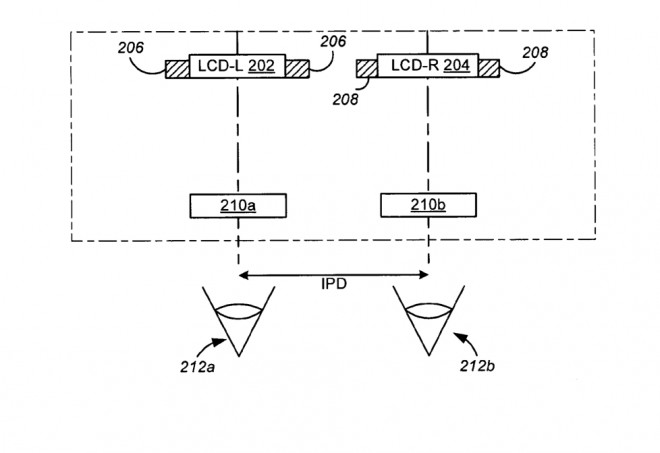
According to the description of the patent, HMD Apple has one or two small screens embedded in a wearable headset, which can provide a stereoscopic three-dimensional image and, with the help of two reflecting mirrors, an augmented reality. The patent describes several possible applications of this technology: medical operations, during which the surgeon in the field of his visibility shows tomography images and other data, the work of fire services, police and military, continuously receiving tactical information, the work of scientists and engineers, who will benefit from the availability viewing stereoscopic drawings of computer-aided design systems.

Stereoscopic image in the idea of Apple can help save the user from motion sickness, which often affects users of other head-mounted displays. It is assumed that users will be able to adjust the "cyborg-glasses" Apple for themselves and their eyes. The patent mentions that the device will be able to receive a picture and information from external portable devices, such as, for example, from the iPhone.
In June, Google received a patent for its Glass technology, and their patent was accurate: a wearable display with an integrated finger-operated sensor. Apple's patent is more vague and more descriptive of a computer display, as the name implies - they call their device HMD (head-mounted display), and not HUD (head-up display), as Google does.
The company from Cupertino has long been interested in futuristic technology: back in 2010, the New York Times tracked the hiring of an engineer working with augmented reality technology. It remains unclear whether Apple will use the new patent trump card against its competitors.
Source: https://habr.com/ru/post/147136/
All Articles