Sound Design in Cubase 5
One of the most interesting areas of work with sound in my opinion is sound design. Accordingly, a sound designer is a person responsible for creating a sound in a particular multimedia project. I have been engaged and interested in sound and music for a long time. In this article I would like to consider a fairly simple example - how to put sound on the video and write the appropriate music.
When I was still in high school, I was a member of a team of guys who were developing a scientific video for the department of physics. The video showed various physical phenomena, and also raised questions about the origin of our universe. Simply put, we did a reportage of our national geographics for the university. For the video was modeled mass 3d animations. As a material for this article, I took one of our short animations about the big bang that perfectly suited, and as a composer and designer I added it.
Here is what we actually do:
')
As a DAW, I have been using cubase for a very long time. Therefore, we will solve our task in cubase.
So let's get started. We have a video without sound track. Cubase can work with video files. The first thing we do is create an empty project and import our video file there. After the import, a video track is created, on which our video file will be presented as a set of frames.
Next we do the storyboard. This concept is used here is not quite as intended, but it seems to me clearly describes what we will do. We need to mark all the frames that are important for sound. For this we will use markers. Add track markers to the project.
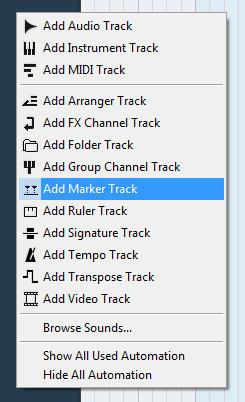
To open a separate window where there will be a list of markers, you need to press the ctrl + M combination. Next we determine which moments in the video are important. We have only the blast itself. Thus, we very carefully move along the time lane and look for a frame when the luminous point explodes. Having found an important frame, we put a marker on it by clicking the mouse on the “add marker” icon.
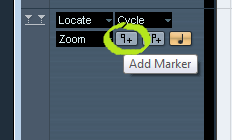
And in the window “markers” we will see our first marker. Add something to the “description” field, for example, “the beginning of an explosion”.
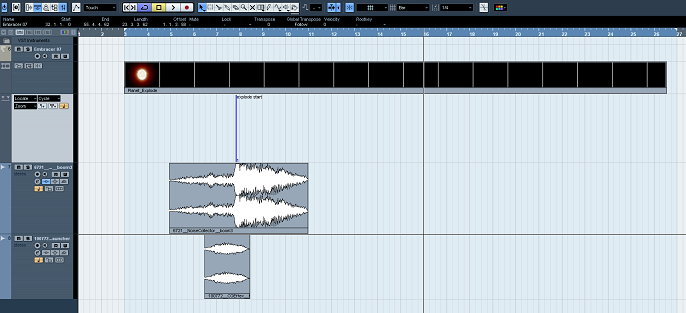
Now you need the sound of an explosion. We can find it in many different ways. I used the free samples site. For my video, I needed 2 samples, this is an explosion, and something interesting about the sound before the explosion, some upward sound, so that together they make a more saturated sound. I found these samples
explosion
rising sound
Download and import our samples into cubase. Using the marker, we can place the sound of the explosion just where we need it.
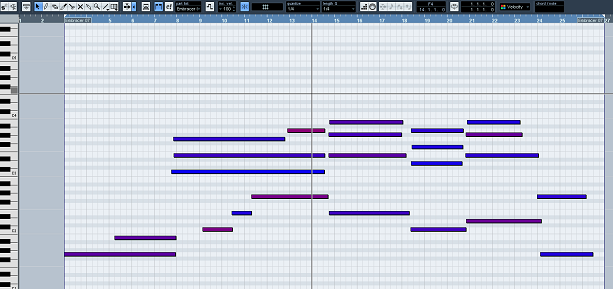
Now the most exciting part. We need to show the talent of the composer. Looking at the video, you need to understand what music is best suited. Of course, space, ambient and the like. Cubase has wonderful built-in plugins. We will use Embracer .

It has very cool space pads. Now we can loop our video around, turn on to play and play until you get bored. In parallel, you can record the melodies born in the head. I, playing on the midi keyboard of circles 5, left that melody that you already heard in the video at the beginning of the article.
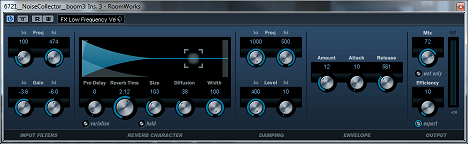
We tint the sound with equalizers and add a long echo to the explosion. For the reverb effect, I again used the built-in and cool RoomWorks plugin with the FX Low Frequency Verb preset.
And here we have made a live video from a silent roller.
Unfortunately, cubase cannot export video, so we render our sound into a wav file and in any other video processing program we combine the video series with the audio one. To once again see and listen to the result, you need to skip the page to the beginning of the article.
In the article, I used a very simple example to consider one (!) Of the possible methods of sound design, which can be suitable for simple commercials, as well as for short and amateur films. After all, with the same ease in cubase, you can record a duplicate speech through a microphone and add sound effects, like our explosion sound.
UPDATED
Sound design is the process of defining, acquiring, controlling, or creating sound elements. It is used in various fields, including filmmaking, TV production, theater, sound recording, live performance, sound art, post-production and the development of computer games. Sound design most often involves manipulations of previously composed or recorded audio, like music or sound effects. Sometimes it can include a combination or manipulation of audio to create the desired effect or mood. A sound designer is one who is engaged in the art of sound design.
translation from en.wikipedia.org/wiki/Sound_design
When I was still in high school, I was a member of a team of guys who were developing a scientific video for the department of physics. The video showed various physical phenomena, and also raised questions about the origin of our universe. Simply put, we did a reportage of our national geographics for the university. For the video was modeled mass 3d animations. As a material for this article, I took one of our short animations about the big bang that perfectly suited, and as a composer and designer I added it.
Here is what we actually do:
')
As a DAW, I have been using cubase for a very long time. Therefore, we will solve our task in cubase.
So let's get started. We have a video without sound track. Cubase can work with video files. The first thing we do is create an empty project and import our video file there. After the import, a video track is created, on which our video file will be presented as a set of frames.
Next we do the storyboard. This concept is used here is not quite as intended, but it seems to me clearly describes what we will do. We need to mark all the frames that are important for sound. For this we will use markers. Add track markers to the project.
To open a separate window where there will be a list of markers, you need to press the ctrl + M combination. Next we determine which moments in the video are important. We have only the blast itself. Thus, we very carefully move along the time lane and look for a frame when the luminous point explodes. Having found an important frame, we put a marker on it by clicking the mouse on the “add marker” icon.
And in the window “markers” we will see our first marker. Add something to the “description” field, for example, “the beginning of an explosion”.
Now you need the sound of an explosion. We can find it in many different ways. I used the free samples site. For my video, I needed 2 samples, this is an explosion, and something interesting about the sound before the explosion, some upward sound, so that together they make a more saturated sound. I found these samples
explosion
rising sound
Download and import our samples into cubase. Using the marker, we can place the sound of the explosion just where we need it.
Now the most exciting part. We need to show the talent of the composer. Looking at the video, you need to understand what music is best suited. Of course, space, ambient and the like. Cubase has wonderful built-in plugins. We will use Embracer .
It has very cool space pads. Now we can loop our video around, turn on to play and play until you get bored. In parallel, you can record the melodies born in the head. I, playing on the midi keyboard of circles 5, left that melody that you already heard in the video at the beginning of the article.
We tint the sound with equalizers and add a long echo to the explosion. For the reverb effect, I again used the built-in and cool RoomWorks plugin with the FX Low Frequency Verb preset.
And here we have made a live video from a silent roller.
Unfortunately, cubase cannot export video, so we render our sound into a wav file and in any other video processing program we combine the video series with the audio one. To once again see and listen to the result, you need to skip the page to the beginning of the article.
In the article, I used a very simple example to consider one (!) Of the possible methods of sound design, which can be suitable for simple commercials, as well as for short and amateur films. After all, with the same ease in cubase, you can record a duplicate speech through a microphone and add sound effects, like our explosion sound.
UPDATED
Sound design is the process of defining, acquiring, controlling, or creating sound elements. It is used in various fields, including filmmaking, TV production, theater, sound recording, live performance, sound art, post-production and the development of computer games. Sound design most often involves manipulations of previously composed or recorded audio, like music or sound effects. Sometimes it can include a combination or manipulation of audio to create the desired effect or mood. A sound designer is one who is engaged in the art of sound design.
translation from en.wikipedia.org/wiki/Sound_design
Source: https://habr.com/ru/post/127214/
All Articles